


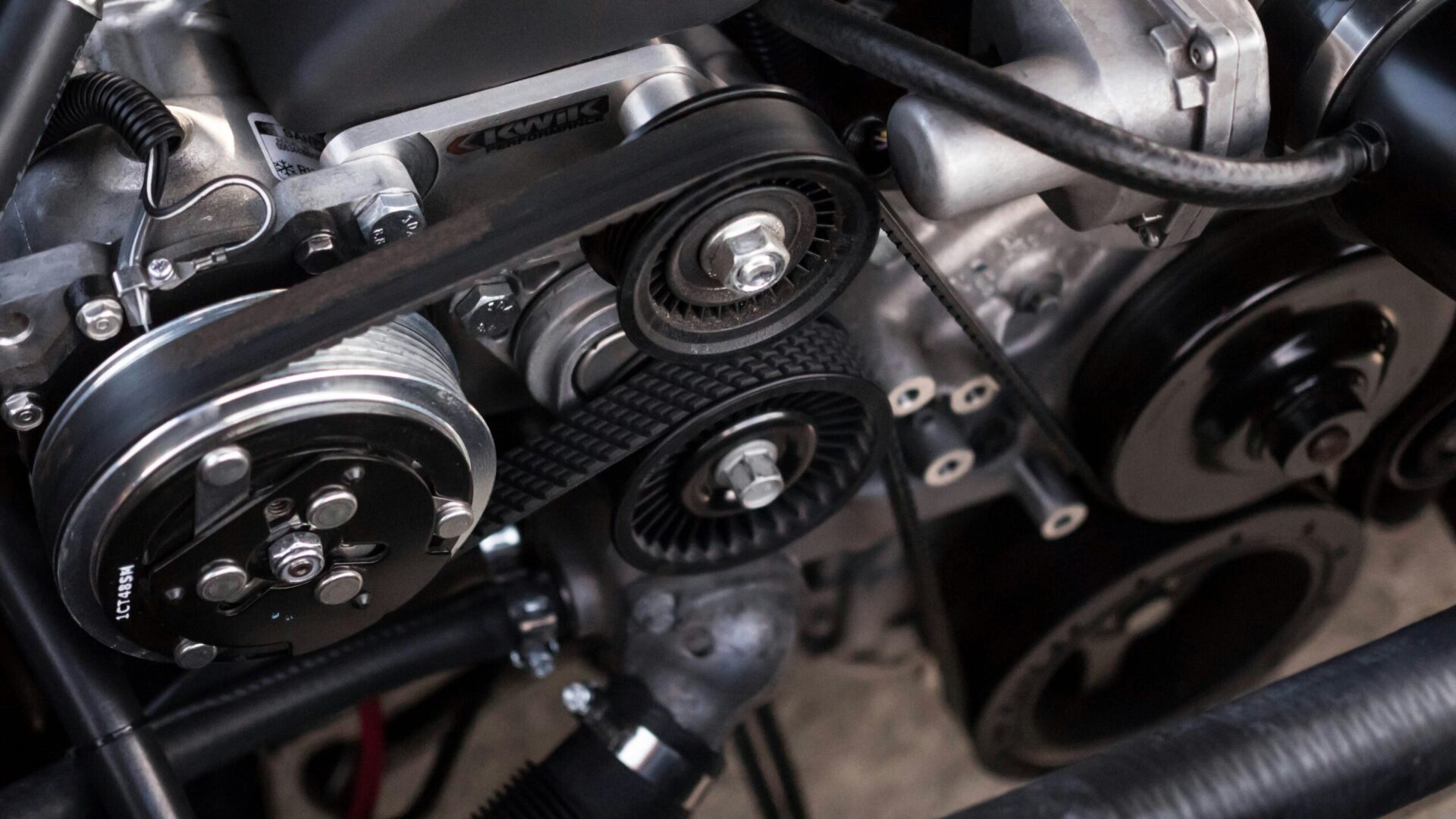





















The OEM-versus-aftermarket question gets presented to car owners as a binary — pay more for the original factory part, or pay less for a knockoff and take your chances. The reality is more useful and more complicated. There are at least four meaningful tiers of parts a modern vehicle owner encounters: true OEM parts from the dealer, OE-equivalent parts made by the same supplier that built the original but sold without the automaker’s logo, quality aftermarket parts from established brands, and economy aftermarket parts of highly variable quality. For many parts, the OE-equivalent or quality aftermarket tier is actually the better value and sometimes the better part. For a smaller set of parts, OEM is the only sensible answer. And for a different smaller set, the economy tier is perfectly fine.
This article walks through a part-by-part framework for making the call, backed by actual price gaps, documented quality differences, and the collision-repair legal landscape that often takes the decision out of the owner’s hands entirely. The tiers that matter are not the ones the parts counter at a dealership typically describes.
The Four Tiers That Actually Exist
The parts market presents OEM and aftermarket as the two choices, but there are really four distinct tiers. Understanding them changes the economic math.
True OEM parts come from the vehicle manufacturer’s parts catalog, sold through dealership parts departments. They carry the manufacturer’s logo and warranty, are inventoried through the automaker’s distribution system, and are the exact part specified on the vehicle’s factory build sheet. They are also the most expensive tier, often by a wide margin.
OE-equivalent parts — the tier most consumers don’t know exists — are built by the same supplier that made the OEM part but sold in the supplier’s own packaging without the automaker’s logo. Denso builds oil filters for Toyota, Mazda, and Subaru; the identical filter sold as “Denso” costs roughly 40% less than the same filter sold as “Toyota” at the dealer parts counter. Bosch supplies oxygen sensors to BMW, Volkswagen, and many Japanese brands. Aisin builds water pumps for Toyota. ZF builds transmissions for countless brands. For these parts, the OE-equivalent option is literally the same part at a lower price.
Quality aftermarket parts come from established aftermarket brands — names like AC Delco, Bosch, NGK, Monroe, KYB, Wagner, Bendix, Napa Gold, Mobil 1, Fram Ultra, WeatherTech. These brands don’t necessarily make the OEM part, but they are engineered to meet or exceed OEM specifications and have substantial reputational stakes in quality. For most non-safety-critical components, the quality aftermarket tier produces parts indistinguishable from OE performance.
Economy aftermarket parts come from unknown or anonymous suppliers, often marketed under generic brand names that change frequently. They dominate the lowest-price listings on Amazon, eBay, and some chain auto parts stores. Quality varies from acceptable to outright dangerous, and the price savings are rarely worth the quality lottery.
The Real Price Gaps
The pricing data across the four tiers is more dramatic than most owners expect. Across common parts in 2026, the gap between OEM and economy aftermarket often runs 3x to 5x, with OE-equivalent typically sitting 25–40% below OEM and quality aftermarket another 15–25% below that.
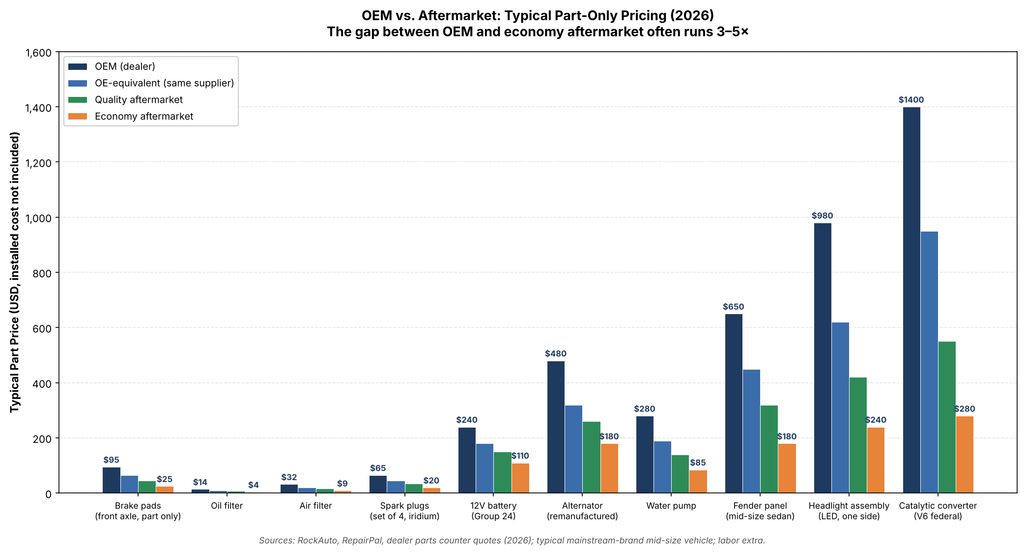
A set of front brake pads for a mid-size sedan illustrates the pattern. OEM Toyota Camry front pads from the dealer run about $95 for the set. The OE-equivalent Advics pads (Advics is the OEM supplier for Toyota) run about $65. Quality aftermarket from Akebono or Bosch runs about $45. Economy aftermarket runs $25 or less — and is where the quality concerns become real, with documented cases of excessive brake dust, uneven wear, inadequate stopping power, and premature failure.
The spread widens dramatically for larger components. An LED headlight assembly for a current-generation mid-size sedan runs $980 OEM, $620 OE-equivalent, $420 quality aftermarket, and $240 economy — a 4× spread. A V6 federal-emissions catalytic converter runs $1,400 OEM versus $280 economy aftermarket, a 5× spread. On these high-ticket items, choosing between tiers has more impact on total repair cost than almost any other decision in the project.
The economics shift when installation labor is factored in. For a $45 brake pad set that costs $350 to install, saving $50 on the pads is small relative to the labor; saving $900 on a $1,400 catalytic converter is enormous even against the same labor bill. The tier-selection decision matters most on parts where the part price is a large fraction of the total installed cost.
Part-by-Part: Where OEM Matters, Where It Doesn’t
The core insight for most owners is that the right answer depends entirely on which part is being replaced. Grouping parts by their quality-sensitivity and failure consequences produces a clear framework.
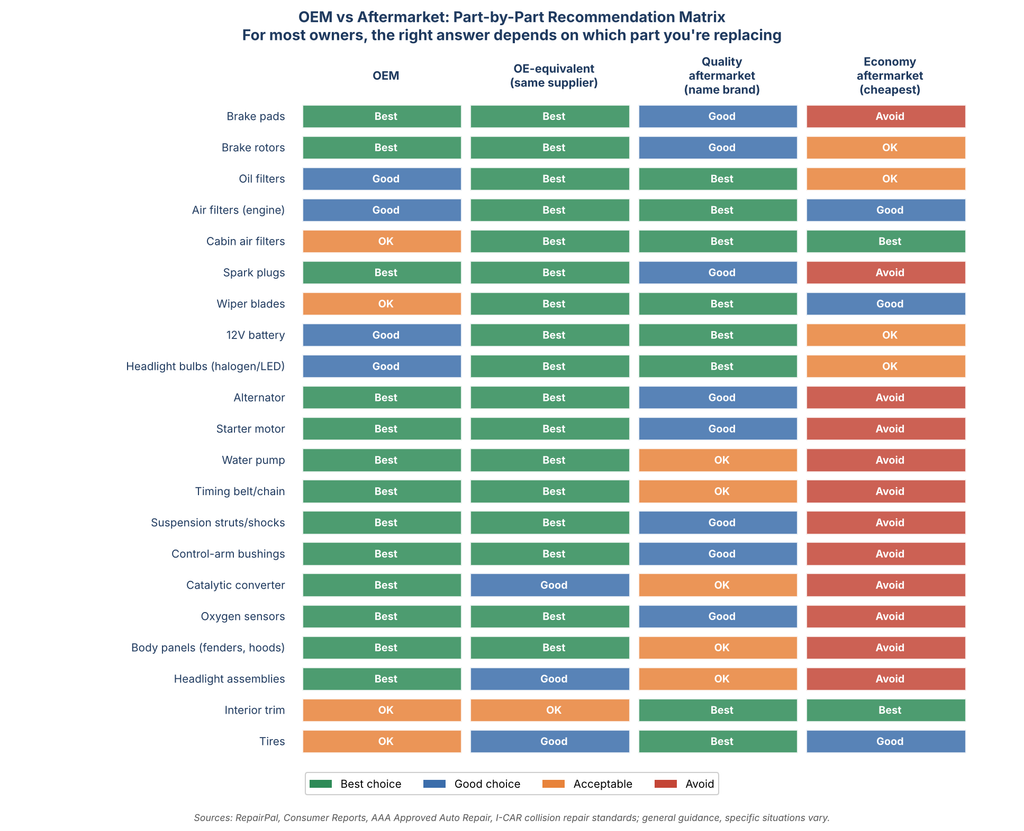
Parts where OEM or OE-equivalent is worth the premium:
- Brake pads and rotors — not because quality aftermarket is unsafe, but because premium OEM pads have better bedding, less noise, less dust, and more predictable wear characteristics. The Toyota/Honda/Mazda OE spec is typically better than mid-tier aftermarket.
- Alternators, starters, water pumps — these are long-life components where premature failure means significant labor to replace a second time. Paying for durability makes long-run sense.
- Timing belts and timing chains — mission-critical; a failure causes catastrophic engine damage on interference engines. Not the place to save $40.
- Catalytic converters — must meet EPA emissions standards specific to the vehicle; many economy aftermarket converters fail to light off correctly and throw perpetual check-engine codes.
- Oxygen sensors — the OE sensor is calibrated to the vehicle’s exact engine management; cheap aftermarket sensors frequently cause driveability problems that take hours of diagnostic time to trace.
- Suspension struts, shocks, and bushings — ride quality and handling degrade noticeably with cheap aftermarket parts. The OE suspension is tuned for the specific vehicle.
- Body panels for later use — if the vehicle may be sold within a few years, OEM body panels preserve resale value because insurance claim histories check for OEM versus aftermarket repairs.
Parts where quality aftermarket is as good or better:
- Oil filters — brands like Mobil 1, Royal Purple, WIX XP, and Fram Ultra meet or exceed OEM filtration specs; often at half the dealer price.
- Air filters — Mann, Mahle, K&N, and Purolator all perform at OE spec; the economy tier here is also generally fine for standard replacement.
- Cabin air filters — nearly all meet the same standards; this is a category where buying the OEM-branded version at 3× the price makes no sense.
- Wiper blades — Rain-X, Bosch ICON, Michelin, and PIAA aftermarket blades outperform most OEM blades.
- 12V batteries — Interstate, Optima, Deka, East Penn, and Costco Interstate-equivalent batteries are built by the same manufacturers that supply OEMs. The AGM upgrade from an aftermarket brand often outperforms the OEM flooded battery.
- Headlight bulbs — Philips, Osram, PIAA, and Hella (all OEM suppliers in various contexts) sold as aftermarket are typically identical to the original.
- Interior trim, floor mats, cargo organizers — WeatherTech, Husky, Rugged Ridge, and others often make products superior to the OEM options at lower cost.
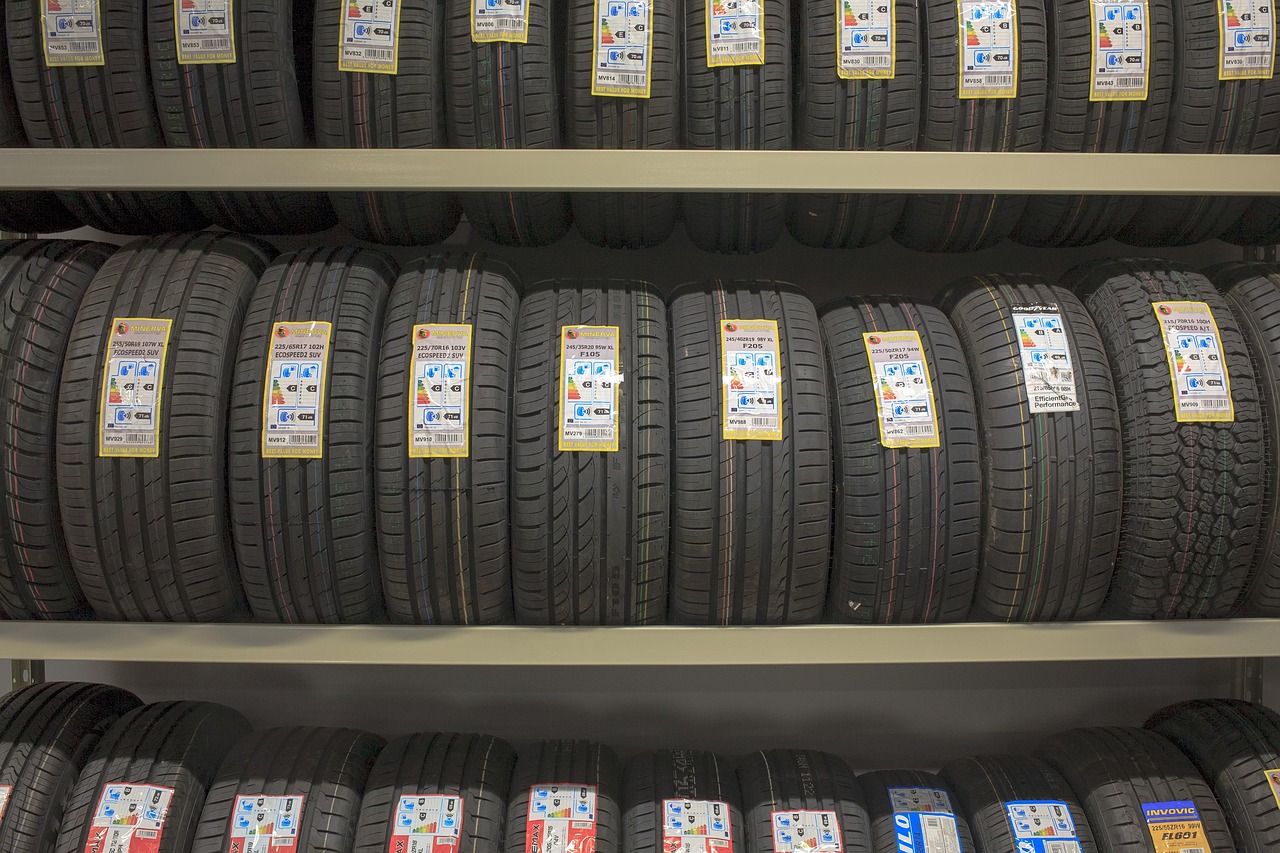
- Tires — OEM-branded tires are rarely the best option; choosing the right tire for your use case usually means going aftermarket.
Parts where even economy aftermarket is acceptable:
- Cabin air filters (again, extremely low-risk)
- Wiper blades (easy to swap if quality is inadequate)
- Standard replacement bulbs (sealed beams and some marker lights)
- Floor mats and some interior accessories
Parts where economy aftermarket is actively dangerous:
- Brake components beyond the big three brands
- Ignition coils and spark plugs below NGK/Denso/Bosch quality
- Safety-related electronics including airbag components (always OEM, period)
- Tire valve stems, lug nuts, wheel bearings below major brands
- Transmission internal parts (the cost of doing it twice far exceeds the savings)
The practical rule is that safety-critical components and labor-intensive replacements justify the premium for OEM or OE-equivalent; consumable items and low-stakes components rarely do.
EV Parts: A Different Economics Entirely
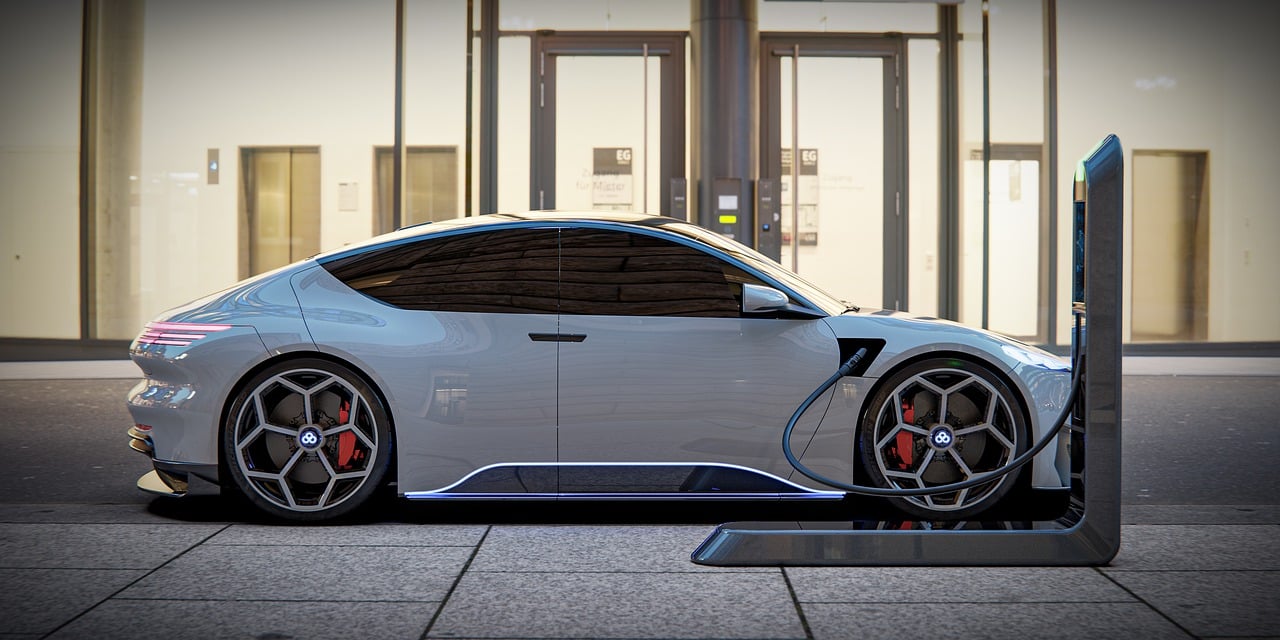
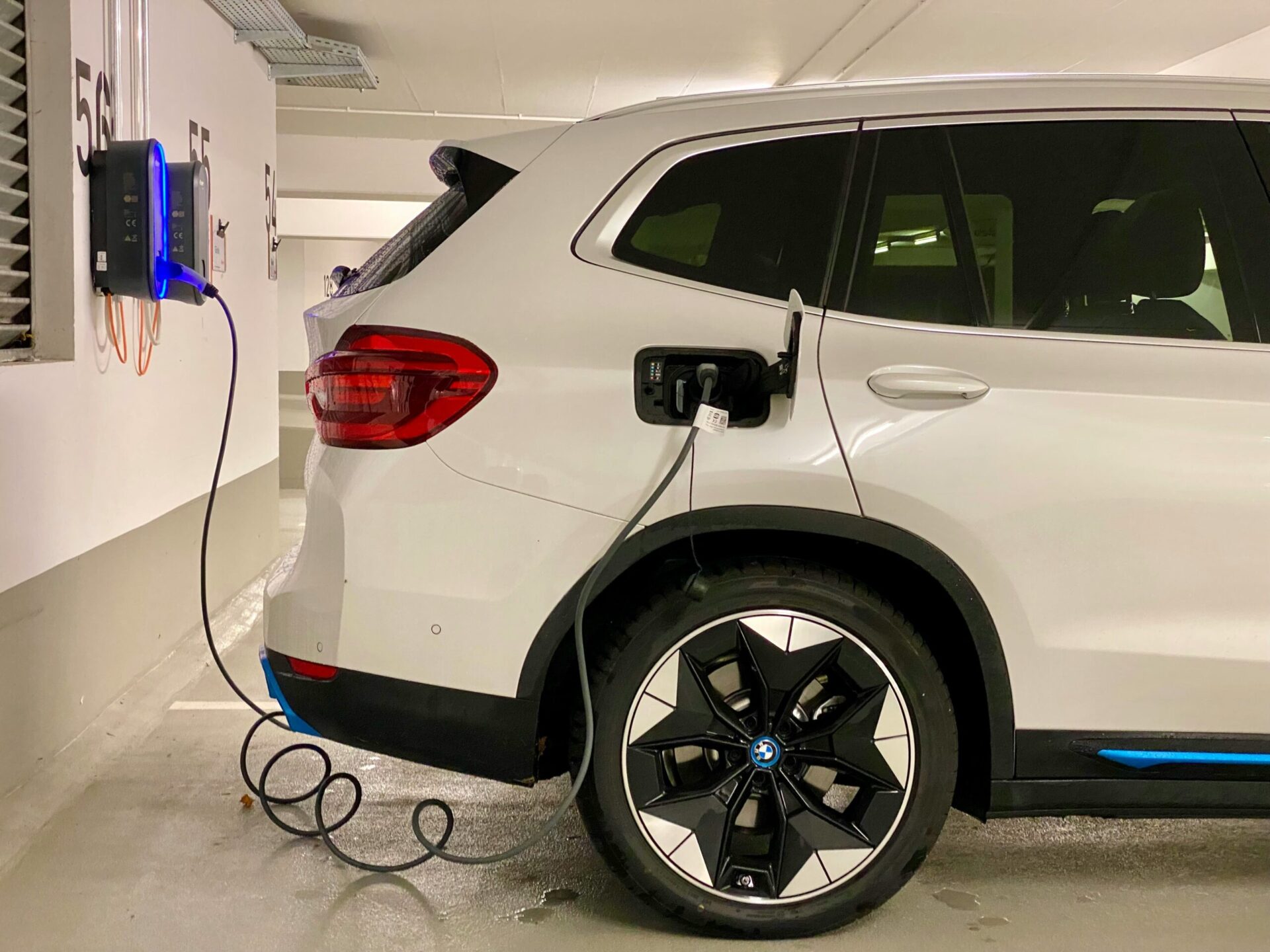
The OEM-versus-aftermarket calculus works differently for electric vehicles than for internal-combustion cars, and in most cases less favorably for the consumer. The aftermarket parts ecosystem that developed over 100 years of ICE vehicles — thousands of suppliers, competing distributors, extensive compatibility knowledge — does not yet exist for EVs. Owners generally have fewer tiers to choose from and often less price competition.
Tesla operates the most opaque parts economy. For years the company sold replacement parts only through its service centers and body shops, with aftermarket availability limited to a handful of enthusiast suppliers. Since 2018 Tesla has opened a parts catalog that technically allows individual purchases, but the actual availability and pricing remain substantially less competitive than for mainstream brands. A Model 3 fender assembly runs $600–$900 from Tesla; equivalent aftermarket options are rare and often of questionable quality. Independent repair shops working on Teslas report persistent back-ordering of common parts and limited cross-referencing with aftermarket suppliers.
Rivian, Lucid, and the dedicated EV lineups from Hyundai, Kia, Ford, and GM are showing similar patterns in their early years — strong OEM pricing power, limited aftermarket competition, and a distribution system built around factory-authorized service rather than independent shops.
Specific EV components where OEM is effectively the only option today:
- High-voltage battery packs — no credible aftermarket; even salvage replacement requires brand-specific expertise. How EV Thermal Management Affects Performance covers the complexity involved.
- Inverters and motor controllers — OEM-only in nearly all cases.
- DC-to-DC converters and onboard chargers — proprietary to each brand.
- Battery management systems (BMS) — part of the pack; no aftermarket.
- Driver-assistance sensors and cameras — brand-specific calibration requirements.
EV components where OE-equivalent or quality aftermarket is viable:
- 12V auxiliary battery — standard automotive battery, aftermarket fine
- Tires — aftermarket choice is actually often better than OEM-recommended tires that sacrifice efficiency for grip or vice versa
- Wiper blades and cabin air filters — standard replacement, aftermarket fine
- Suspension struts and bushings — comparable to ICE aftermarket situation
- Brake pads — EVs use brakes less frequently (regenerative braking does most work) but when replacement is needed, aftermarket pads are typically fine
The broader EV parts ecosystem is improving as more vehicles reach the 4-to-7-year window where independent repair shops typically become significant players. Right-to-repair legislation at the state level — Massachusetts passed the strongest version in 2020, with Maine, Colorado, and California following — is slowly forcing automakers to provide diagnostic access and service documentation that enables aftermarket repair. The pace of change is slow but directional. The How OTA Updates Change Vehicle Performance article covers related issues around EV software and parts pairing that further complicate the picture.
Collision Repair: When the Insurer Makes the Call
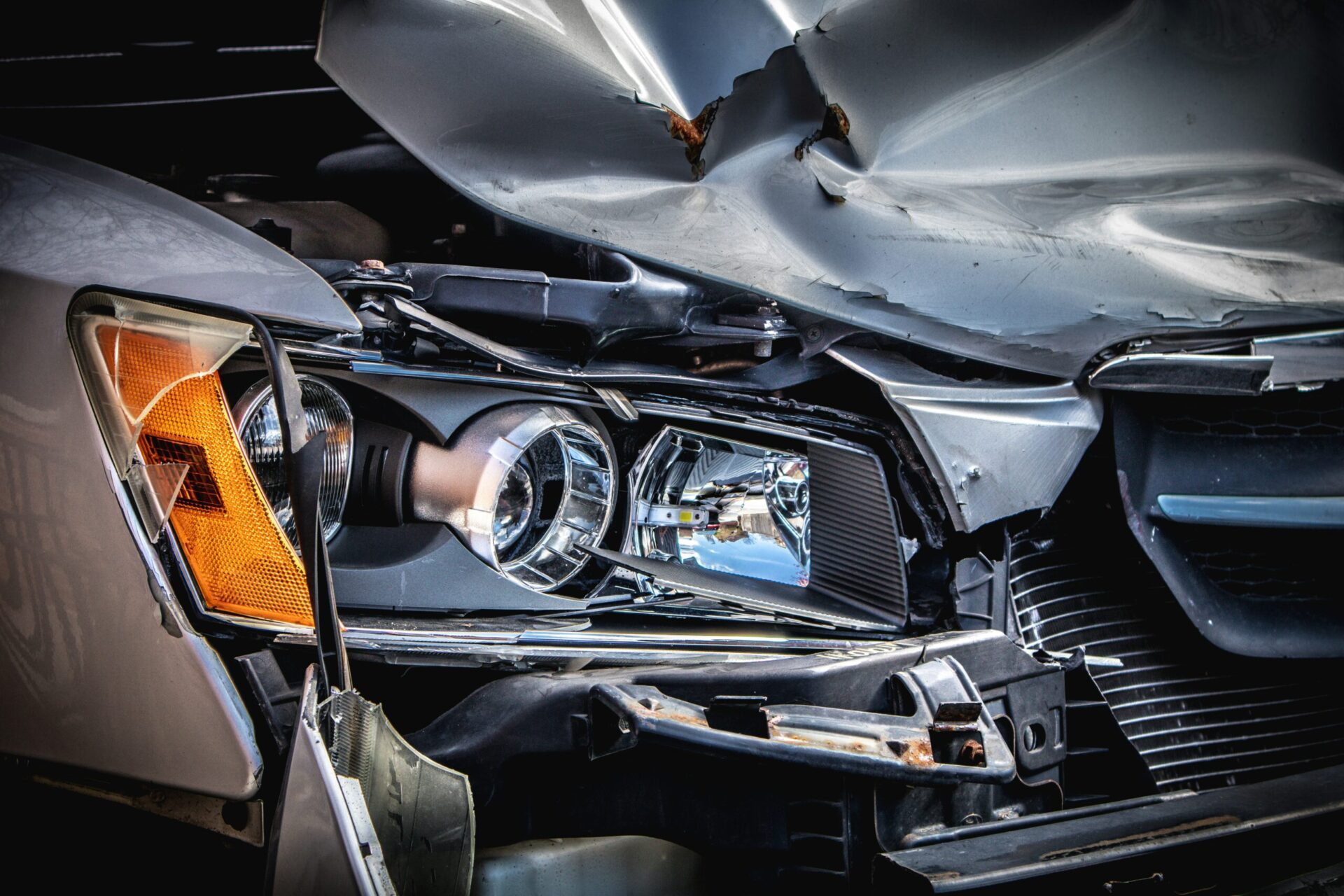
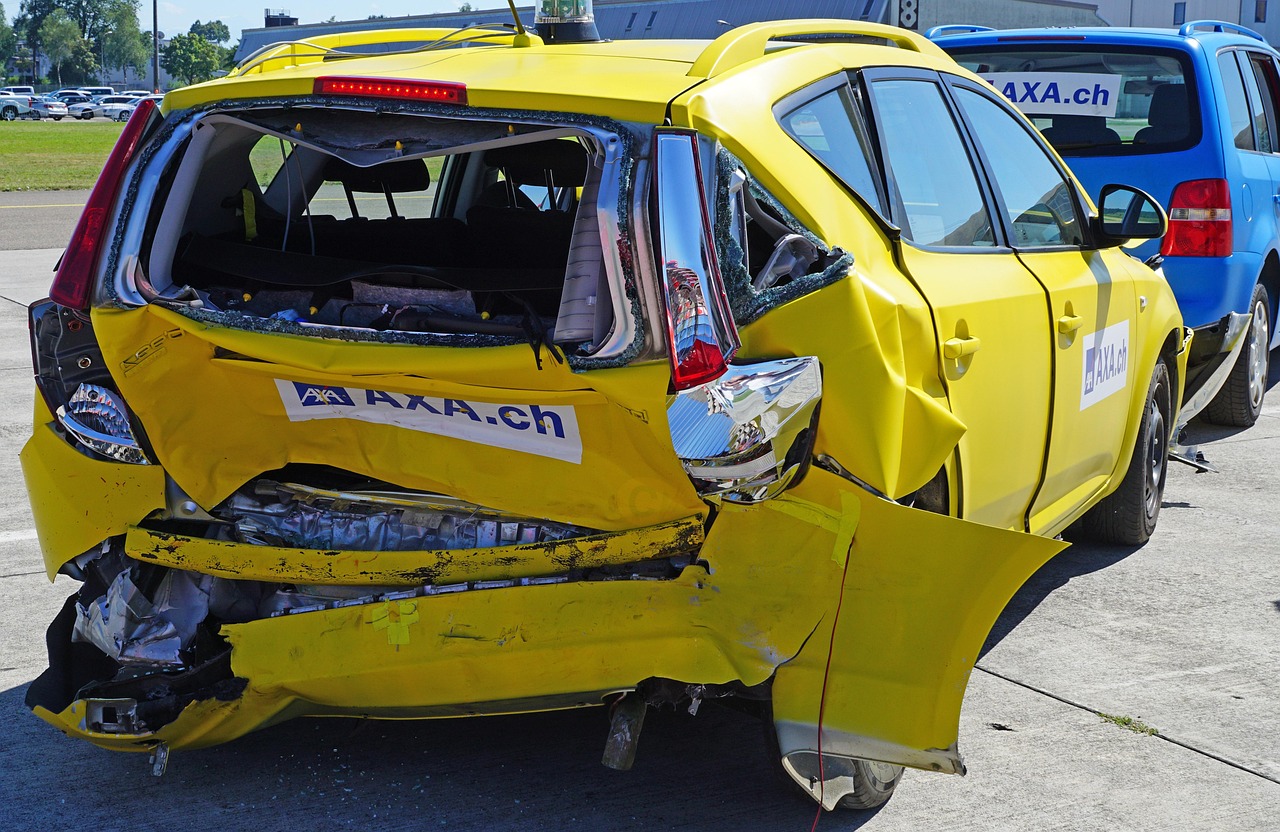
The hardest version of the OEM-versus-aftermarket decision happens after a collision, when the owner’s control over the parts choice is limited by insurance company policy and state law. For most crashes handled through insurance, the carrier specifies the parts, not the owner, and the parts are often aftermarket even when the vehicle is nearly new.
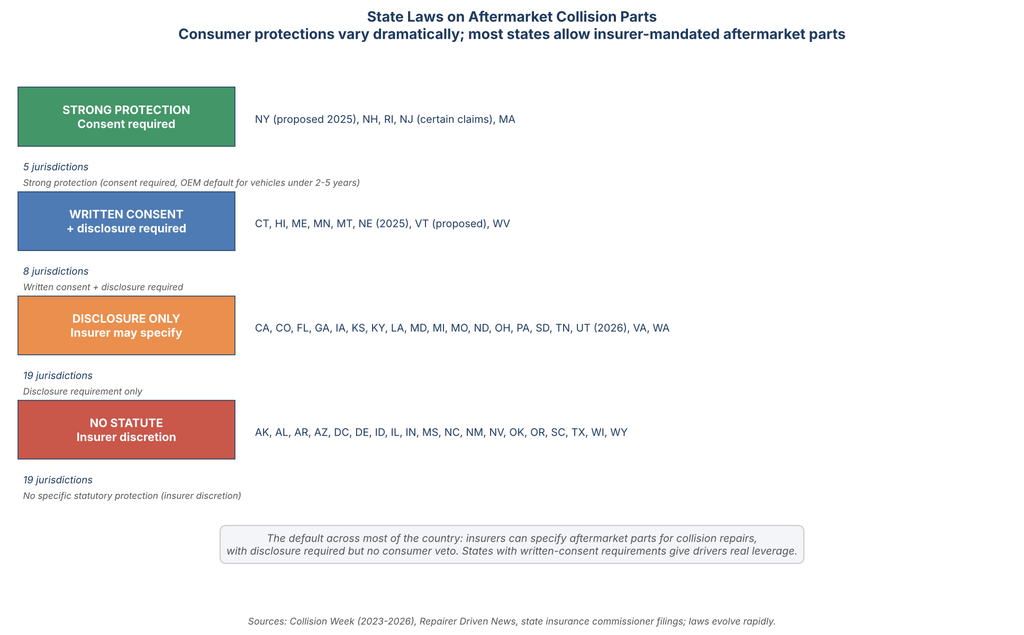
The regulatory landscape varies significantly. Roughly five states offer strong consumer protections — the owner must affirmatively consent before aftermarket parts can be used, and some states default to OEM for vehicles under 2-5 years old. Eight states require written consent plus disclosure. Nineteen states require only disclosure, meaning the repair shop or insurer must tell the owner aftermarket parts are being used but does not need the owner’s agreement. The remaining nineteen jurisdictions have no specific statutory protection; insurer discretion controls.
The practical outcome is that for most of the US, if your late-model vehicle is hit, the insurance company’s preferred collision shop will likely install aftermarket body panels, headlight assemblies, and bumper covers unless you actively push back. The industry term for these parts is “LKQ” (like kind and quality), which became both a parts certification concept and the name of one of the largest aftermarket collision-parts suppliers.
CAPA (Certified Automotive Parts Association) runs the main independent certification program for aftermarket collision parts. CAPA-certified parts must meet dimensional, material, and testing specifications that approximate OEM performance. The certification is not universal — only certain parts from certain manufacturers earn it — but when a repair shop installs a CAPA-certified part, it is meaningfully closer to OEM quality than a generic aftermarket equivalent.
The actual fit and performance gap varies. For a basic steel fender, aftermarket versions typically fit adequately; some require additional shop labor to align properly, which the insurer may or may not cover. For complex assemblies — headlight housings with integrated cameras, bumpers with ADAS sensors, body panels with precise fitment tolerances required for advanced driver-assistance systems to function — the aftermarket version often requires calibration adjustments or does not support the full feature set. A vehicle with a lane-keeping camera behind an aftermarket windshield may lose automatic lane-centering function until the camera is recalibrated, which some aftermarket glass cannot support.
For owners who want OEM parts on a collision repair, the levers are:
- In states with consent requirements, exercise the veto on aftermarket parts
- In disclosure-only states, demand OEM and negotiate; the insurer will often cover the difference for parts with safety implications or ADAS integration
- Pay the difference out of pocket, with the insurer covering the aftermarket price
- Choose a shop that will push back on insurer directives — independent body shops with no insurance network affiliation often have more flexibility
- Check your own policy for OEM-parts riders — some insurers sell an upcharge rider that guarantees OEM parts for repairs; typically $30–$100 per year
The How Insurers Assess Vehicle Risk article covers the broader insurance decision-making that affects collision repair outcomes, and the How to Interpret IIHS and NHTSA Safety Ratings piece covers related safety considerations that bear on what parts are acceptable in a repaired vehicle.
Where Warranty and Liability Actually Land
The warranty story is often used to sell OEM parts, but the specifics are worth understanding because they are less dramatic than the sales pitch implies.
OEM parts typically come with a 12-month / 12,000-mile warranty when purchased and installed by a dealership. The warranty is usually defect-focused — if the part itself fails due to a manufacturing defect, replacement is covered. It does not usually cover installation errors, consequential damage, or wear.
OE-equivalent parts often come with the supplier’s own warranty, which is sometimes longer than the OEM warranty because the supplier is competing on value. Denso-branded parts often carry a 24-month warranty.
Quality aftermarket parts from established brands typically come with warranties ranging from 90 days (consumables) to lifetime (certain premium brake rotors and shocks). Brands like Monroe and KYB offer limited lifetime warranties on their premium suspension lines.
Economy aftermarket parts often have no meaningful warranty, or a warranty that requires the owner to ship the failed part back at their own expense for a replacement that may take weeks to arrive.
The Magnuson-Moss Warranty Act is important context. US federal law prohibits automakers from voiding a vehicle warranty based on the use of aftermarket parts unless the automaker can prove the aftermarket part caused the specific failure being claimed. This means the common dealer claim that “using non-OEM parts voids your warranty” is legally incorrect in most cases. Owners who install aftermarket parts can still make warranty claims on unrelated systems; the dealer must demonstrate causation to deny coverage.
For installation liability, the general rule is that the shop installing the part becomes partially responsible for its performance. A shop that installs a customer-supplied economy aftermarket part typically disclaims warranty on the part itself but remains responsible for the labor if the installation was improper. Insurers covering collision repairs generally warrant the completed repair work for a limited period regardless of which parts were used.
Practical Decision Framework
Putting the framework together, the practical decision tree for most owners works as follows:
For scheduled maintenance items (oil, filters, wipers, cabin filters, bulbs), choose quality aftermarket by default — significant savings, no meaningful quality loss. For wear items with safety implications (brake pads, tires, suspension), go OE-equivalent or quality aftermarket from named brands — avoid the economy tier. For labor-intensive replacements (alternator, water pump, timing belt), go OEM or OE-equivalent to avoid paying labor twice. For critical safety systems (airbag components, high-voltage EV parts, ADAS sensors), go OEM only. For collision repairs where the insurer specifies aftermarket, exercise state-law rights where available and consider paying the difference out of pocket for safety-related components. For cosmetic and interior items, economy aftermarket is often fine.
The Hidden Costs of Owning an Older Vehicle and Mechanical Wear Patterns in High-Mileage Vehicles articles cover related topics on long-term ownership costs where parts decisions compound over time. On an older vehicle, the decision calculus shifts further toward quality aftermarket because the economic justification for premium OEM pricing narrows as remaining vehicle value declines.
The Takeaway
The OEM-versus-aftermarket question deserves a more nuanced answer than the one the parts counter typically provides. True OEM parts are the premium tier, worth paying for on safety-critical components and labor-intensive replacements where the cost of redoing the job exceeds the savings. OE-equivalent parts — the same component from the same supplier without the dealer markup — are often the sweet spot for cost-conscious owners who still want OE quality. Quality aftermarket from established brand names is as good or better than OEM for most consumable and wear items, and often cheaper. Economy aftermarket is where the real quality variance lives, and should be approached cautiously — fine for low-stakes items, dangerous for brakes, electronics, or anything that affects vehicle control.
For EV owners, the parts economy is less mature, OEM dominates more categories by necessity, and the cost of unexpected repairs skews higher as a result. Right-to-repair legislation and the maturation of EV-specific aftermarket suppliers are slowly changing this, but the gap with ICE vehicles remains significant.
For collision repair, the owner’s choice is constrained by state law and insurer practice, with most states defaulting to aftermarket parts unless the owner pushes back. Knowing what state you’re in, what your policy allows, and when to escalate is worth more than the specific parts debate.
Treat the OEM-versus-aftermarket question as a part-specific decision, not a universal one. The right answer for brake pads is not the right answer for a cabin air filter, and the right answer for a 2026 Toyota is not the right answer for a 2010 Chevy. Framework over dogma is what saves money without sacrificing safety.
External Sources
NotATeslaApp — Tesla Supports Right to Repair
Consumer Reports — Auto Parts: OEM vs. Aftermarket
AAA — Approved Auto Repair Parts Standards
RepairPal — OEM vs Aftermarket Parts Guide
CAPA — Certified Automotive Parts Association
I-CAR — Inter-Industry Conference on Auto Collision Repair
Collision Week — State Legislation on Non-OEM Parts
Repairer Driven News — Nebraska Bill on OEM Parts Disclosure
Repairer Driven News — NY Bill on OEM Parts Consent
FTC — Magnuson-Moss Warranty Act Guidance
Autocare Association — OEM Repair Procedures


























Leave a Reply
You must be logged in to post a comment.