






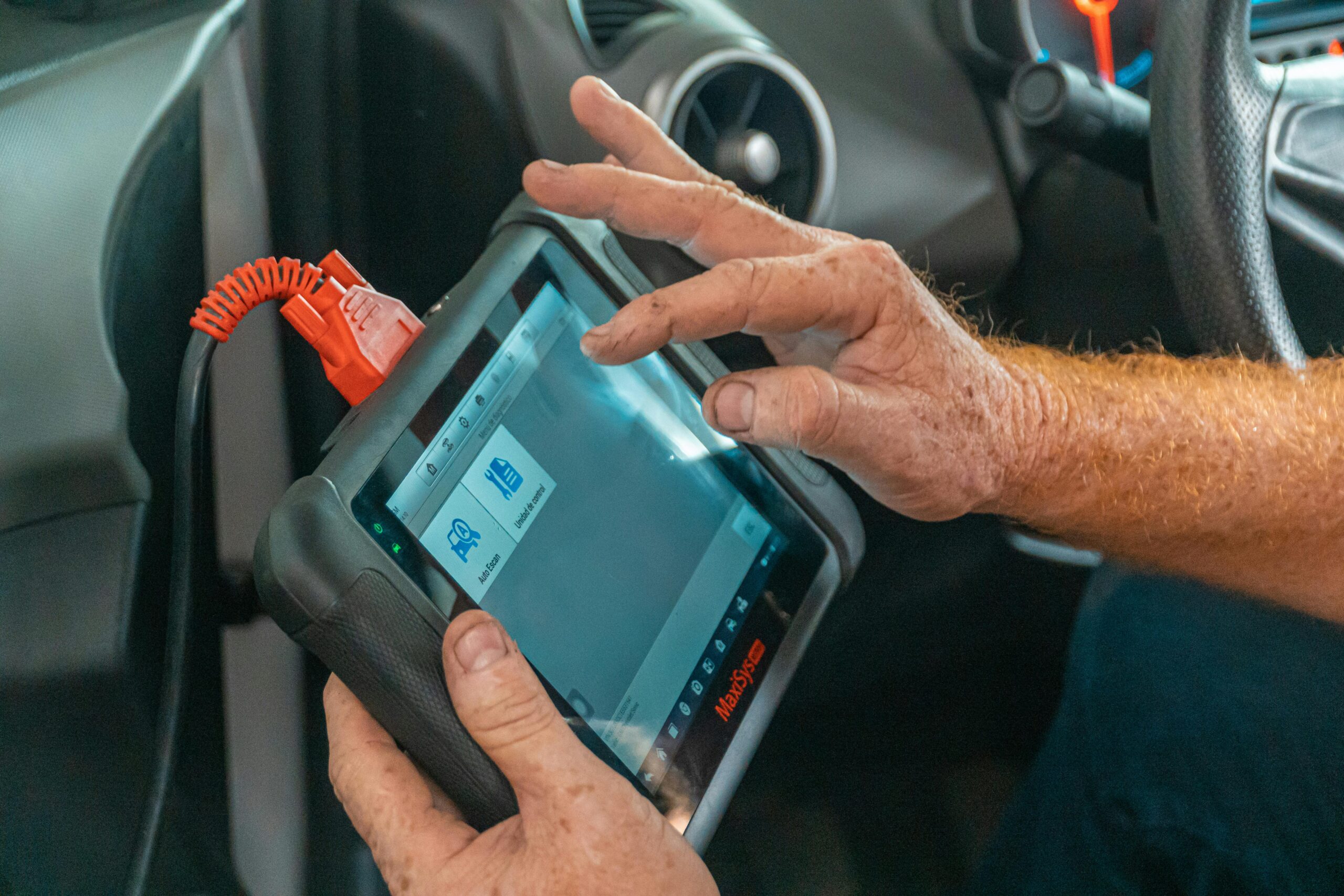
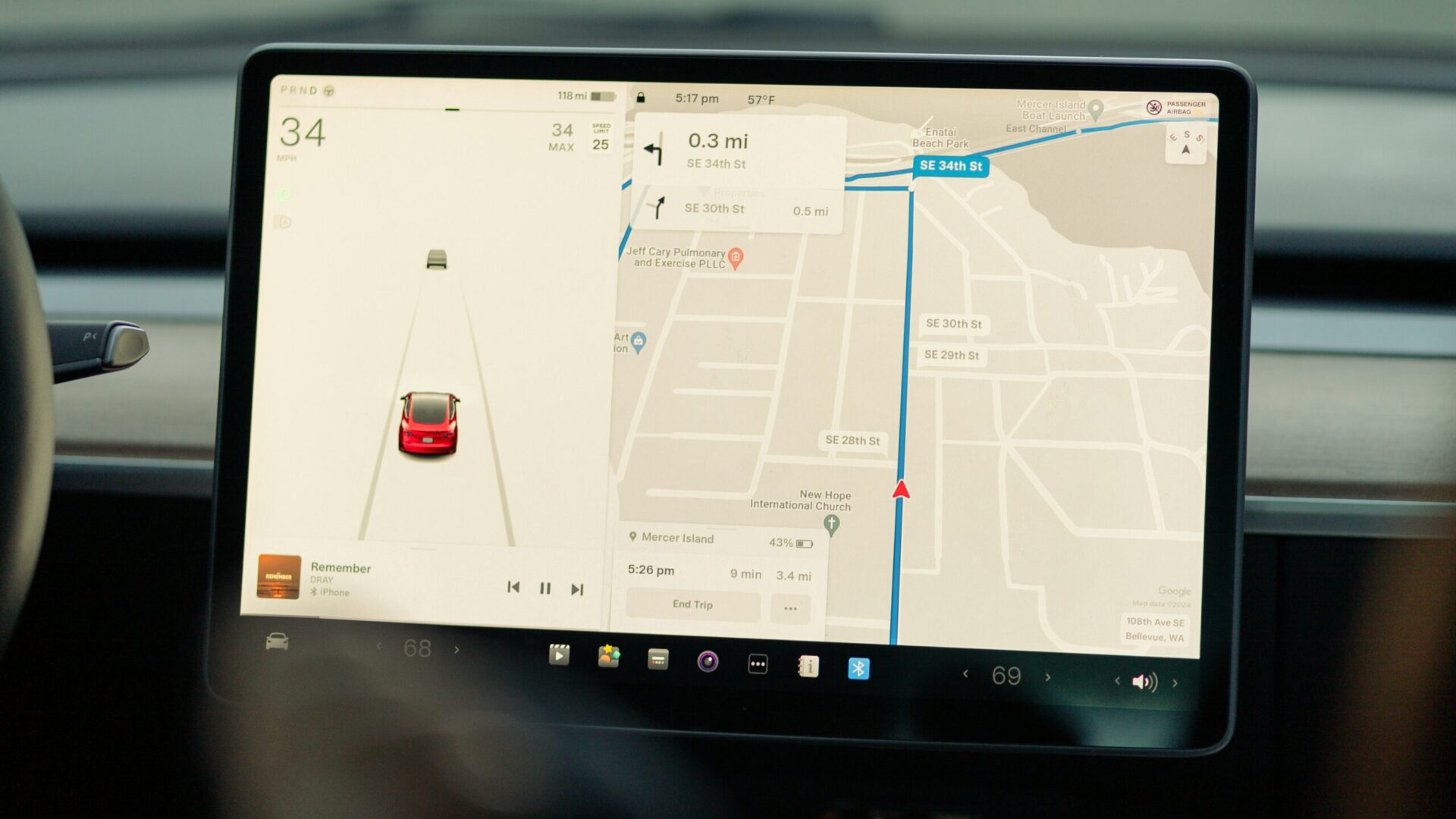
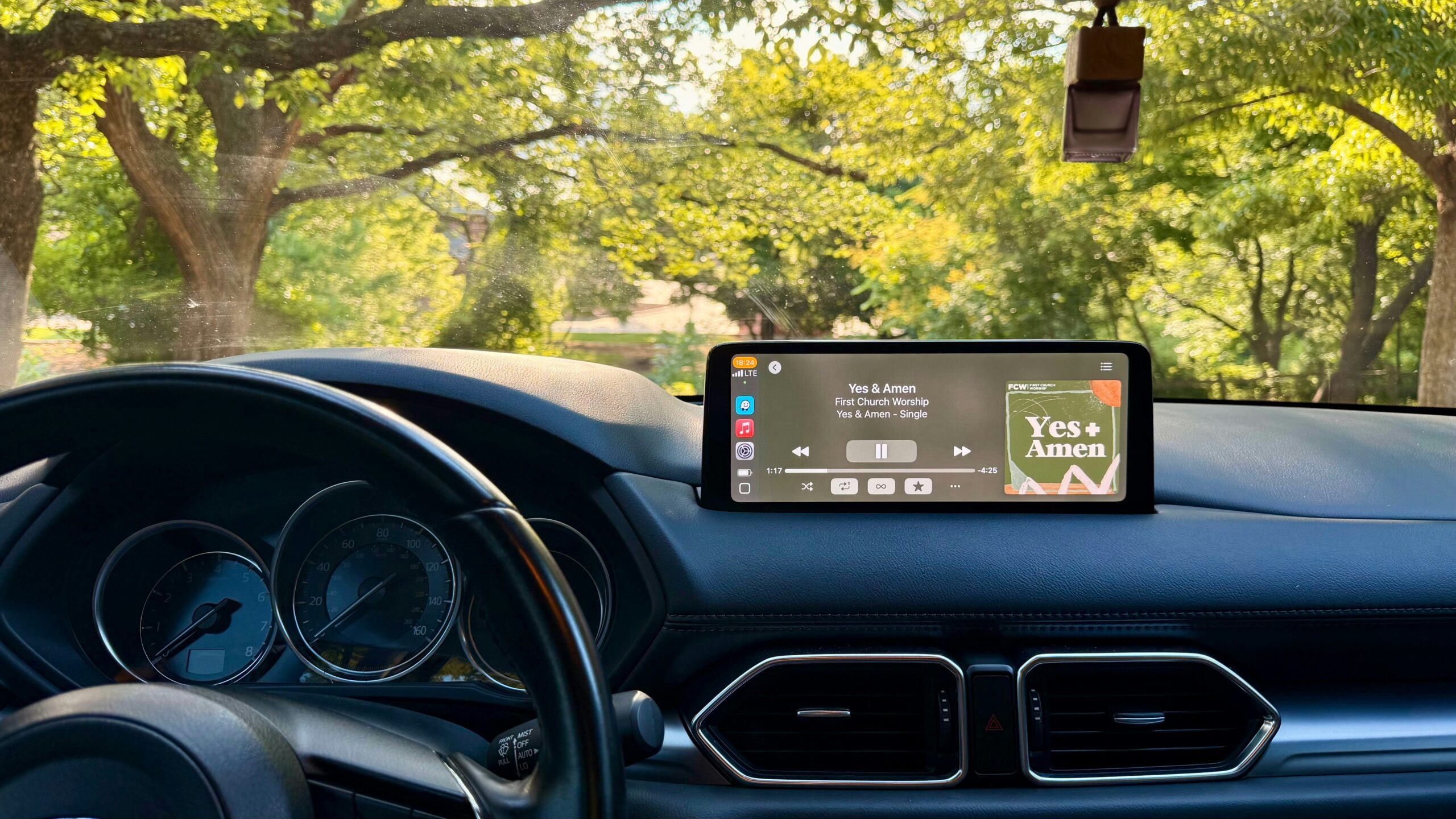













The modern car is a surveillance device that happens to also drive. It knows where you go, when you leave, how fast you got there, who called you on the way, what music you played, and in many cases what your face looked like while you listened. It records, transmits, aggregates, and in many documented cases sells that information to third parties — insurance companies, data brokers, law enforcement, and “service providers” with no obvious connection to transportation. Most owners have no idea it happens, because the consent forms that enable it are buried in the same clickwraps everyone scrolls past when picking up the keys.
This article walks through what automakers actually collect, where it goes, what it gets used for, and what the legal and regulatory landscape looks like in late 2026. The story has moved significantly since 2023, when the Mozilla Foundation published a report that called cars the worst privacy category it had ever reviewed. The GM/OnStar/LexisNexis scandal of March 2024 forced the industry into the first meaningful pullback of the connected-car era, data brokers have shuttered specific products, state attorneys general have opened investigations, and a wave of state-level vehicle privacy legislation is now active. Owners have more tools than they did two years ago. They still have fewer than they should.
The adjacent questions about how insurance companies use telematics (through their own opt-in UBI programs) and how over-the-air software updates change vehicle behavior are covered in the How Insurers Assess Vehicle Risk and How OTA Updates Change Vehicle Performance articles. This piece focuses specifically on what automakers themselves collect and where that data goes.
What “Telematics Data” Actually Means in 2026
The word “telematics” originally described the combination of telecommunications and informatics — a vehicle sending operational data to a remote server. In the OnStar era, that meant crash notifications, remote unlock, and diagnostic trouble codes being transmitted over a cellular modem. In 2026, telematics has expanded to cover essentially every signal a modern vehicle generates, and most new vehicles generate a lot.
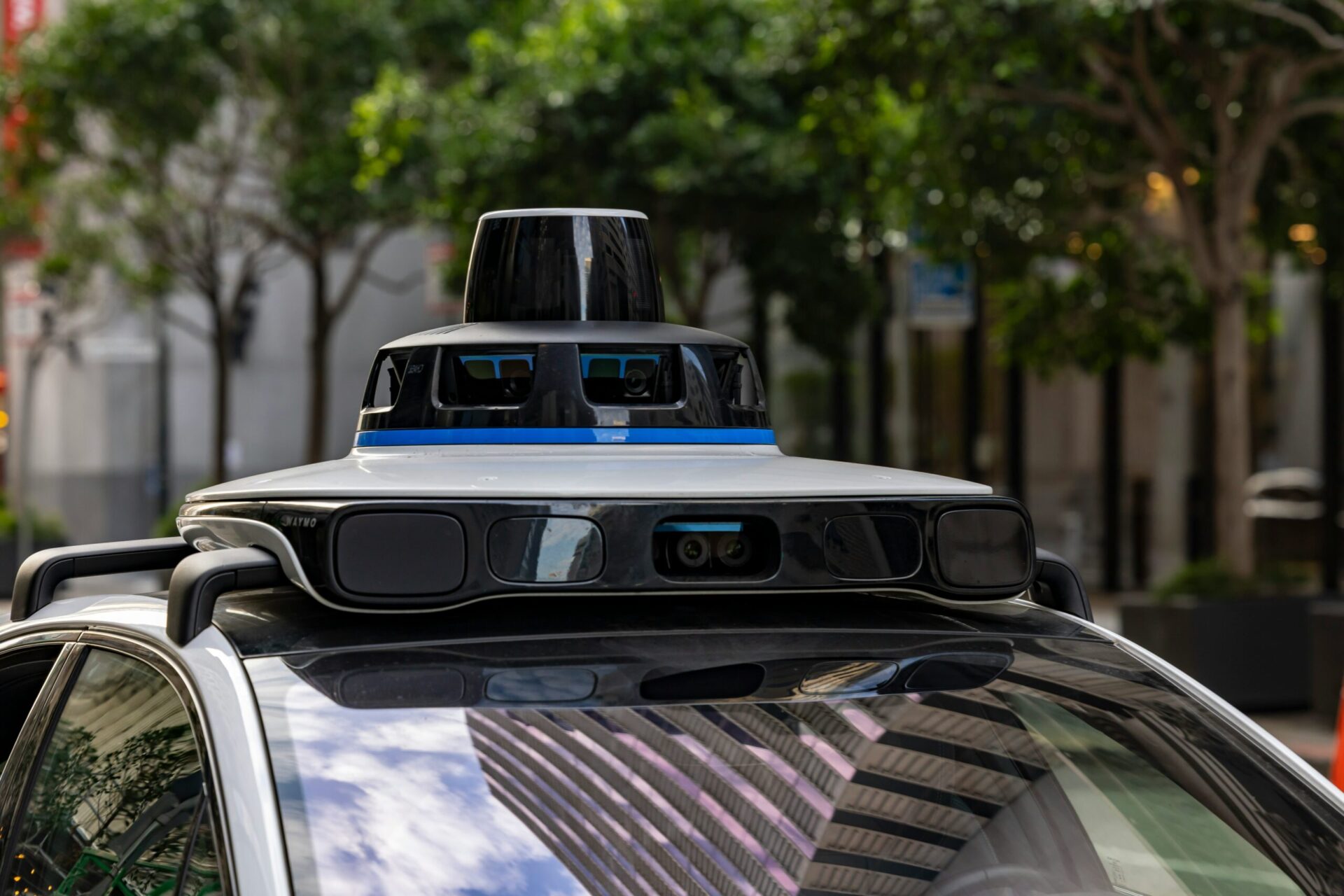
A late-model connected vehicle contains between 100 and 200 individual sensors feeding onboard computers. Those computers aggregate signals from GPS receivers, accelerometers, gyroscopes, tire pressure monitors, door and seatbelt sensors, HVAC controls, infotainment systems, interior and exterior cameras, microphones, biometric sensors (face ID, fingerprint readers), paired phone connections, and the vehicle’s own electronic control modules. The vehicle’s embedded cellular modem — standard on nearly every new vehicle sold in the US since 2018 — transmits a selected subset of this data back to the manufacturer on a continuous or near-continuous basis.
The Mozilla Foundation’s September 2023 “Privacy Not Included” vehicle category review examined the privacy policies and data practices of 25 major car brands and found the state of the industry worse than any category it had ever reviewed. The findings:
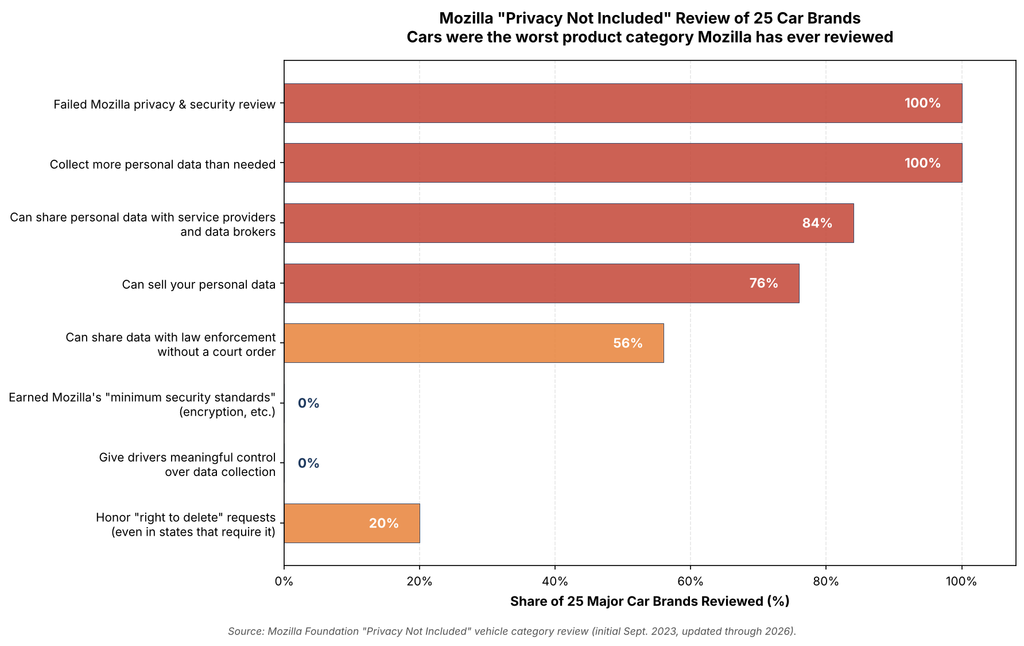
Every brand reviewed — 25 out of 25 — failed Mozilla’s privacy and security standards. Every brand collected more personal data than needed for vehicle operation. 84% reserve the right in their privacy policies to share personal data with service providers and data brokers. 76% reserve the right to sell that personal data. 56% reserve the right to share data with law enforcement without a court order. Zero brands met Mozilla’s minimum security standards (such as encryption on data transmission and storage). Zero gave drivers meaningful control over data collection beyond buying an older, non-connected vehicle.
Mozilla called out specific brands as worst offenders. Tesla failed every category and was flagged for untrustworthy AI practices around its driver-assistance systems. Nissan’s privacy policy disclosed collection of data about “sexual activity” — a category the brand did not explain in response to Mozilla’s inquiries. Kia’s policy likewise included sexual-activity data. Only Renault and Dacia (both subject to EU GDPR) performed comparatively well, and even those did not pass Mozilla’s standards.
The Full Data Inventory: Beyond Speed and Location
The categories of data automakers collect have expanded far beyond what most owners expect. Reading the privacy policies of 25 major brands reveals a consistent pattern: operational data that could plausibly serve a safety or diagnostic function, device-level data that could plausibly enable features, and a category of highly sensitive personal data that has no obvious vehicle-operation justification at all.
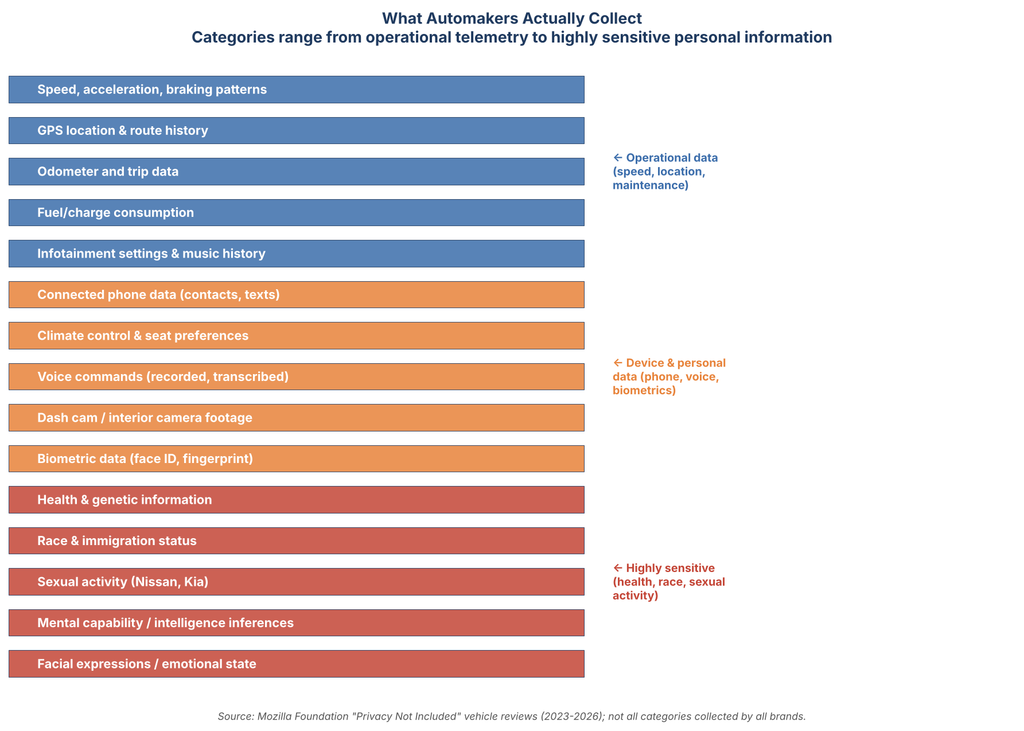
The operational tier includes speed, acceleration, braking, GPS location, odometer readings, trip data, fuel or charge consumption, and infotainment system usage. Most owners accept that modern cars collect this. It is what enables the maintenance reminders, the route history in the nav system, the fuel economy displays, and the connected app features. It is also what feeds insurance data brokers when owners enroll in programs that share it.
The device and personal tier goes further. Paired phone data — contact lists, text message metadata, recent calls, and sometimes message content — is accessed when a phone connects via Bluetooth or CarPlay/Android Auto. Voice commands are recorded, transmitted to cloud servers for processing, and often retained in the vehicle’s account history. Interior camera footage from driver monitoring systems and dash cams is captured continuously on many Tesla, GM, and Ford models. Biometric data from face ID (Genesis, Hyundai, BMW) and fingerprint sensors (Hyundai, Genesis, some Kia models) is stored on-vehicle but also transmitted to manufacturer systems in some cases.
The highly sensitive tier is where the most disturbing category appears. Multiple brands’ policies reserve the right to collect health and genetic information, race, immigration status, sexual activity data (Nissan, Kia), inferences about mental capability or intelligence (several brands), and facial expression analysis to infer emotional state (Mercedes-Benz, BMW, Tesla). Most consumers would assume these categories simply couldn’t apply to car data. The policies suggest they do.
Several brands collect data from passengers, not just drivers. Subaru’s privacy policy explicitly states that being a passenger in a Subaru vehicle makes you a “user” who has consented to its data practices — a legal construction that effectively treats consent as implied by physical presence in the vehicle.
Why Automakers Collect All This
The business rationale varies by data category. Operational data serves product development, warranty analysis, and maintenance scheduling — legitimate manufacturer uses. Connected-services revenue (navigation, remote start, in-car Wi-Fi, subscription features) requires cellular connectivity and user account data. Fleet and insurance partnerships — covered in detail below — require driving behavior data. But the breadth of collection goes well beyond what these use cases justify.
The direct monetization opportunities are what drove the expansion. Industry research firms have projected connected-vehicle data to become a $500+ billion global market by 2030, with revenue streams including:
- Insurance data sales to risk modelers and carriers directly
- Location data sales to retailers, real estate analytics firms, and advertising platforms
- Driving behavior data to fleet management, auto financiers, and mobility services
- Infotainment analytics to content providers and advertisers
- Repair and parts data to dealers, aftermarket parts companies, and insurance repair networks
- Subscription unlocks for features physically present in the vehicle (heated seats, acceleration boost, driver-assistance tiers)
Each of these streams generates recurring revenue in a way that vehicle sales alone do not. For automakers facing margin pressure on vehicles themselves, connected-services revenue has become strategically essential. The industry projects a path from roughly $12 billion in 2022 global connected-services revenue to over $145 billion by 2030 — a trajectory covered in the How OTA Updates Change Vehicle Performance article from the OTA business-model angle.
The problem is that the consent architecture for this data collection has not kept pace with the collection itself. Most owners enroll in connected services through a dense terms-of-service agreement at the point of sale or when first setting up a vehicle’s app. The specific data practices are typically disclosed in a separate privacy policy linked but rarely read. Opting out often disables features the owner paid for.
The GM/OnStar/LexisNexis Scandal: How Data Actually Moves
The connected-car privacy story broke into mainstream awareness in March 2024, when a New York Times investigation revealed that General Motors had been feeding driving behavior data from OnStar-equipped vehicles to LexisNexis and Verisk Analytics, two major data brokers that in turn sold the data to insurance companies.
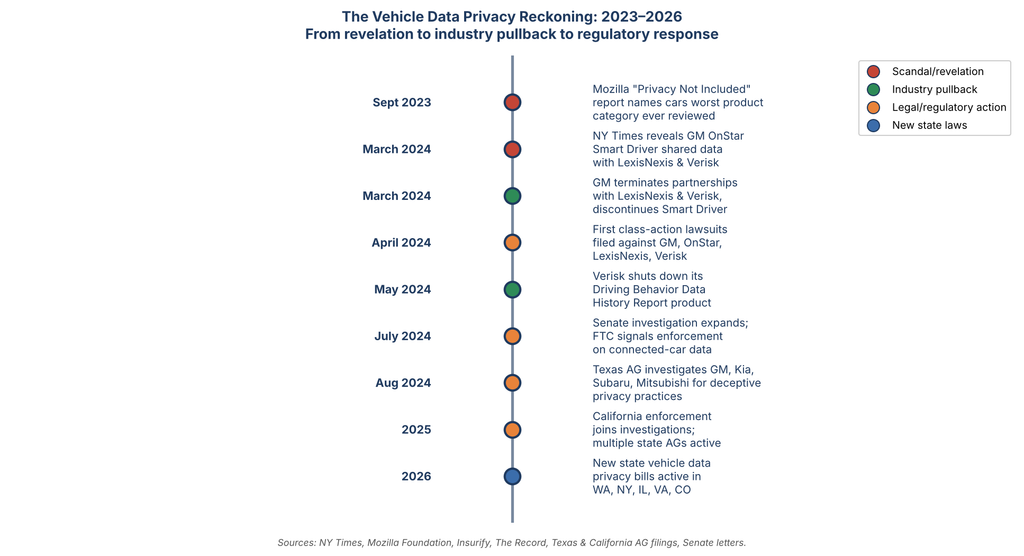
The mechanism worked like this. GM offered an OnStar “Smart Driver” feature that owners could enable for the ostensible purpose of giving them feedback on their driving habits — hard braking, rapid acceleration, speed above posted limits, late-night driving. In the fine print of various sign-up flows (including some that occurred automatically when owners signed up for the OnStar app or activated the vehicle’s connectivity services), OnStar’s data-sharing permission was pre-checked. That data flowed to LexisNexis and Verisk, which packaged it into driver behavior reports marketed to insurance carriers. When affected owners shopped for insurance, carriers that purchased these reports used them to adjust premiums — often upward, in some documented cases by as much as 21%.
Several things made this egregious rather than just controversial. Owners who had never explicitly agreed to share data with insurance companies reported that their insurance rates jumped at renewal with no clear explanation. Some owners reported that OnStar had been collecting driving data even though they had never activated the Smart Driver feature. The data brokers were selling reports to insurers on specific named individuals without those individuals’ knowledge, under a data-use pattern that would have been illegal in most consumer-finance contexts under Fair Credit Reporting Act rules — but vehicle data has sat in a gray area where FCRA protections do not clearly apply.
The response came quickly. GM terminated its partnerships with LexisNexis and Verisk in March 2024 and discontinued the Smart Driver product. Verisk shut down its Driving Behavior Data History Report entirely in May 2024, after disclosing that it had also received data from Honda and Hyundai. Class-action lawsuits were filed in April 2024 against GM, OnStar, LexisNexis, and Verisk in four states. Senator Ed Markey sent letters to 14 automakers demanding details of their data practices and urged the FTC to investigate; the responses were characterized as “evasive and vague.” The Texas Attorney General opened a formal investigation of GM, Kia, Subaru, and Mitsubishi Motors in August 2024 for alleged deceptive trade practices related to vehicle data privacy. California enforcement authorities joined the investigation in 2025.
The scandal forced a temporary industry pullback but did not fundamentally resolve the structural issue. Automakers continue to collect the same data categories. The specific GM-to-LexisNexis pipeline is closed; comparable pipelines continue to operate through other channels. Ford has publicly stated it “does not sell connected vehicle data to data brokers,” but Markey characterized the automaker responses as largely non-responsive on specific practices.
The Regulatory Response: State Laws Catching Up
The US federal framework for vehicle data privacy is thin. There is no federal statute directly analogous to GDPR. The FTC has general authority to act against “unfair or deceptive practices” and has signaled increased attention to connected-car data, but has not yet brought a signature enforcement action in this category. Several existing federal privacy laws — the Driver’s Privacy Protection Act (DPPA), the Fair Credit Reporting Act (FCRA), and the Gramm-Leach-Bliley Act (GLBA) — apply to narrow slices of vehicle data but leave most of it unregulated at the federal level.
State-level regulation has moved faster. The California Consumer Privacy Act (CCPA), amended by the California Privacy Rights Act (CPRA), gives California residents rights to know what data is collected, to request deletion, and to opt out of data sales. Those rights apply to vehicle data when the automaker does business in California, which effectively all of them do. California’s enforcement authority joined the Texas investigation of multiple automakers in 2025.
Washington State has one of the strongest consumer privacy frameworks for vehicle data, with specific provisions that apply to connected vehicles. New York, Illinois, Virginia, and Colorado have active 2026 legislative proposals that would add vehicle-specific disclosure and consent requirements beyond general consumer privacy laws. The pattern is essentially the same across these bills: explicit consent for sharing beyond operational necessity, clear opt-out mechanisms, mandatory deletion on request, and restrictions on sharing without affirmative consent.
The patchwork approach means a connected vehicle crossing state lines operates under different legal regimes depending on where the driver lives, where the data server is located, and where the data recipient is based. For automakers, the practical effect has been that many are moving toward higher-floor compliance (California-level protections applied nationally) rather than trying to administer different data flows in different states. For consumers, the result is that privacy protections vary widely and often unpredictably.
What Buyers and Owners Can Actually Do
The options available to individual drivers in 2026 are limited but meaningful. The most effective ones:
- Review the vehicle’s privacy policy before buying. The policy will be long. The categories to look for are explicit mentions of data sales to third parties, sharing with “affiliates” and “service providers,” and data retention periods. Policies that do not specify data categories or recipients are red flags.
- Access the vehicle’s privacy dashboard. Most modern vehicles now have an in-car or in-app privacy settings menu, often buried several layers deep. Tesla’s data sharing controls are in the Service settings; GM’s are in the OnStar account; Ford’s are in the FordPass app; Toyota’s are in the Connected Services section. Turning off “Share driving data” or similar toggles prevents some but not all collection.
- Request a copy of your data. Under California’s CCPA (if you’re a California resident) or via Privacy4Cars’ free data request tool (available nationwide), you can request what the automaker has on you. Automakers are legally required to respond in several states, though in practice the responses are often incomplete.
- Request deletion. Same channels. Most automakers will delete some categories but not all; “operational” data they claim they need for safety usually stays.
- Opt out of telematics-based insurance sharing specifically. Many automakers have a separate opt-out for insurance-related data sharing distinct from their general data sharing. If you don’t want your driving data feeding into insurance scoring, this is the specific toggle to find.
- Disable always-on cellular connectivity if you can. This is harder than it sounds — modern vehicles typically do not expose a user-facing way to disconnect the embedded cellular modem. Physically disabling the modem (removing fuses or antennas) is possible on most vehicles but may disable safety features and void warranties.
- For dealership trade-ins, perform a factory reset. Vehicle data persists through ownership changes on most models, meaning the next owner (or dealer, or auction buyer) can see where you went and what you did. The reset procedure varies by brand and is often buried in the owner’s manual.
- Use Privacy4Cars’ Vehicle Privacy Report tool. This free service at privacy4cars.com will produce a report for a specific VIN detailing what data categories the manufacturer collects and what opt-outs exist.
None of these steps restore full privacy. They narrow the collection and give the owner more awareness of what remains. The structural fix — legally mandated minimum privacy protections with meaningful enforcement — remains a state-by-state and bill-by-bill effort.
The Used Car Data Problem
One underappreciated dimension of the vehicle data story involves used cars. When a vehicle changes ownership, the data associated with it does not automatically transfer or delete. Prior owners’ location histories, paired phone data, voice command recordings, home and work addresses (often stored as “favorites” in the nav system), and connected account credentials often persist in the vehicle’s systems after resale.
The implications cut multiple ways. Used-car buyers can often see significant personal information about previous owners from the vehicle’s infotainment system — names from phone pairings, home addresses from navigation history, routine trip destinations. Previous owners can sometimes still receive notifications or exert remote control over sold vehicles if their account was not properly removed. In worst-case scenarios documented by Consumer Reports and Privacy4Cars, previous owners have been able to track the location of their former vehicles for months or years after sale.
Dealers often perform cursory resets at trade-in but rarely full factory resets of connected-vehicle systems. The Used Car Reliability by Region article covers other used-vehicle considerations; on the privacy side, the practical advice is that both sellers and buyers should independently perform a factory reset and account removal at the time of ownership change.
The Assessing Seller Credibility in Private Car Sales piece covers related issues in private transactions where the data-wipe process is even less controlled than at dealerships.
The Takeaway
The scale of data collection in modern vehicles is larger than most owners imagine, broader than operational necessity requires, and governed by consent architectures designed to maximize collection rather than clarity. The Mozilla Foundation’s 2023 review was not a one-time snapshot but a baseline that remains largely accurate three years later: cars collect more personal data, from more categories, with less consumer control than any other consumer product category that has been systematically reviewed.
The GM/OnStar/LexisNexis scandal of 2024 forced a specific pipeline closed and triggered regulatory attention that is still playing out. The underlying business model — connected-services revenue built partly on data monetization — has not changed, because the industry projects that revenue to become more important, not less, as vehicle sales margins compress. The direction of travel is toward more collection, more sharing, more subscription features, and more data-driven revenue.
The counterweights are state-level privacy legislation, class-action litigation, and enforcement attention from state attorneys general. Those counterweights are real but slow. In the meantime, individual owners have a handful of practical tools — the privacy dashboard, the data access request, the opt-out toggles, Privacy4Cars — that reduce but do not eliminate collection. The most consequential single action a buyer can take is to read the privacy policy of a vehicle before signing for it, because that is the point at which consent is actually captured.
The modern car is a surveillance device that also drives. Knowing that is the first step to deciding what to do about it.
External Sources
Casey Gerry — GM, OnStar, and LexisNexis Sued for Data Privacy Violations
Mozilla Foundation — Privacy Not Included: Cars
SecurityWeek — 25 Major Car Brands Get Failing Marks from Mozilla
CleanTechnica — Mozilla Foundation Condemns Data Collection By Cars
Insurify — GM Faces Lawsuits for Sharing Driver Data
The Record — Verisk Shuts Down Driver Patterns Product
Fortune — GM, Honda, and Hyundai Accused of Inappropriately Selling Customer Data
LLRX — Automakers Are Collecting Sensitive Data and Selling It Without Permission
MoneyGeek — Your Car Has Been Selling Your Driving Data to Insurers
Engadget — Tesla Tops Mozilla’s “Creepiest” Carmakers List
Nelson Mullins — Privacy Regulation of Auto Industry to Accelerate in 2026
Bloomberg Law — Internet-Connected Car Privacy Questions Prompt States to Act























Leave a Reply
You must be logged in to post a comment.