






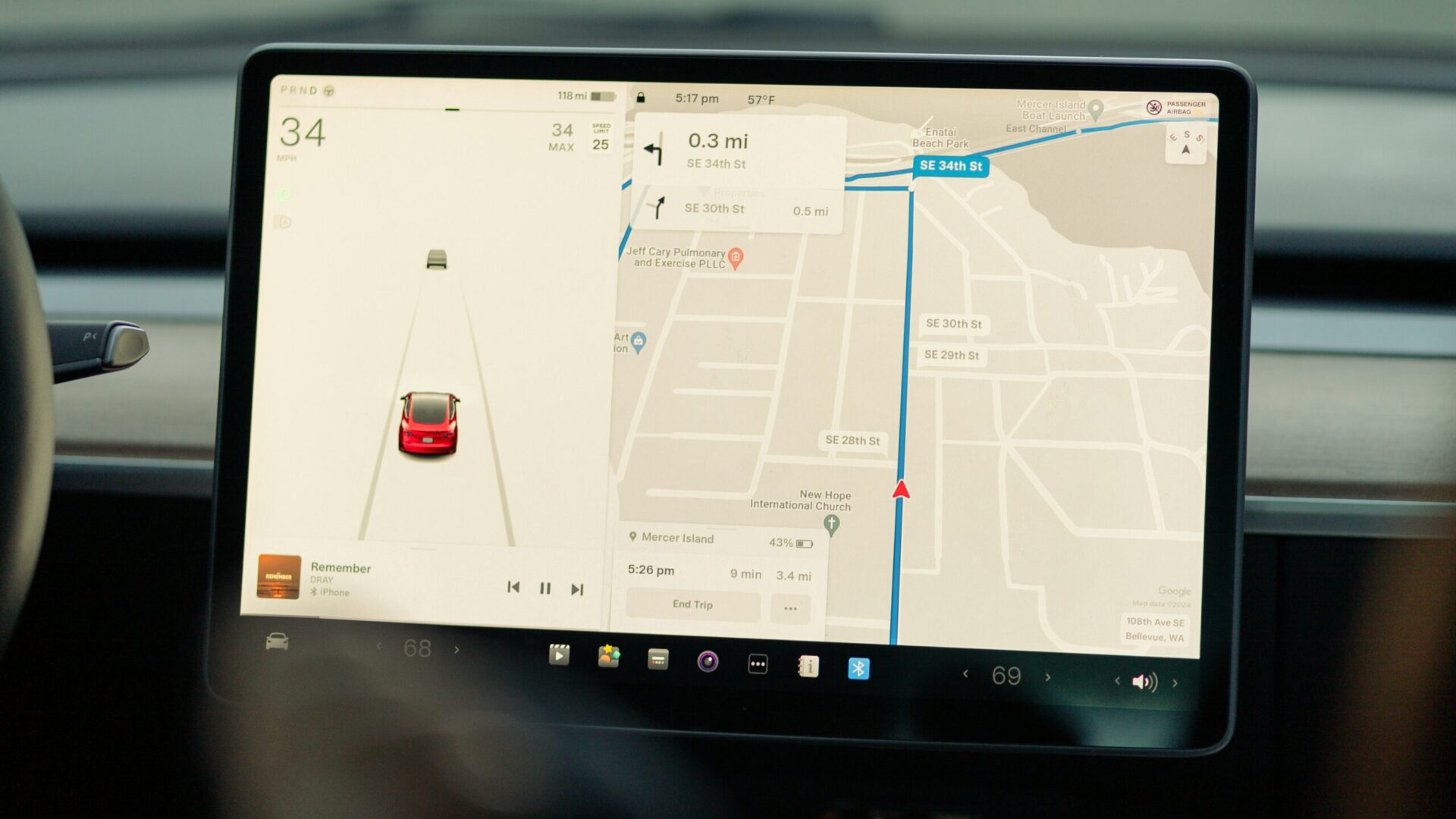










In 2015, Tesla pushed a software update to the Model S that added the first version of Autopilot to vehicles already parked in owners’ driveways. Overnight, cars that had been sold with no driver-assistance features gained the ability to steer themselves on highways. No dealer visit, no mechanical change, no additional cost. The update downloaded while owners slept and transformed the capability of hardware they already owned. It was the clearest demonstration yet of what over-the-air (OTA) updates could do — and a preview of how the entire auto industry would be reshaped over the next decade.
Fast-forward to 2026 and OTA capability is table stakes for any new vehicle worth considering. Tesla, Rivian, Ford, GM, Hyundai/Kia, BMW, and Mercedes all push regular updates to vehicles in customers’ garages. Some are mundane bug fixes. Some add meaningful new features. A few have gone the other direction — removing capabilities, throttling performance, or moving features that used to be free behind monthly subscriptions. OTA has become simultaneously the single most powerful tool for vehicle improvement and the most powerful tool manufacturers have for changing the economics of ownership after the sale.
This guide covers how OTA actually works under the hood, which manufacturers do it well versus poorly, what current updates typically contain, and — critically — how OTA has quietly reshaped what “buying a car” actually means for buyers in 2026.
How OTA Updates Actually Work
An OTA update is any software update delivered to a vehicle wirelessly, without requiring a physical connection or dealer visit. The concept is simple; the execution involves a surprising amount of engineering.
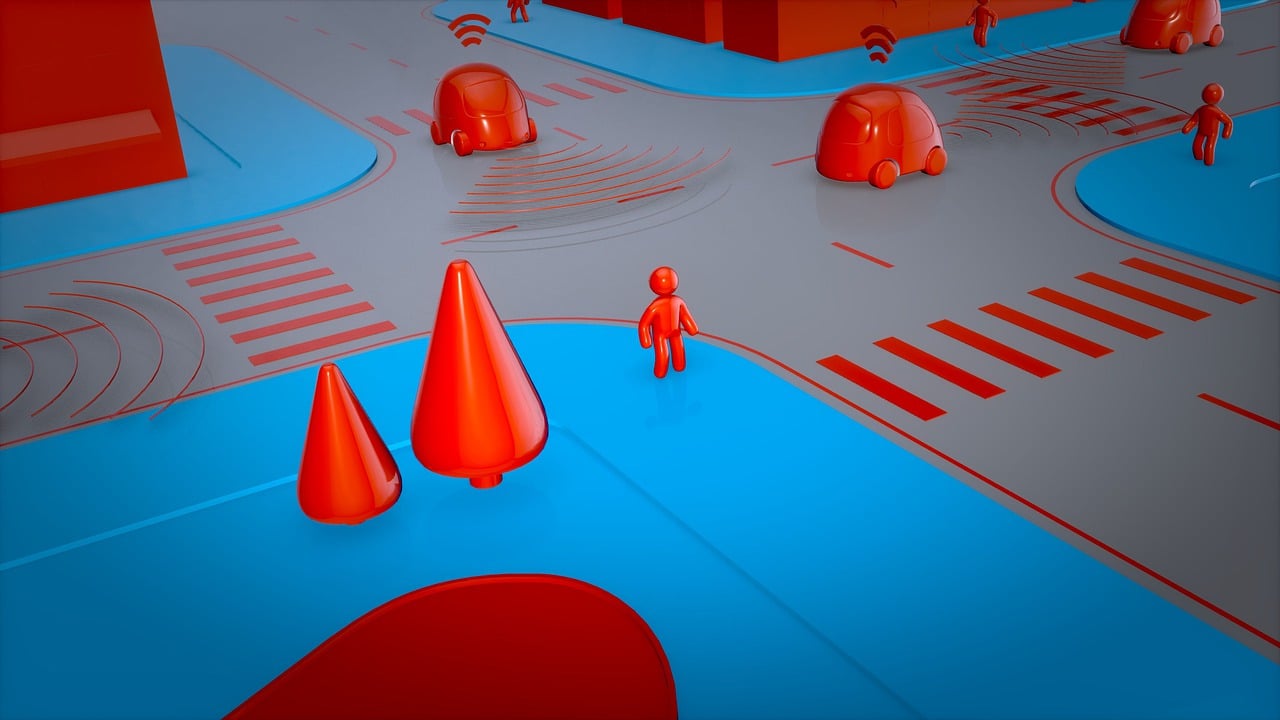
The connectivity layer. Every OTA-capable vehicle has a built-in cellular modem (typically 4G LTE, with 5G rolling out across 2024-2026 models), plus Wi-Fi for home downloads. The modem is factory-installed and connects to the manufacturer’s servers, usually at no cost to the owner for the update function itself (separate connected-services subscriptions cover features like remote start and streaming).
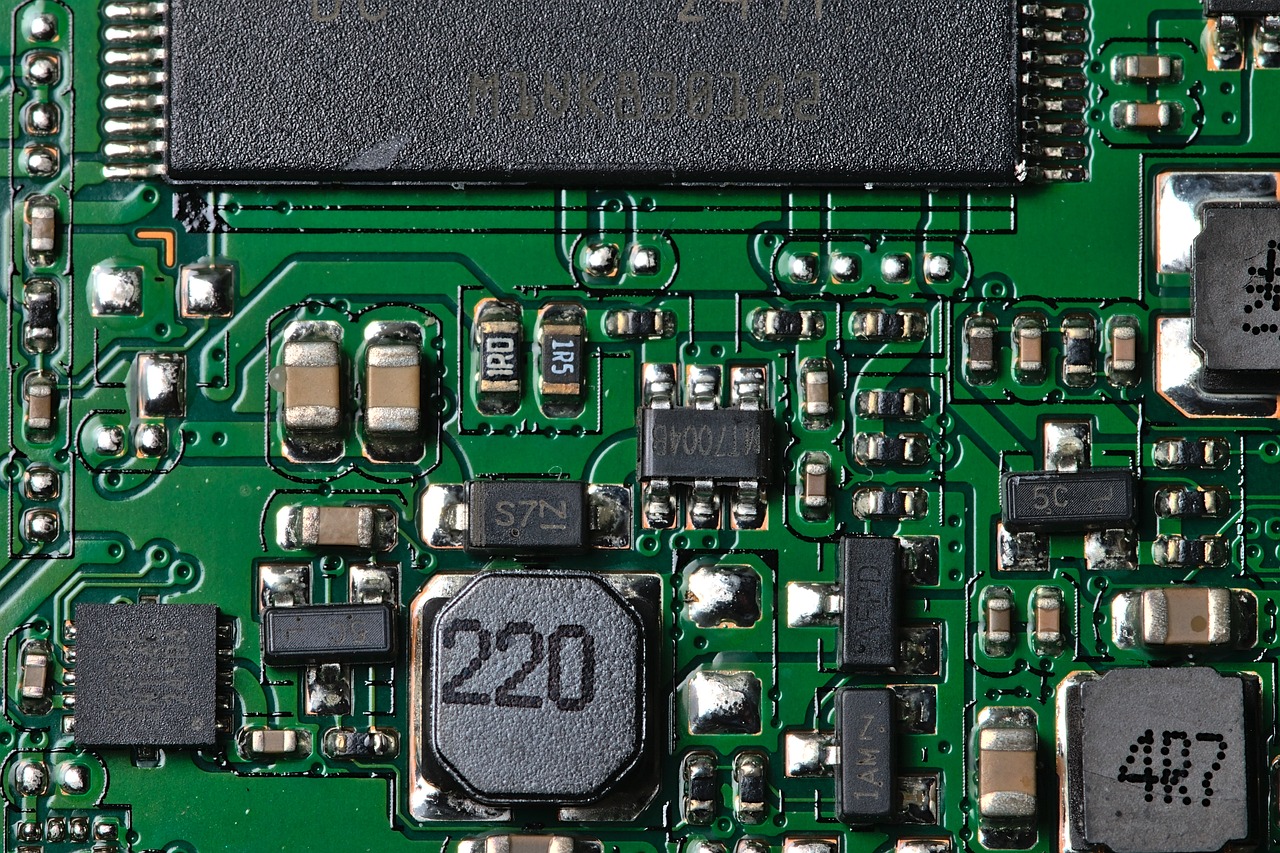
The update architecture. Modern vehicles contain between 50 and 150 individual electronic control units (ECUs) — small computers managing everything from engine timing to seat heaters. Early OTA capability updated only the infotainment ECU. Full-vehicle OTA (what Tesla and Rivian do) updates any or all of these ECUs in coordinated packages. This requires what engineers call a “software-defined vehicle” architecture: central compute, zonal controllers, and standardized communication buses that let the OEM push code anywhere in the system.
The download and install flow. When an update is available, the vehicle checks in with the manufacturer’s servers (usually via the cellular modem). If the owner has approved automatic updates, the package downloads in the background — often multiple gigabytes for significant updates. Installation happens when the vehicle is parked and powered off, typically overnight. Depending on scope, installations can take 20 minutes to 4+ hours. During install, most vehicles cannot be driven.
The verification and rollback. Properly engineered OTA systems include cryptographic verification (the vehicle verifies the update is genuinely from the manufacturer before installing), A/B partitioning (the new software goes into a staging area and only becomes active if verification succeeds), and rollback (if something goes wrong, the vehicle reverts to the prior version automatically).
Recall fixes. The National Highway Traffic Safety Administration (NHTSA) now accepts OTA remediation as a valid recall remedy. Ford reported pushing 45+ OTA updates through H1 2026 alone, several of which addressed safety recalls that would previously have required physical dealer visits. For owners, the practical impact is enormous — a recall that used to require taking a day off to visit the dealer now resolves overnight while the car sits in the driveway.
What OTA Capability Looks Like by Brand
Not all OTA systems are equal. The term covers everything from a “software-defined vehicle” platform that can update essentially every system (Tesla, Rivian) to narrow infotainment-only updates (some legacy brands). The practical difference is enormous.
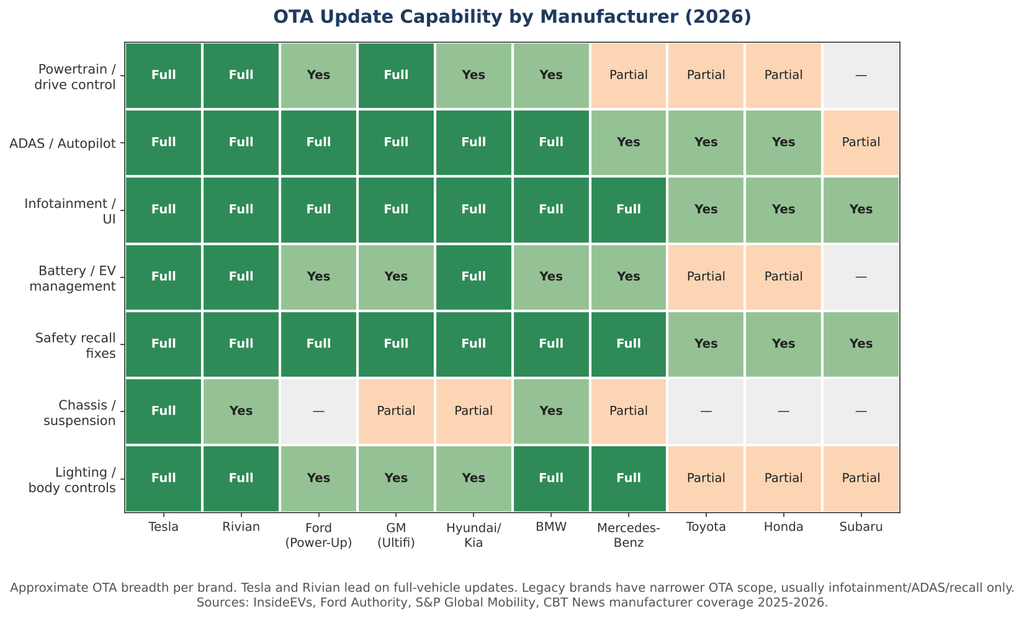
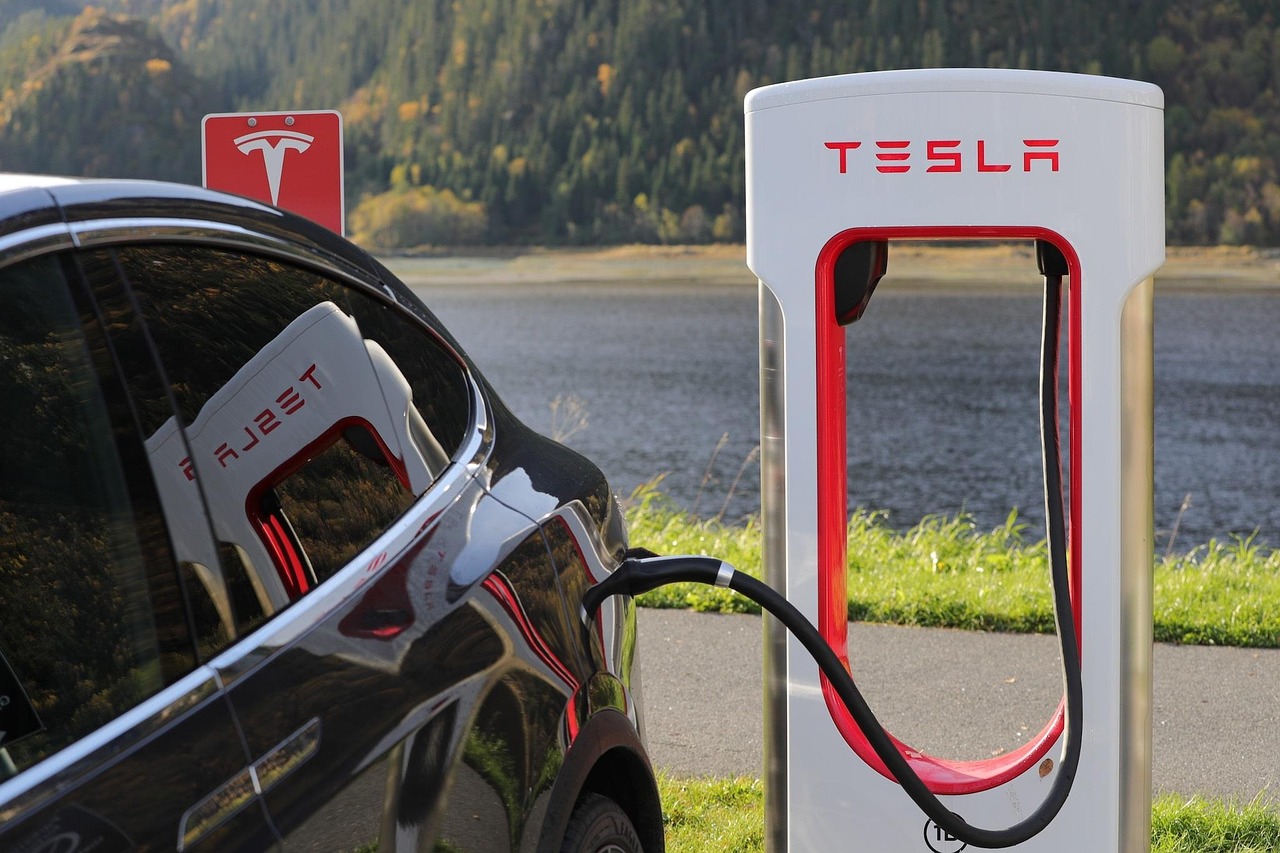
Tesla remains the industry leader by a meaningful margin. Every subsystem is OTA-updateable: drive motor control, battery management, suspension damping (on air-spring models), ADAS/Autopilot, infotainment, lighting, interior climate, driving dynamics. Updates arrive roughly every 4-8 weeks with meaningful functionality changes. Tesla’s software architecture was built from the ground up for full-vehicle OTA — a decision that still gives it a 5-7 year head start on most legacy competitors.
Rivian was designed with Tesla’s playbook in mind. The R1T and R1S receive regular full-vehicle updates covering drive modes, off-road capability, infotainment, and ADAS. Rivian owners report update frequency comparable to Tesla, with coverage approaching Tesla’s breadth.
Ford (Power-Up) has made rapid progress. Ford Power-Up launched in 2021 on the Mustang Mach-E and has expanded to F-150, F-150 Lightning, Bronco, Explorer, and most newer models. Scope now includes ADAS (BlueCruise updates), infotainment, powertrain tuning on certain models, and safety recall remediation. Not yet at Tesla parity but closing the gap.
GM (Ultifi) launched its software-defined platform with the Cadillac Lyriq and has extended it to the Blazer EV, Equinox EV, Hummer EV, and updated Silverado/Sierra configurations. Ultifi covers infotainment, Super Cruise updates, battery management, and growing powertrain control. Legacy GM vehicles (pre-Ultifi) have limited or no OTA capability.
Hyundai/Kia have strong OTA on newer models (Ioniq 5, Ioniq 6, EV6, EV9, newer Sonata/Elantra/Tucson model years). The company’s ccNC infotainment platform supports regular updates, and battery management OTA is standard on the e-GMP electric platform.
BMW and Mercedes-Benz have mature OTA for infotainment, ADAS, and lighting/body control. Powertrain OTA is more limited than Tesla/Rivian but expanding. BMW’s iDrive 8 and 9 platforms both support regular updates. Mercedes MBUX similar.
Toyota and Honda lag significantly on OTA capability. Both have infotainment OTA on newer models and can push safety recall fixes OTA in some cases, but powertrain, chassis, and body-control OTA remain limited or absent. Toyota’s Arene software platform (announced 2023, rolling out 2025-2027) will narrow the gap, but current Toyota and Honda buyers should expect much more limited OTA scope than Tesla or Hyundai buyers.
Subaru has the narrowest OTA capability of the mainstream brands — primarily infotainment updates, with most meaningful software changes still requiring a dealer visit.
For buyers researching new vehicles, OTA capability is a spec that should be evaluated alongside horsepower and fuel economy. A vehicle with weak OTA capability in 2026 will look increasingly dated by 2029-2030 as competitors continue pushing improvements to their vehicles that yours can’t receive. Our breakdown of whether you should trust tech in first-year car models covers the flip side — first-year OTA platforms are also where OTA bugs are most likely to surface.
What Updates Actually Do
The marketing around OTA focuses on dramatic capability additions — Autopilot, new drive modes, significant range improvements. The reality is more mundane. Most OTA updates in any given month on any given vehicle are small bug fixes and infotainment improvements, not headline features.
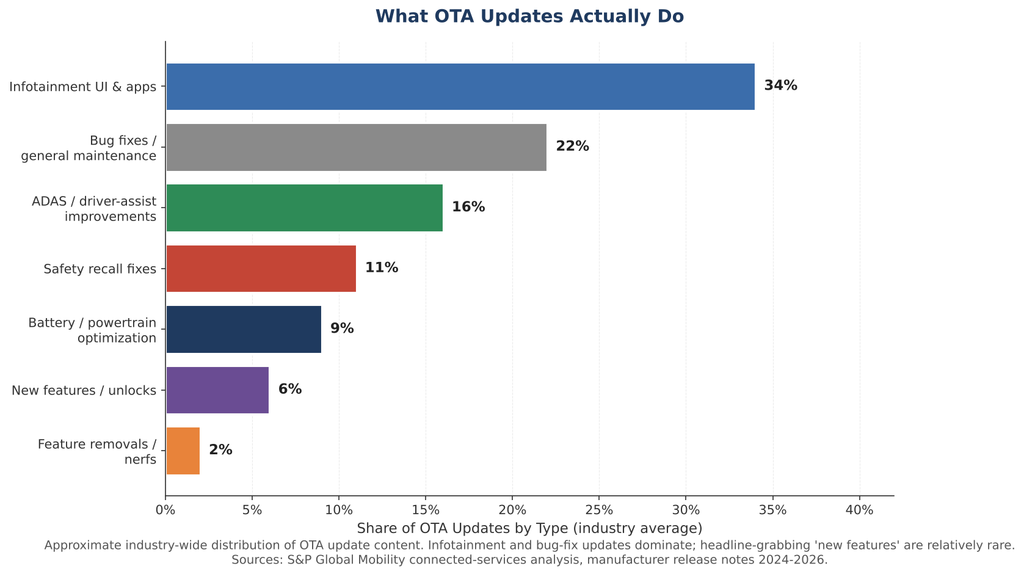
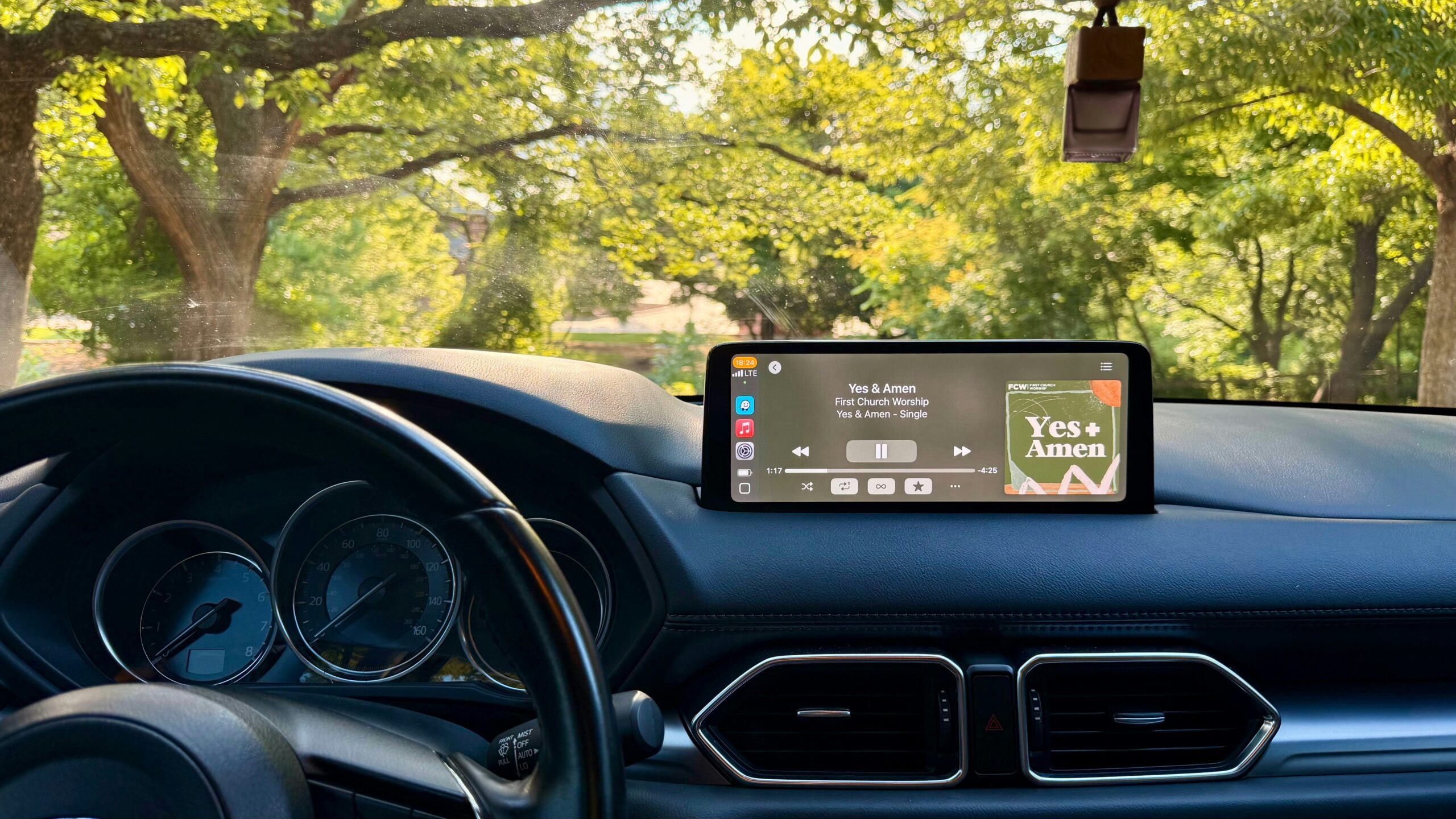
Infotainment UI and apps (~34% of updates). The single largest category. New Spotify features, bug fixes in the navigation system, updates to streaming apps, Apple CarPlay/Android Auto compatibility improvements, new wallpapers, UI tweaks. Useful but rarely transformative.
General bug fixes and maintenance (~22%). The automotive equivalent of smartphone patches. Fixing a weird bug where the climate control forgets your preferred fan speed, resolving a random reboot in the backup camera, improving battery-pack balancing algorithms. Owners often don’t notice these fixes — they just notice that annoyances stop happening.
ADAS / driver-assist improvements (~16%). Lane-keeping algorithm refinements, adaptive cruise control tuning, blind-spot warning sensitivity adjustments, automatic emergency braking improvements. Tesla Autopilot updates and Ford BlueCruise expansions make news, but similar if less-publicized tuning happens on every ADAS-equipped vehicle from most manufacturers.
Safety recall fixes (~11%). Increasingly common and arguably the most valuable category. A recall that used to require a dealer visit now resolves silently overnight. Owners save 2-4 hours per recall, manufacturers save hundreds of dollars per vehicle in dealer labor.
Battery and powertrain optimization (~9%). More common on EVs. Better battery balancing, improved thermal management (see our breakdown of how EV thermal management affects performance), optimized regenerative braking, charging curve refinements. These updates often add 2-5% real-world range over the life of the vehicle just by letting the vehicle use its battery more efficiently.
New features and unlocks (~6%). The headline-grabbing category — new drive modes, new game or entertainment apps, new ADAS capabilities. Rare but memorable. Tesla Dog Mode, Sentry Mode, Light Show, and the various Easter eggs are all OTA additions post-purchase.
Feature removals and nerfs (~2%). Rare but real. We cover this below because the small percentage understates the impact — when a feature is removed or throttled, it’s usually a significant one that owners notice immediately.
The Benefits — Real, Not Hyped
The positives of OTA are concrete and measurable for owners:
Continuous improvement. A 2023 Tesla Model Y today drives meaningfully differently than it did the day it left the factory. Autopilot has improved, the UI has evolved, charging speeds have been optimized, and new features exist that didn’t when the car was purchased. The vehicle appreciates in capability even as it depreciates in dollar value. Our deep dive on how new cars depreciate over time covers the dollar side; the capability side is pure upside.
Recall convenience. NHTSA recalls used to mean scheduling a dealer visit, taking off work, waiting for parts, and sometimes getting a loaner for a day. For OTA-remediable recalls, that entire process is replaced by an overnight update. For owners of brands with aggressive OTA scope, recall participation rates are higher because the friction is nearly zero.
Faster bug resolution. Hardware defects require physical fixes. Software defects — infotainment freezes, driver-assist false alerts, charging-schedule glitches — can be fixed in days or weeks instead of the months or years a traditional software patch cycle would require.
Delayed obsolescence. A car that keeps receiving meaningful updates feels current for longer. Buyers of 2015-2018 Teslas still benefit from the same core software improvements that go to brand-new buyers. This is unusual — before OTA, a 10-year-old car was running the same software it shipped with.
Feature unlocks. Some manufacturers use OTA to enable features the hardware already supports. Tesla’s progression on Autopilot capability is the clearest example — hardware shipped years before the software was ready to use it.
The Dark Side — Also Real
The same technology that enables continuous improvement also enables continuous control. This is the part the marketing doesn’t emphasize.
Feature paywalls and subscriptions. BMW’s 2022 attempt to charge $18/month for heated seats in markets outside the U.S. is the most-cited example. The hardware was installed at the factory; the OTA infrastructure let BMW disable it until the owner subscribed. Public backlash was severe enough that BMW reversed course on heated seats specifically — but BMW has publicly stated it remains committed to the broader subscription model, just differently packaged. Tesla, Mercedes, and most premium brands now offer subscription features. Tesla’s Enhanced Autopilot ($99/month) and FSD ($199/month) are the most common examples.
Remote feature removal. The 2020 Tesla Model S “range nerf” case is the textbook example — Tesla pushed an OTA update that reduced the maximum charge level on older 85 kWh battery packs, reducing effective range by 10-15% on affected vehicles. Tesla argued the reduction was for battery longevity and safety; owners argued it was a post-sale reduction of the capability they purchased. After legal pressure, Tesla eventually offered affected owners partial compensation. The incident established that manufacturers can take back capability remotely; whether they should remains contested.
Transferability problems. Some subscription-unlocked features don’t transfer with the vehicle. A buyer of a used Mercedes who inherits the car with heated-steering-wheel enabled may find the subscription doesn’t carry over — they have to subscribe separately. This affects resale value in ways buyers rarely factor at purchase time. Our coverage of how trade-in equity affects loan decisions covers the broader resale math; subscription-feature non-transferability adds another wrinkle.
GM’s connected-services warning. GM announced in 2024 that certain vehicle features — including some safety features — require active OnStar subscriptions to function. Vehicles with lapsed subscriptions lose some capability. The policy received significant customer backlash but remains in place for some features.
Data collection. OTA capability requires persistent connectivity, which means manufacturers continuously collect data from the vehicle: location, driving behavior, usage patterns, voice recordings (on vehicles with voice assistants), and more. The 2023 Mozilla Privacy Not Included study ranked cars as the worst product category for data privacy they had ever evaluated. OTA isn’t the cause of this problem, but it depends on the same infrastructure.
Catastrophic update risk. A bad OTA update can brick a vehicle temporarily — this has happened to Tesla multiple times, including a 2023 update that caused significant infotainment issues across the Model 3 and Y fleet. Properly engineered OTA systems have rollback mechanisms, but not all do, and rollback isn’t always available for all subsystems.
Dealership tension. Manufacturers pushing OTA for recall fixes and software issues bypasses dealer service revenue. Some franchise dealer associations have pushed back, arguing manufacturers are violating state franchise laws. Several state cases are pending. For buyers, this is less a direct issue and more a background political fight shaping which features are available and how.
The Subscription Business Is Scaling Fast
OTA capability is the technical foundation for the broader shift to “software-defined vehicles” and the subscription business model it enables. The economics are compelling for manufacturers:
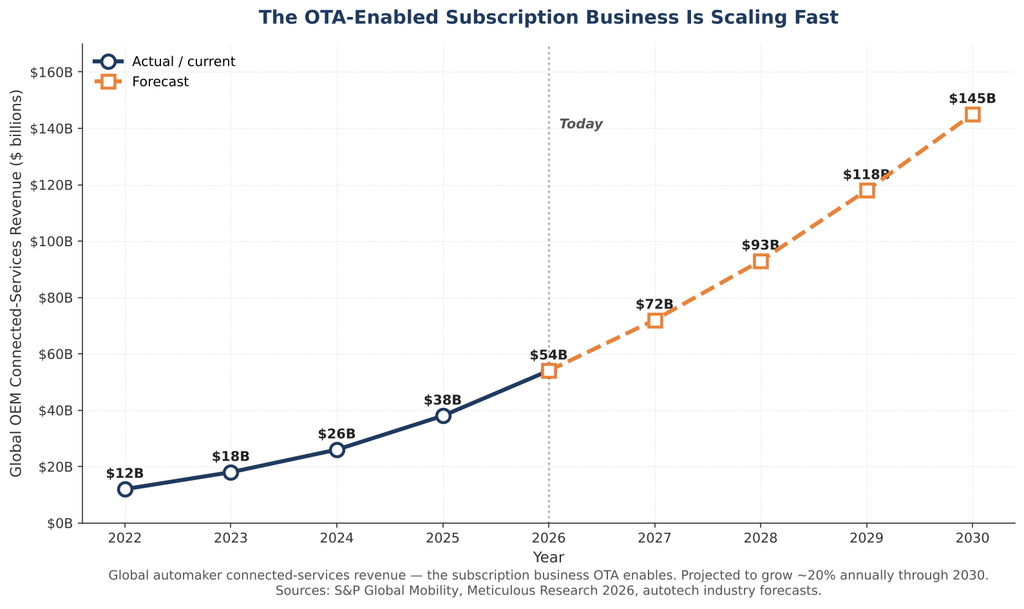
Global automaker connected-services and subscription revenue hit roughly $54 billion in 2026 and is forecast to approach $145 billion by 2030. S&P Global Mobility’s analysis and Meticulous Research’s 2026 outlook both expect roughly 20% annual growth through the end of the decade. For context, that revenue growth rate dwarfs the traditional new-car sales business.
The subscription categories include:
- Safety and connectivity: OnStar, Toyota Safety Connect, Hyundai Blue Link, Subaru STARLINK — basic emergency response, remote start, vehicle status. $10-30/month ranges.
- Entertainment and streaming: In-vehicle Wi-Fi hotspots, satellite radio, streaming video for passengers (when parked). $5-25/month.
- ADAS / self-driving features: Tesla FSD ($199/month), Enhanced Autopilot ($99/month), Ford BlueCruise ($75/month after trial), GM Super Cruise ($25-75/month).
- Hardware feature unlocks: Heated seats, heated steering wheel, adaptive suspension modes, performance boost packages. Varies widely by manufacturer.
- Navigation and traffic: Real-time traffic, enhanced navigation, EV charging network integration. $5-15/month.
For buyers, the practical implication is that the sticker price is increasingly only part of the total cost of ownership. Our pillar guide on total cost of ownership beyond the purchase price has the full framework; subscriptions add a new ongoing line item not present in pre-OTA ownership.
What Buyers Should Actually Do
Several practical steps help owners get OTA’s benefits while avoiding the downsides:
Confirm OTA scope before buying. Ask specifically: “What systems on this vehicle can receive OTA updates? What updates have been pushed in the past 12 months? What subscription-only features exist, and what do they cost?” If the salesperson can’t answer, check the manufacturer’s owner community forums.
Keep OTA enabled for safety and recall updates. Even if you dislike feature-removal risk, declining safety recall OTAs means your vehicle is operating with known safety defects. These are almost always worth taking.
Review release notes before approving updates. Most OTA systems let you review what an update changes before installing. If an update is purely entertainment or infotainment, approval is low-stakes. If it touches powertrain, ADAS, or battery, understand what’s changing.
Maintain Wi-Fi coverage where you park. OTA updates over cellular can count against data allowances on some plans. Wi-Fi downloads are faster and don’t eat into connectivity subscriptions.
Understand what’s subscription vs. purchased. Before buying, get a written list of features that require active subscriptions. If heated seats or ADAS require ongoing payment, factor that into the ownership budget.
Document pre-update capability. If a manufacturer has a history of post-sale feature reduction, screenshots and performance records of advertised capabilities at delivery can matter in disputes. This matters most for hardware-based performance claims (range, 0-60, towing).
Check subscription transferability. If buying used, confirm with the manufacturer (not the seller) which features will transfer to your ownership and which will require new subscriptions. Our coverage of assessing seller credibility in private car sales covers private-sale due diligence; subscription transferability is a 2026 addition to the standard checklist.
Don’t block OTA entirely. GM and other manufacturers have warned that blocking OTA updates can void warranties. This isn’t a legal edge case — it’s a documented manufacturer policy on multiple brands.
Bottom Line
OTA updates have genuinely changed what owning a car means. The vehicle in your driveway is no longer a finished product delivered once at purchase. It’s a living platform that evolves — usually in your favor, sometimes not — for as long as the manufacturer chooses to support it. For brands that do OTA well (Tesla, Rivian, and increasingly Ford, GM, Hyundai/Kia, and BMW), that evolution is one of the strongest arguments for choosing a modern vehicle over an older one. The capability you buy today will genuinely be better in three years than it is now.
The flip side is that manufacturers now have post-sale control over the vehicle in ways they never did before. Features can be moved behind paywalls. Performance can be throttled. Recalls can be remediated silently. Subscription revenue can be extracted from hardware you already own. The industry is still figuring out where the lines are, and courts and regulators are still sorting through the legal questions.
For buyers in 2026, the practical path is clear: shop for OTA capability as actively as you shop for horsepower or fuel economy, understand which features are subscription-based before purchase, keep critical updates installed, and recognize that the economics of “buying a car” have shifted. The $45,000 you pay today is no longer the end of the manufacturer’s influence over the vehicle. In exchange, you get a car that keeps improving. Whether that trade favors you depends almost entirely on which brand you chose and what you agreed to at the dealership.
Watch the brands. Read the release notes. Know your subscriptions. The owners who do significantly better than average in the OTA era are the ones who treat their car’s software the way they treat their phone’s software — with attention, not assumption.
Sources and Further Reading
NHTSA — Over-the-Air Updates and Recall Remediation
Ford Authority — Ford Software Updates Notably Increased Through H1 2026
S&P Global Mobility — Connected Services as an Increasingly Important Slice of Automakers’ Revenue
Meticulous Research — OTA Features Outlook 2026-2036
CBT News — The Influence of Over-the-Air Updates for Connected Vehicles
InsideEVs — Tesla Sparked a Car Software War. It’s Not Going So Hot
InsideEVs — How Western Companies Are Losing the Software Race
The Drive — BMW Commits to Subscriptions Even After Heated Seat Debacle
TechRadar — BMW Doubles Down on Divisive Car Subscription Features
Gadget Review — How OTA Updates Let Automakers Steal Back Car Features
Atlanta Journal-Constitution — Subscription Features: Are You Renting Your Own Vehicle?
AutoGuide — The Future of the Auto Industry Is Subscriptions, Like It or Not
Kiplinger — Automakers’ Added Subscription Fees Raise Legal Questions





















Leave a Reply
You must be logged in to post a comment.