


















When buying from a private seller, it’s crucial to assess their credibility to avoid getting ripped off or stuck with a lemon. Whether you’re purchasing a used car, a piece of jewelry, or a second-hand gadget, you need to be confident that the selPrivate-party car sales can save you thousands of dollars compared to buying from a dealer. A seller moving a 2021 Toyota RAV4 on Facebook Marketplace often prices it $2,500-$4,500 below dealer retail because they’re not carrying the same overhead — no sales commissions, no reconditioning costs, no lot financing. For the buyer willing to do the work, private sales are where the real deals live.
They’re also where the real risks live. FTC Consumer Sentinel data shows private-party vehicle fraud complaints have climbed sharply post-2020, driven by the shift of listings to online marketplaces where sellers are harder to verify and payment methods are easier to fake. Carfax’s 2025 data estimates over 400,000 flood-damaged vehicles have re-entered the U.S. used market since 2022, many through private sales with laundered titles. Curbstoning — unlicensed dealers posing as private owners — remains a quiet, high-volume scam in nearly every U.S. market.
This guide covers how to assess seller credibility when buying from a private party, how to spot the specific scams that plague this market, and — for readers on the other side of the transaction — how to vet buyers when you’re the one selling. Every step here is specific to cars, not generic “private-sale advice” that could apply to anything.
Why Private Car Sales Are Different
Buying from a franchised dealer gives you certain baseline protections: the dealer is licensed, bonded, and subject to state consumer protection laws. They have a physical address, business registration, and reputation that can be checked. They’ve already done some paperwork — title transfer, lien release, odometer certification — before the vehicle hit their lot.
In a private sale, you get none of that. The seller might be a legitimate owner trying to upgrade. They might be a curbstoner — someone running an unlicensed used-car business out of their driveway. They might be a seller with a legitimate car but undisclosed damage, flood history, or an odometer that doesn’t quite match reality. They might not even exist — just an online listing with stolen photos designed to collect a wire transfer from a buyer who never sees a car.
Private-party pricing reflects this risk. The $4,500 you save versus the dealer is partly real savings (no dealer markup) and partly the implicit compensation for doing all the verification work yourself. Buyers who skip the verification work are overpaying for the risk they’re absorbing.
The Scam Landscape in 2026
Before covering how to vet a seller, understanding which scams are actually common helps you know what you’re looking for.
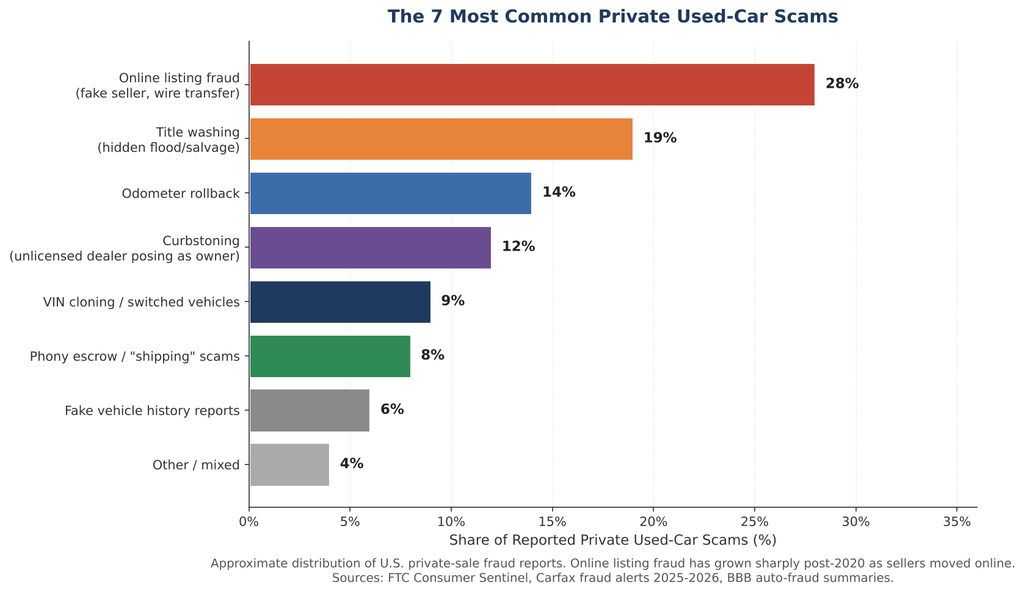
Online listing fraud is now the single largest category — roughly 28% of reported private-sale fraud in recent years. The scam works like this: a thief creates a listing with a too-good-to-be-true price, uses stolen photos from a legitimate listing (often from another state), claims to be out of town (military deployment, “moving urgently”), and asks for wire transfer or gift-card payment “for shipping.” There is no car. The money disappears. Carfax’s 2026 online-scam alert notes these scams have grown as more private sales move to Facebook Marketplace, Craigslist, and OfferUp.
Title washing — moving a salvaged, flood-damaged, or junked vehicle through multiple state DMVs to “clean” the brand off the title — accounts for roughly 19% of private-sale fraud. After major hurricanes (Helene, Milton, Debby) and historic flooding events, thousands of totaled vehicles get repaired superficially, retitled in states with weaker branding laws, and resold through private channels. The buyer gets a vehicle that looks clean on paper and in person but has corroded electronics, seized bearings, and a battery pack (for EVs) that was fully submerged.
Odometer rollback (~14%) hasn’t disappeared with digital odometers. Modern tampering requires accessing the vehicle’s ECU with aftermarket tools, but the equipment is cheap and widely available. A 180,000-mile vehicle rolled back to 90,000 can net the fraudster $3,000-$6,000 in extra sale price.
Curbstoning (~12%) is the unlicensed-dealer scam. A curbstoner buys cars at auction, repairs them cheaply, parks them on the street or in parking lots with hand-lettered “FOR SALE” signs, and sells them as if they were the owner. The FTC and most state attorneys general warn against this because curbstoners don’t give the warranty protections required of licensed dealers, often sell vehicles with hidden defects, and leave buyers with no recourse.
VIN cloning / switched vehicles (~9%) involves putting the VIN plate from a legitimate, undamaged vehicle onto a stolen or salvaged vehicle of the same make/model. Buyers who verify only the dash-mounted VIN against the title can be fooled. Cross-checking multiple VIN locations catches most of these.
Phony escrow scams (~8%) involve the “seller” directing the buyer to a fake escrow service (often with a name close to legitimate services like PayPal or Escrow.com). The buyer deposits funds that go directly to the fraudster.
Fake vehicle history reports (~6%) are generated through fraud-ring websites that produce official-looking reports with clean histories for vehicles that actually have major issues. If the seller provides the VHR, assume it’s suspect and pull your own.
The 8-Step Credibility Check
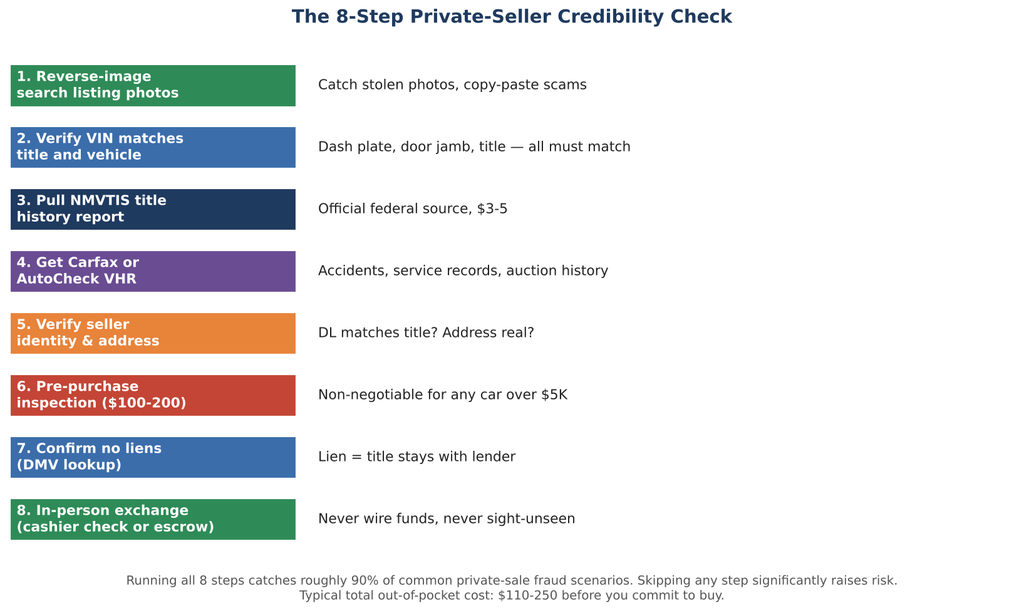
Your defense against all of this is a systematic process. Running these steps costs $110-250 in reports and inspection fees — and catches roughly 90% of common scams before you’ve handed over money.
Step 1: Reverse-Image Search the Listing Photos
Right-click any photo in the listing and use Google Lens, TinEye, or Bing Visual Search. If the same photos appear in listings from other cities, other states, or dealer websites from 2 years ago, you’re looking at online listing fraud. Legitimate sellers take their own photos — typically with inconsistent lighting, slightly messy backgrounds, and specific identifying details like the seller’s own driveway.
Step 2: Verify the VIN Matches Title and Vehicle
Every vehicle has its VIN stamped in at least four places: the driver-side dashboard (visible through the windshield), the driver-side door jamb sticker, a federal safety certification label, and physically stamped on the engine block and/or frame. Crosscheck at least two locations against the title. If the VIN on the dash is a replacement plate (bent edges, rivets that look newer than the car, or non-OEM rivets), that’s a VIN cloning red flag.
The VIN also tells you whether the car matches what the seller claims. The 10th character is the model year. The 11th is the manufacturing plant. Running the VIN through NHTSA’s free VIN decoder confirms year, model, engine, and standard features. A seller claiming a 2022 but whose VIN decodes to 2019 is either confused or lying.
Step 3: Pull the NMVTIS Title History Report
The National Motor Vehicle Title Information System is a federally mandated database every state DMV must report to. It’s the most authoritative source for title brands (salvage, flood, rebuilt, junk), odometer discrepancies, and theft status. It costs $3-5 from any of the approved NMVTIS providers. NMVTIS is the one report you should pull before any other.
Step 4: Get a Carfax or AutoCheck Report
NMVTIS tells you about titles. Carfax ($45) and AutoCheck ($25) add accident reports, service records, auction history, and open recalls. The services overlap but aren’t identical in coverage.
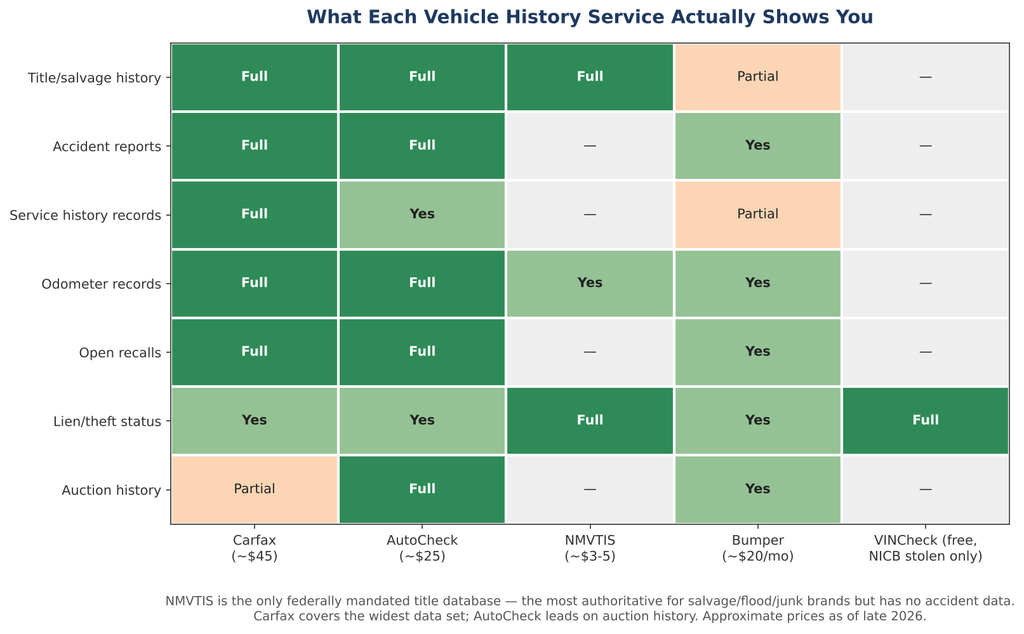
Carfax covers the widest data set overall — strongest on service history records from independent shops and dealer networks that report to them. AutoCheck leads on auction history, which matters because auction appearances often reveal story a seller omits (previous reposs, insurance totals, dealer-to-dealer flips). For high-value purchases, running both is worth the combined cost.
Important caveats: no VHR catches everything. Minor accidents that weren’t reported to insurance don’t show up. Flood damage caught at a non-reporting shop doesn’t show up. Carfax itself warns that about 60% of its reports show no accident history because minor collisions often aren’t reported. A clean Carfax is a positive signal, not a guarantee.
Step 5: Verify the Seller’s Identity and Address
Ask to see the seller’s driver’s license. The name on the DL must match the name on the title. If the seller is selling “for a friend” or “for a family member,” that’s a curbstoning red flag — walk away unless they can produce a signed, notarized power of attorney and documentation of the real owner’s identity.
Note the seller’s address and compare it to the address on the title and registration. Google-maps the address: if it’s a parking lot, storage facility, or vacant property, you’re probably dealing with a curbstoner. Legitimate sellers almost always have you come to their actual home or workplace.
Step 6: Independent Pre-Purchase Inspection
This is the non-negotiable step. For any vehicle purchase over $5,000, pay an independent mechanic $100-200 for a pre-purchase inspection (PPI). Most mobile mechanic services will come to the seller’s location. Many dealerships will do a PPI on used cars for $100-150.
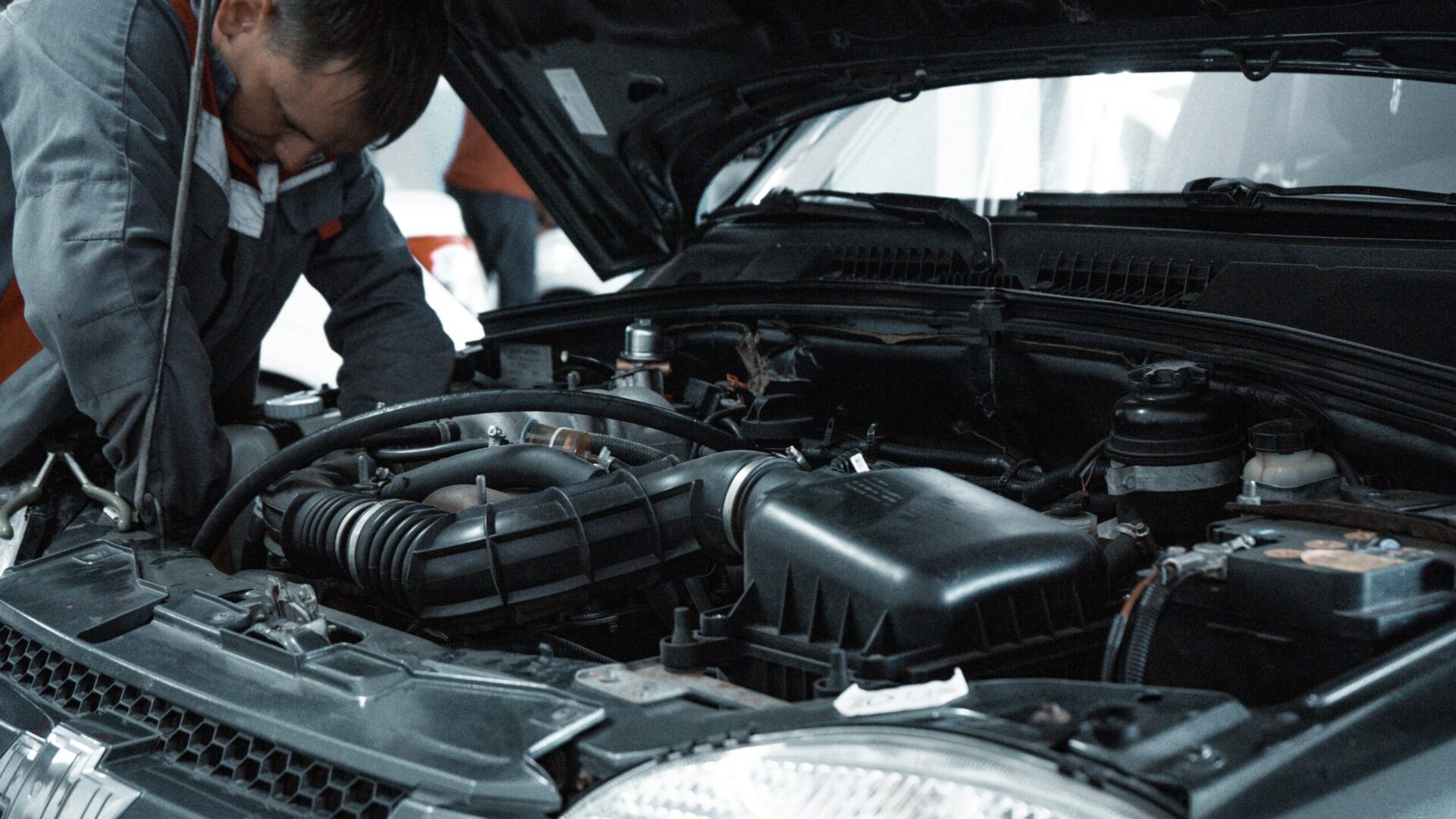
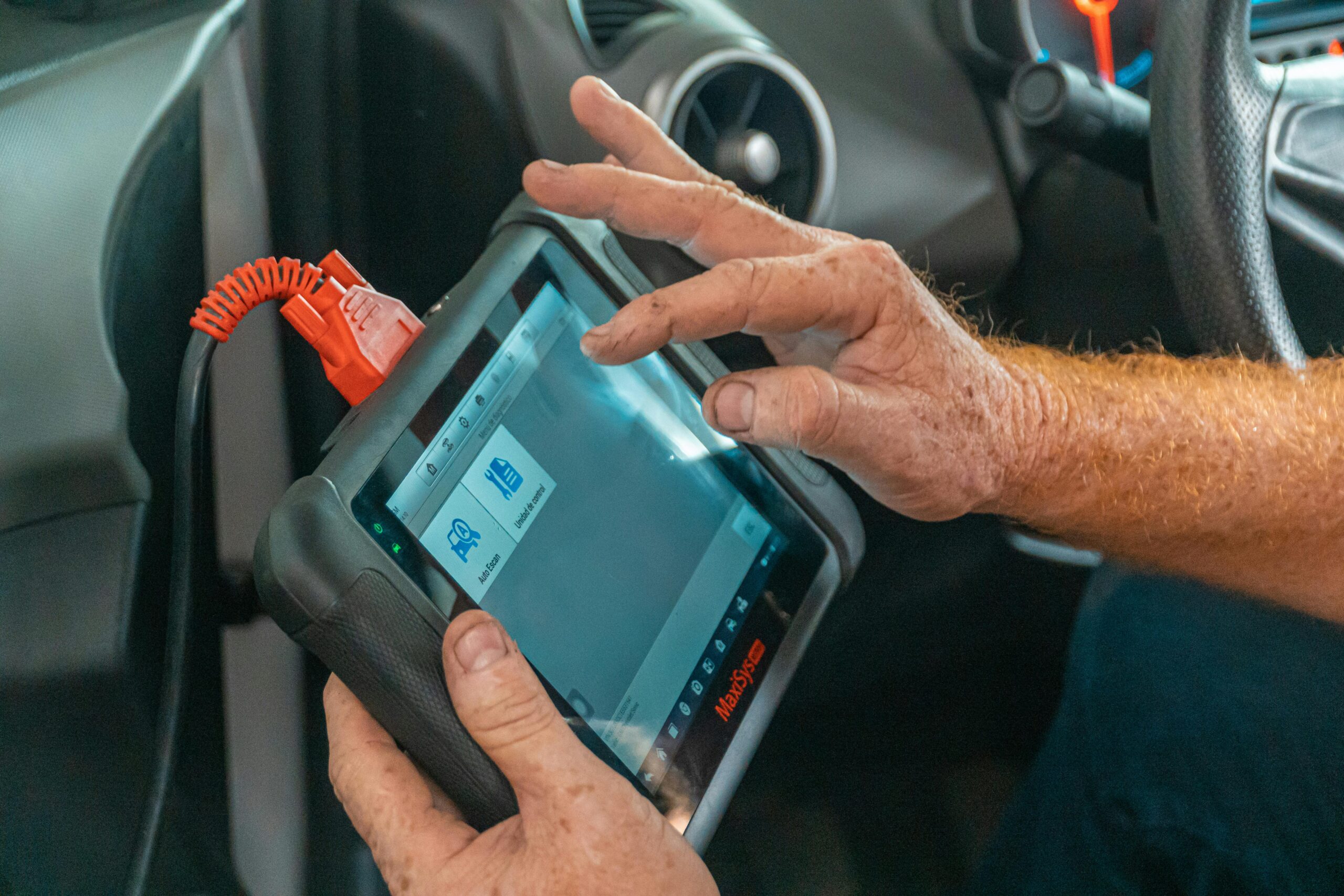
A proper PPI catches: engine and transmission issues not visible to a layperson, hidden accident damage (overspray, mismatched panel gaps, welded repairs), flood indicators (water in the spare tire well, silt in HVAC vents, oxidation on wiring harnesses), brake/suspension/tire wear, and OBD-II codes the seller may have temporarily cleared. If the seller refuses to allow a PPI, that’s the end of the conversation.
Our breakdown of used car reliability by region covers why PPIs are especially important for vehicles from salt-belt or flood-prone states — regional history creates specific damage patterns a general inspector may miss without being told what to look for.
Step 7: Confirm No Open Liens
If the seller still owes money on the car, the lender technically holds the title. A buyer who pays the seller without clearing the lien first can end up with a car they can’t legally transfer. Most state DMVs offer online lien lookups by VIN for $2-5. Some states require you to request this in person.
If there is a lien, the correct process is: buyer pays the lender directly (or deposits funds in escrow), lender releases the title, and the signed-off title transfers to the buyer. Never hand cash to a seller with an active lien and trust them to “pay it off later.”
Step 8: Secure the In-Person Exchange
Final payment should be in-person, at a secure location (many police stations now host “safe exchange zones” for private sales), and use a cashier’s check or certified funds — not personal check, not wire transfer, not cash, and absolutely not gift cards or cryptocurrency. For high-value transactions, legitimate escrow services (Escrow.com is the largest reputable one) hold funds until both parties confirm the transfer.
Signed documents include: the title (seller signs over), a bill of sale (dated, signed by both parties, listing VIN and purchase price), and odometer disclosure (required by federal law for vehicles under 20 years old). Our coverage of how trade-in equity affects loan decisions touches on why documentation matters — every piece of paperwork becomes part of your vehicle’s history and affects what you’ll be able to do with it later.
Red Flags That Should End the Conversation
Beyond the vetting steps, certain seller behaviors should immediately end the conversation:
“I’m deployed / moving abroad / dealing with a divorce” + out-of-state location. Classic online fraud setup. The vehicle doesn’t exist.
Refusal to let you inspect or test drive the vehicle in person. No exceptions. If you can’t see it, you can’t buy it.
Demands for payment before you see the car. Deposits are sometimes reasonable, but should never exceed a few hundred dollars for a car you’ve seen in person, and should never be sent before identity and title verification.
Pressure to wire funds, use gift cards, send cryptocurrency, or use a “shipping escrow” you’ve never heard of. Every one of these is a 2026 scam signature.
Seller address matches multiple other online listings. Curbstoning indicator — same person selling multiple vehicles while claiming each one is “theirs.”
Title that looks photocopied, laminated, or shows signs of alteration. Inspect the physical title: original state titles have security features (watermarks, hologram seals, raised printing). A photocopy claiming to be “a backup” means the real title is in someone else’s name.
Seller won’t allow a pre-purchase inspection. No legitimate seller refuses a buyer-paid PPI on a car they’re trying to sell honestly.
VIN plate looks tampered with or inconsistent across locations. VIN cloning. Walk away.
Vehicle history report shows gaps, out-of-sequence odometer readings, or ownership changes in states known for title laundering (Georgia, Alabama, Tennessee, and Texas have historically been more lenient on branding transfers).
Price is significantly below private-party value from KBB, Edmunds, or Carfax for the same year/model/mileage. If a 2021 Tacoma with 40,000 miles is listed at $18,000 when Kelley Blue Book private-party value is $31,000, something is wrong. Either the car has undisclosed damage, or the listing is fraud.
How Private Sales Fit Into the Bigger Picture
Private-party pricing advantages are real — but only if the time and risk you absorb are smaller than the dollar savings. Our pillar guide on total cost of ownership beyond the purchase price covers the full cost picture, but private-sale decisions should factor in:
Time cost. 20+ hours of listing-sifting, VIN-checking, driving to inspections, and paperwork is real. A buyer who values their time at $30/hour has effectively spent $600 before the first dollar changes hands.
Inspection cost. Budget $100-250 for the full vetting workflow. This is money well spent.
Lost incentives and tax treatment. Dealer purchases qualify for manufacturer incentives, certified pre-owned warranties, and in some states favorable sales tax treatment (trade-in tax credits). Private sales usually don’t.
Financing reality. Private-party loans typically run 1-2 percentage points higher than dealer-arranged financing for the same credit tier. Our coverage of how interest rates impact car loans covers the broader rate climate; the private-sale premium stacks on top.
If you’re flexible on vehicle and the dealer price difference is under $2,000, the time and risk investment often isn’t worth it. If the difference is $3,500+ and you’re set on a specific vehicle a seller is offering, private-party makes sense — if you do the full vetting work. Our breakdown of how seasonality affects used car prices covers when private-party deals get the best (fall and winter) and worst (spring).
If You’re the One Selling: Vetting Buyers
The transaction looks different from the seller’s side, but it carries its own risks. The private-sale buyer who scams the seller usually operates through one of these methods:
Counterfeit cashier’s checks. The buyer presents what looks like a certified bank check for the purchase amount or more (the “overpayment” variant asks the seller to refund the difference via wire). The check appears to clear initially but is flagged as counterfeit days later. The seller is on the hook for the full amount plus whatever they wired back.
The disappearing test drive. A buyer “test drives” the vehicle and doesn’t return. For high-value vehicles, always photocopy the buyer’s driver’s license and keep your own car keys (hand them back only when the test drive concludes). Serious buyers accept this without complaint.
Title transfer fraud. The buyer takes delivery of the vehicle but delays actually transferring the title. If the buyer causes an accident or incurs tolls, tickets, or liability during the gap, the seller (still listed on the title) may be held responsible. Most states offer a “release of liability” form the seller files immediately on sale — file it the day the vehicle leaves your possession.
Payment-method pressure. A buyer insisting on cryptocurrency, Zelle for a large amount, or any non-standard payment method is probably setting up a reversible-transaction scam. Cashier’s checks verified by calling the issuing bank directly (not the number on the check) remain the safest payment method for high-value cars.
Seller-protection steps:
- Meet at a bank branch during business hours, so the cashier’s check can be verified in-person at the issuing institution
- Transfer title and physical keys only after funds are confirmed irrevocable
- File release-of-liability with your state DMV the same day
- Keep a signed, dated bill of sale with buyer’s full name, address, DL number, VIN, purchase price, and both signatures
- Remove license plates before handing over the vehicle (in most states, plates stay with the seller)
Bottom Line
Private-party car sales remain the most cost-effective way to buy a used vehicle — but only for buyers willing to do the systematic verification work. The $2,500-$4,500 price advantage over a dealer is partly real value, partly compensation for the risk the buyer absorbs. Buyers who skip the vetting steps pay the dealer-equivalent price in discovered defects, fraud losses, or title headaches down the road.
The 8-step process — reverse-image search, VIN verification, NMVTIS and Carfax/AutoCheck reports, seller identity check, independent inspection, lien verification, and secure in-person exchange — catches the vast majority of common scams for $110-250 in out-of-pocket cost. That’s the baseline for any serious private purchase.
For sellers, the risks are different but equally real. Counterfeit payments, title-transfer gaps, and test-drive fraud all require different defenses than the buyer-side scams. The common thread on both sides: verify everything that can be verified before money or keys change hands, use secure meeting locations and verified payment methods, and walk away from any transaction where the other party refuses to engage with standard verification steps.
The good deal exists in private sales. The scam exists too. The difference between walking away with a bargain and walking away burned is almost always the quality of the vetting process the buyer or seller ran before committing. Spend the $150 and the afternoon. It’s the cheapest insurance you’ll ever buy.
Sources and Further Reading
Stacker / The Zebra — Why Used-Car Scams Are Harder to Spot Todayler is trustworthy and honest about the item’s condition and history. In this article, we’ll explore the essential steps to evaluate seller credibility in private-party sales, empowering you to make informed and secure purchases.
National Motor Vehicle Title Information System (NMVTIS)
FTC — Buying a Used Car From a Dealer or Private Seller
Carfax — Alerts Consumers to Growing Online Car Sales Scams
Carfax — Flood-Damaged Vehicles Surge in Used Market
Caribou — Avoid These 7 Used Car Buying Scams in 2026
eTags — Used Car Buying Scams Guide
CarWhere — Curbstoning: The Illegal Car-Flipping Scam
Bumper — Best Vehicle History Report 2026: Carfax vs. AutoCheck vs. Bumper

















Leave a Reply
You must be logged in to post a comment.