





















The right-to-repair fight is entering its fifteenth year as a formal regulatory question in the United States, and the ground has shifted several times. What started in Massachusetts in 2012 as a simple proposition — that owners and independent shops should be able to access the same diagnostic information dealerships get — has expanded into a battle over telematics data, software-locked features, EV service standards, and the business model automakers increasingly depend on. The REPAIR Act (HR 1566) advanced out of House subcommittee in February 2026, Maine’s 2023 law officially took effect in January 2025 but is stalled in implementation, and a growing number of states have active proposals.
For individual car owners, the practical question is what any of this actually changes about their next repair bill. The honest answer is: more than people realize on some things, less than they’d like on others, and nothing at all on the newest frontier — software features that are physically present in the vehicle but kept locked behind monthly subscriptions. This article walks through the legal landscape, what rights owners actually have in 2026, which states lead and which lag, and the next battle that current law doesn’t touch.
The adjacent question of which parts to actually install — OEM, OE-equivalent, quality aftermarket, or economy — is covered in the OEM vs Aftermarket Parts article. This piece focuses on the legal access question that determines whether a consumer or independent shop can even get to the point of installing anything.
What Right-to-Repair Actually Means in Vehicles
At its core, automotive right-to-repair is about information and access, not parts. The question is whether an independent mechanic working on your 2024 Honda CR-V has the same diagnostic tools, repair procedures, software capability, and parts availability that your Honda dealership does. If the answer is no, the dealership has an information monopoly that forces owners toward dealer service whether or not it’s actually better or cheaper.
The practical categories at stake are:
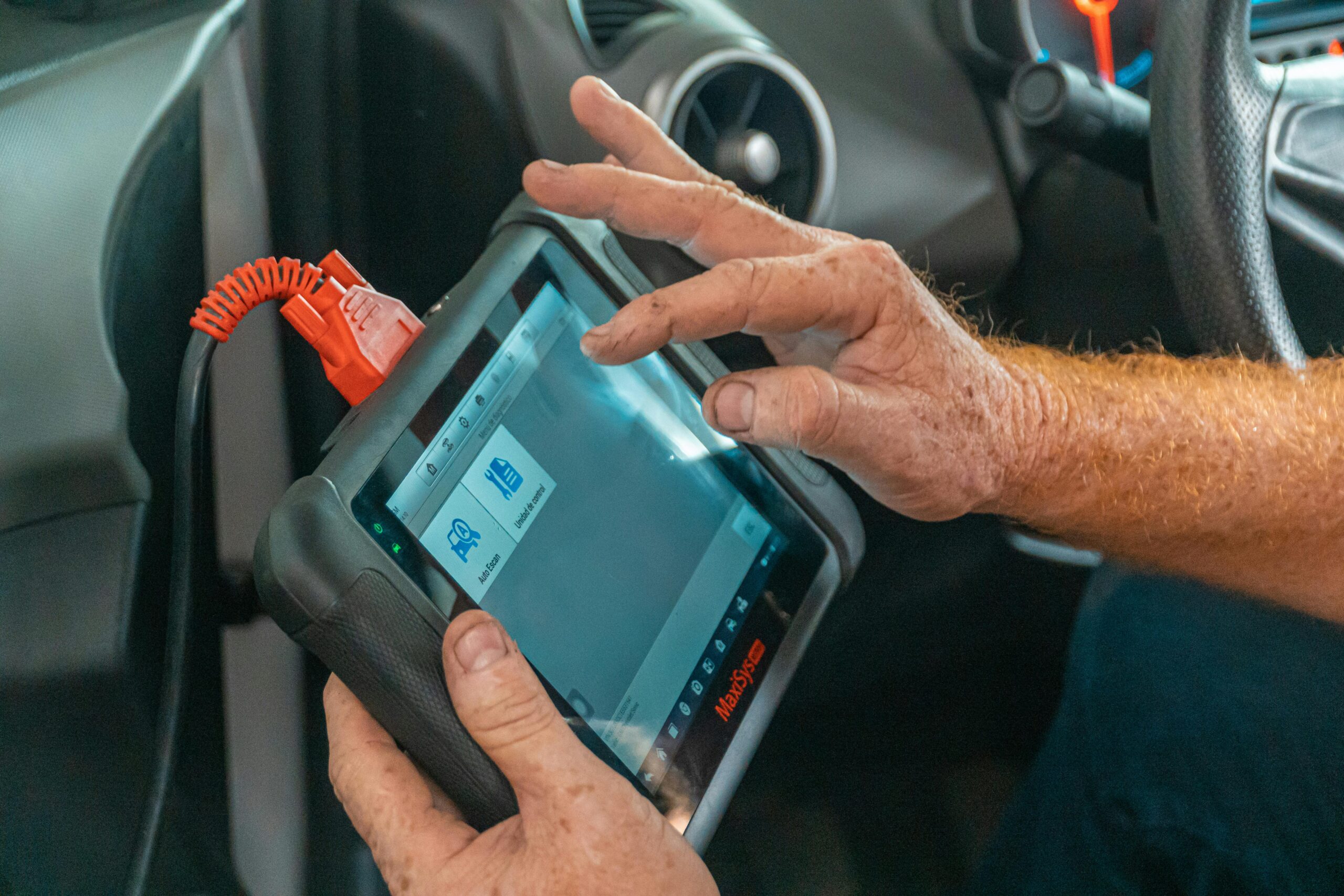
- Diagnostic trouble codes (DTCs) — the fault codes a vehicle generates when something goes wrong, read through the OBD-II port under the dashboard. Most of these are standardized, but automakers have increasingly added proprietary codes that only dealer-authorized tools can interpret.
- Repair procedures and specifications — the step-by-step instructions, torque values, wiring diagrams, and TSBs (technical service bulletins) that make a proper repair possible. Automakers typically publish these only to subscribing dealers and certified networks.
- Scan tool and software compatibility — modern repairs often require programming new modules, resetting learned values, or matching components to the vehicle’s VIN. Independent shops need either the dealer tool or aftermarket tools licensed to perform these functions.
- Replacement parts — covered in detail in the OEM vs Aftermarket Parts article; the question for right-to-repair is whether automakers restrict supply or add artificial barriers.
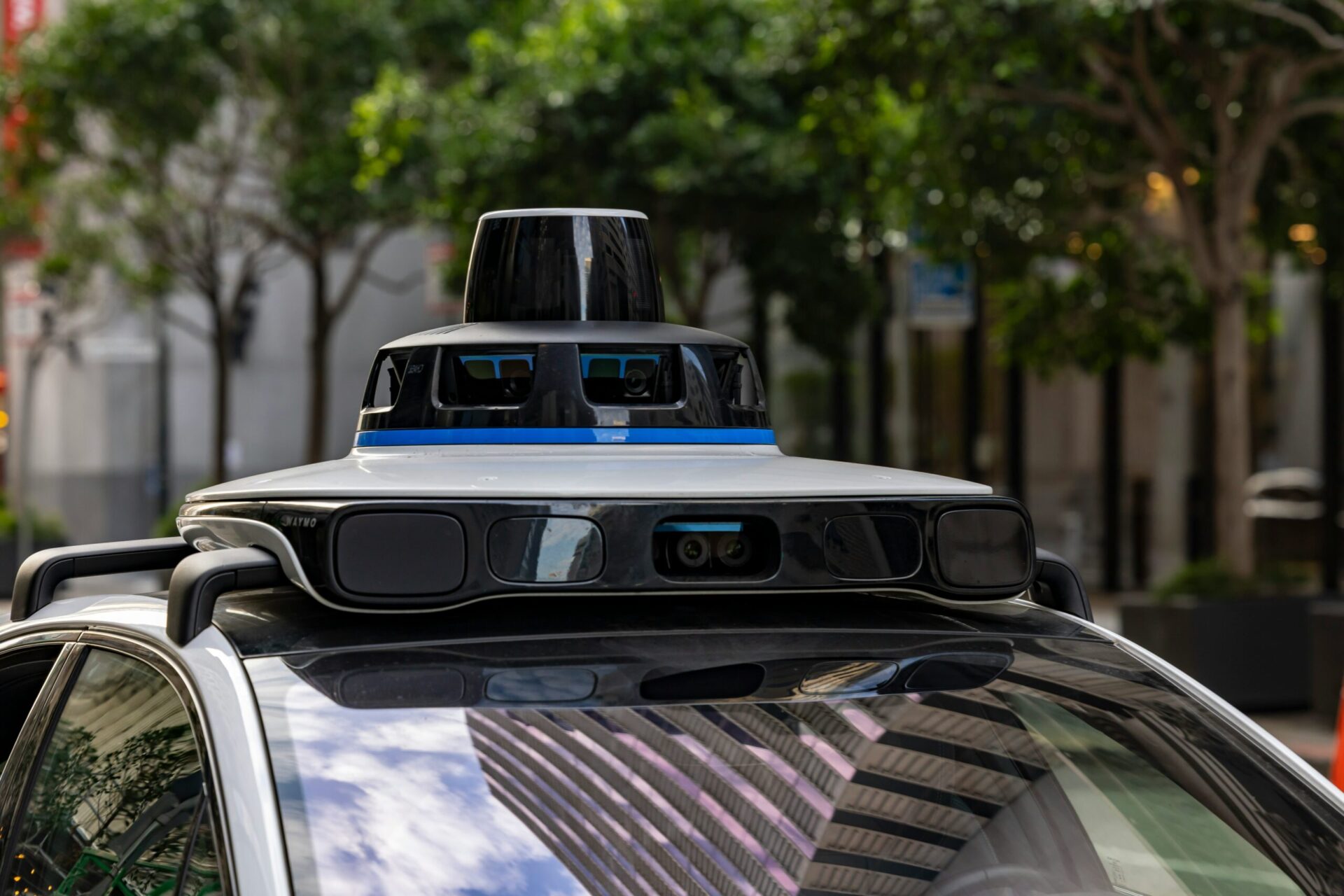
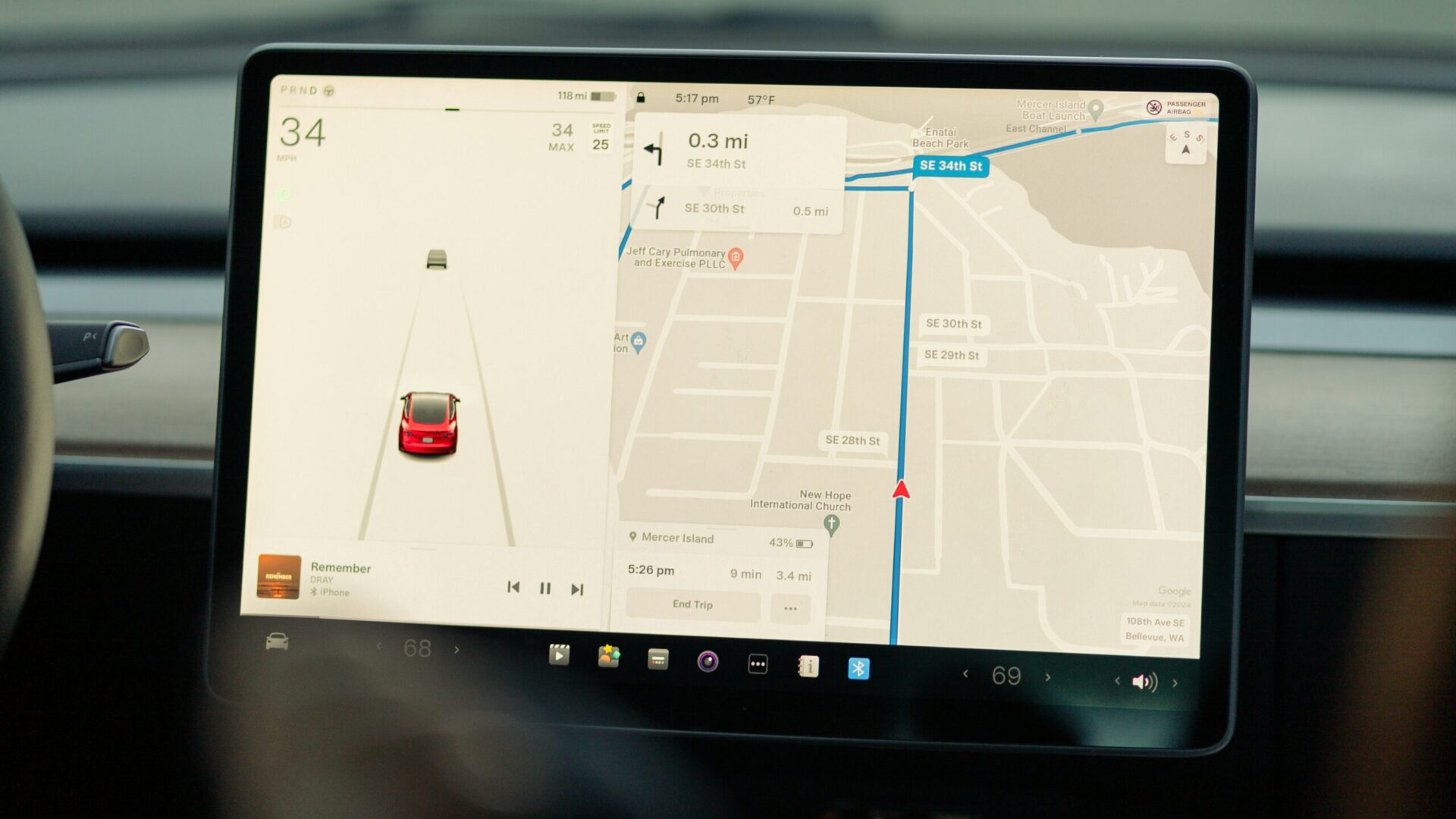
- Telematics data — the newest battleground. Modern vehicles transmit operational data to the manufacturer; independent shops have argued they need the same real-time data stream to diagnose and repair modern vehicles.
- Specialty tools — scan tools, programming interfaces, calibration rigs. Automakers can price these to be effectively unavailable to independent shops ($15,000+ for a full suite is common).
Louis Rossmann, the electronics repair advocate who became a public face of the broader right-to-repair movement, has made the point that the fight is about access rights, not quality standards. Right-to-repair doesn’t guarantee that an independent shop will do a better job than a dealer — it just makes the competition legal.
The Legal Landscape: Where Laws Actually Exist
The US has no federal right-to-repair law for vehicles as of late 2026. The landscape is state-by-state, with a patchwork that gives owners in a few states real leverage and owners in most states only the leverage that the industry has voluntarily conceded.
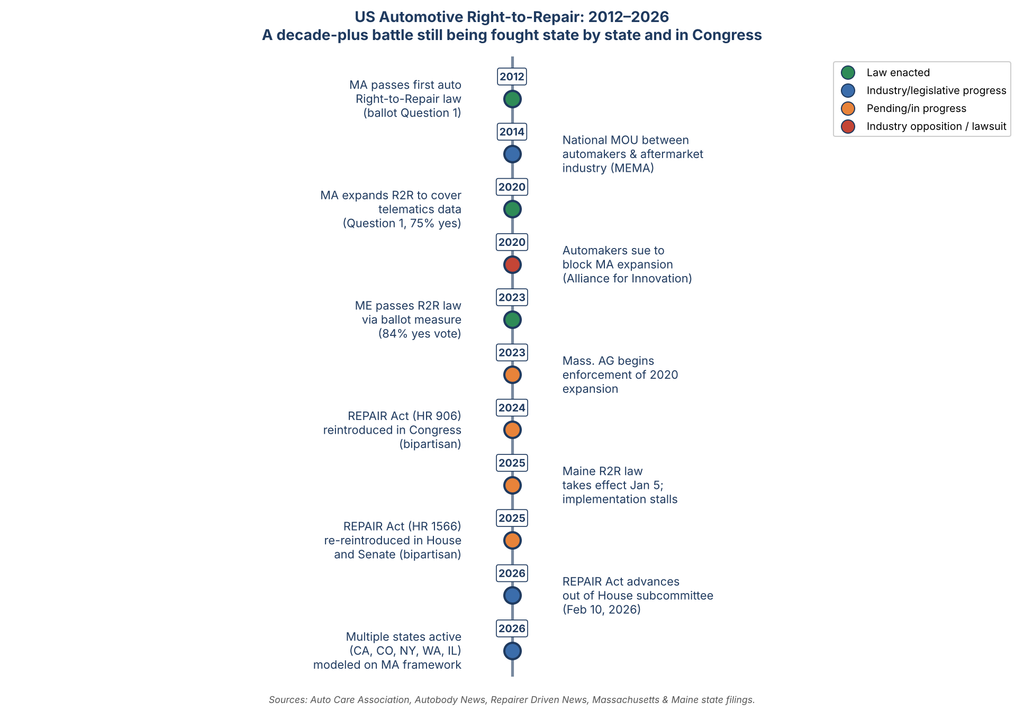
Massachusetts is the foundational case. In 2012, voters passed Question 1 by a wide margin, requiring automakers selling in the state to provide the same diagnostic and repair information to independent shops that they provided to franchised dealers. The law was significant enough that automakers chose to comply nationally rather than build state-specific information systems, effectively making Massachusetts’s law a de facto national standard for the categories it covered.
In 2020, Massachusetts voters passed a second Question 1 — this one with 75% support — expanding the earlier law to cover telematics data. The 2020 expansion required automakers to provide independent shops with access to real-time mechanical data transmitted wirelessly from vehicles, not just the historical OBD-II information. Automakers immediately sued in federal court, arguing that the expansion conflicted with federal safety and cybersecurity standards and should be preempted. The lawsuit dragged on for several years, with Massachusetts delaying enforcement; the Massachusetts Attorney General began enforcing the 2020 law in 2023, and in 2025 a federal judge largely dismissed the automakers’ preemption challenge.
Maine followed Massachusetts’s model, passing its own right-to-repair law via a 2023 ballot measure with 84% voter approval. The law was modeled closely on the Massachusetts 2020 expansion. It technically took effect January 5, 2025, but implementation has stalled because the law requires an independent entity to administer the data-access platform — an entity that has not yet been established. The Maine legislature reconvened in January 2026 to amend portions of the telematics access law and resolve the implementation blocks.
Several other states have active proposals modeled on the Massachusetts framework. California, Colorado, New York, Washington, and Illinois have all introduced some form of vehicle right-to-repair legislation in 2025 or 2026, with varying scope and enforcement mechanisms. None has passed as of November 2026, but the direction of legislative momentum is clear.
At the federal level, the REPAIR Act (HR 1566) has been introduced in each of the last three Congresses and has steadily gained support. The current version, reintroduced in February 2025, advanced out of the House Energy and Commerce Subcommittee on Commerce, Manufacturing, and Trade in February 2026 — the furthest any federal automotive right-to-repair bill has progressed. Supporters are pushing to include its provisions in the Surface Transportation Reauthorization Act that Congress must pass by late 2026. The bill has bipartisan sponsorship, with Rep. Neal Dunn (R-FL) as the lead author and cosponsors from both parties. A competing proposal, the SAFE Repair Act backed by vehicle manufacturers, emphasizes safety oversight and consumer protection in ways critics argue would preserve most dealer-side information advantages.
What These Laws Actually Cover (and What They Don’t)
The practical question for an owner facing a repair decision is what specific access the law gives them in their state. The answer is less complete than the headlines suggest.
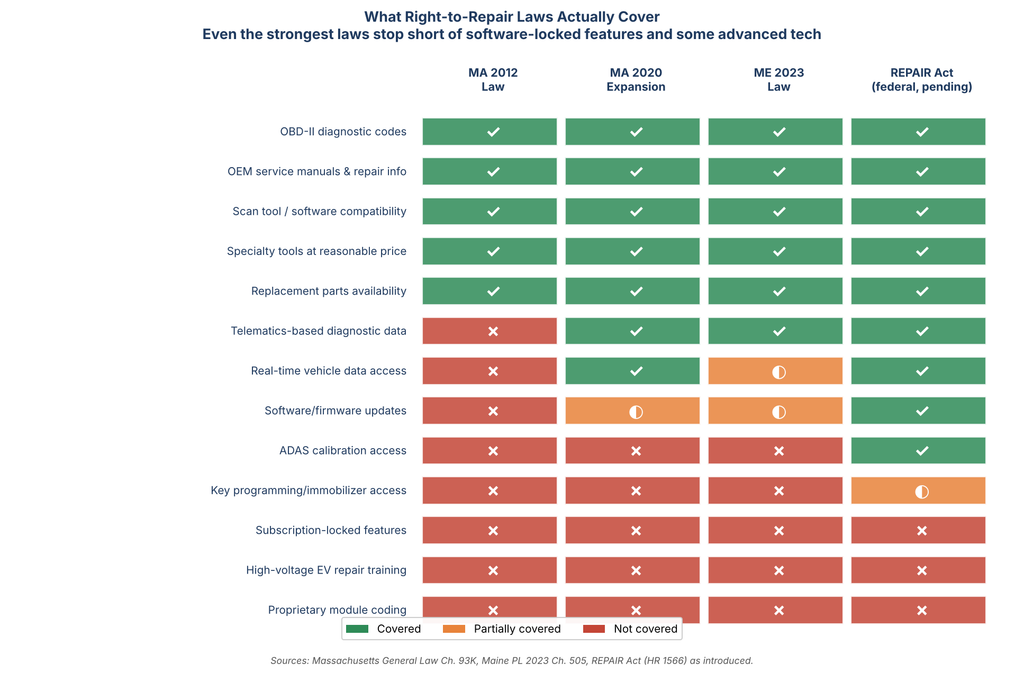
The universally covered categories — covered under every version of right-to-repair law passed or proposed — are OBD-II diagnostic code access, OEM service manuals, scan tool and software compatibility requirements, and specialty tool availability at reasonable commercial terms. These have been the foundation since 2012 and are no longer seriously contested.
The telematics expansion — real-time mechanical data transmitted wirelessly from the vehicle — is covered under the Massachusetts 2020 law, the Maine 2023 law, and the federal REPAIR Act. It is not covered under the original Massachusetts 2012 law or in states with no right-to-repair statute. This category is where the industry has pushed back hardest because telematics data is also commercially valuable, and the connected-car ecosystem described in the Automakers Are Collecting Your Telematics Data article depends on automakers controlling access.
Software and firmware updates are only partially covered under current laws. Automakers can still restrict access to the OTA update ecosystem described in the How OTA Updates Change Vehicle Performance article. The REPAIR Act’s language covers software access in principle but leaves significant implementation discretion to federal regulators.
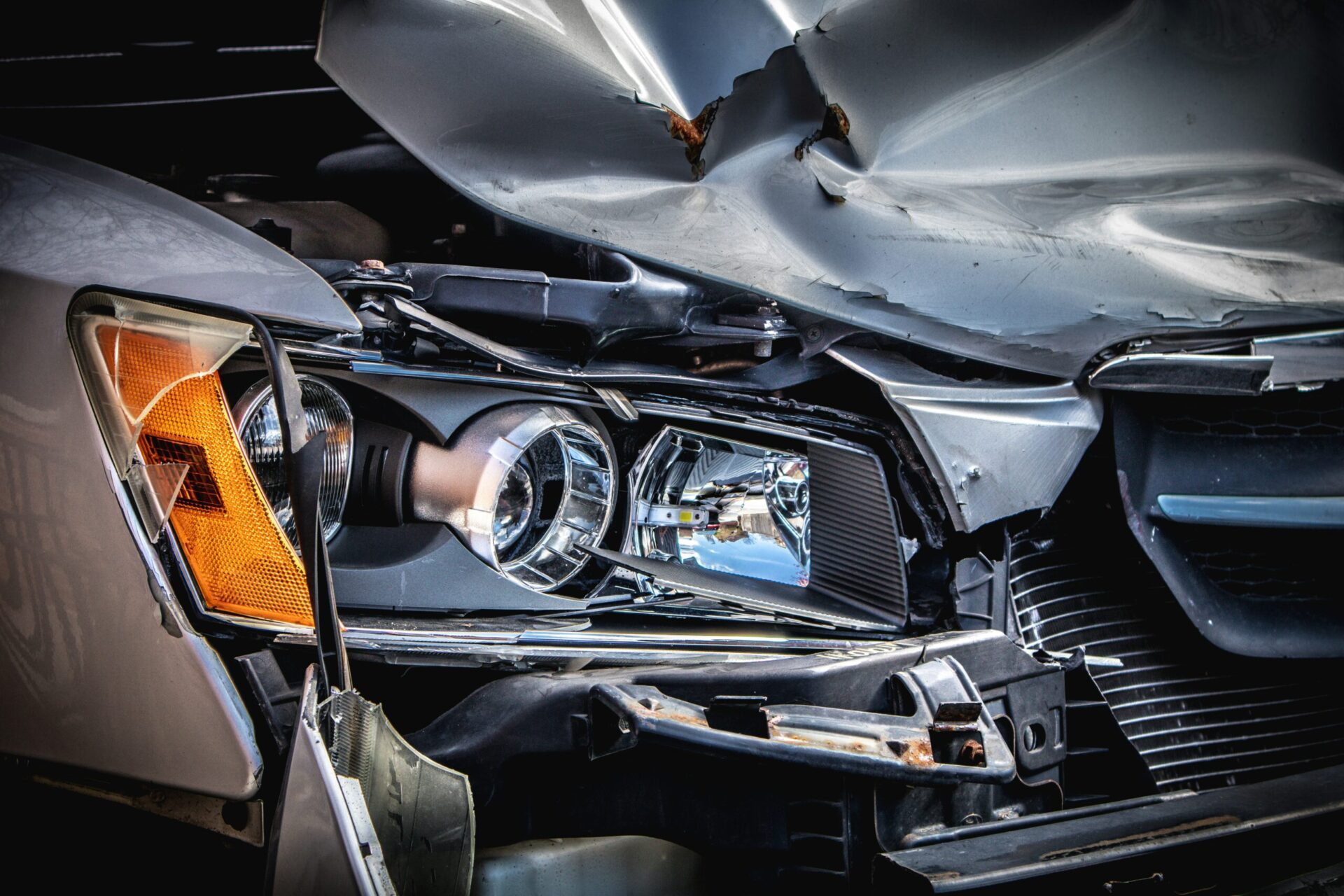
ADAS (advanced driver-assistance system) calibration access — the increasingly critical capability needed to properly repair modern vehicles with lane-keeping cameras, adaptive cruise control radars, and parking sensors — is covered only under the pending federal REPAIR Act, not under any state law currently in effect. For independent collision shops repairing late-model vehicles, this remains a significant gap. Many have to either send vehicles to dealers for calibration or purchase manufacturer-specific calibration equipment at substantial cost.
Key programming and immobilizer access is covered only partially even under the REPAIR Act. Automakers have long argued that providing programming access to anyone outside their authorized network creates security risks (stolen vehicle re-programming, specifically). The industry has largely won this argument, though the patchwork limits legitimate repair in some cases.
Subscription-locked features are not covered under any right-to-repair law passed or proposed. This is the frontier where current legislation stops.
High-voltage EV repair training and certification is not addressed by right-to-repair laws at all. A shop with physical access to repair information still needs trained technicians and specific safety protocols to work on EV battery systems — a gap that the market is slowly filling through independent training programs but that right-to-repair legislation has not addressed.
Practical Owner Rights in 2026
With the legal landscape grounded, the practical question becomes what owners can actually do today. The answer varies by state but has improved substantially from the 2010 baseline.
Owners anywhere in the US can request OBD-II diagnostic code readouts from independent shops using standard scan tools. They can refuse dealer service recommendations and get second opinions from independent mechanics with full access to the trouble codes. They can purchase repair manuals and service information — either directly from the manufacturer (many sell subscriptions to the information portals Toyota TIS, Honda SIS, GM ACDelco TDS, Ford OASIS, and others) or through third-party aggregators like ALLDATA and Mitchell 1.
Owners in Massachusetts and Maine have additional rights to telematics data access, though Maine’s implementation gap means the right is theoretical in practice until the administering entity is established. Owners in states with no right-to-repair law still benefit from the industry’s largely national compliance posture, but have less leverage when disputes arise.
A few specific practical tips based on the current legal landscape:
- For routine maintenance, independent shops have had full access to information since the 2014 industry MOU; dealer-only claims for routine service are rarely warranted.
- For diagnostic work on persistent check-engine codes, request specific diagnostic trouble codes from any shop. If a shop says they “can’t read” certain codes on your vehicle, that’s a signal to seek a different shop with better scan tool coverage, not evidence that dealer service is required.
- For software updates and reprogramming, dealer service is often still the practical option because independent shops’ investment in brand-specific programming tools varies. Massachusetts and Maine residents have additional legal grounds to demand independent access; residents elsewhere may have to accept the dealer requirement.
- For ADAS calibration after collision repair, calibration access is still not guaranteed under state law. The OEM vs Aftermarket Parts article covers the related question of whether parts choices affect calibration requirements.
- For keys and immobilizer work, most owners will still need dealer service because key programming access is restricted on security grounds across most jurisdictions.
- For EV-specific repairs, availability of independent repair capability varies dramatically by brand, with Tesla, Rivian, and Lucid having the most limited independent networks.
If a dealer or shop tells you something requires dealer-only service and you suspect it doesn’t, the first check is to look up the vehicle’s specific procedure in ALLDATA, Mitchell 1, or the manufacturer’s own subscriber portal. The second check is to contact a different independent shop that specializes in your brand.
The New Frontier: Software-Locked Features
The current right-to-repair debate is, in important ways, already behind the curve. The ground has shifted from access to information and parts to access to features the owner physically owns but cannot use. This is the frontier where no existing or proposed right-to-repair law provides protection.

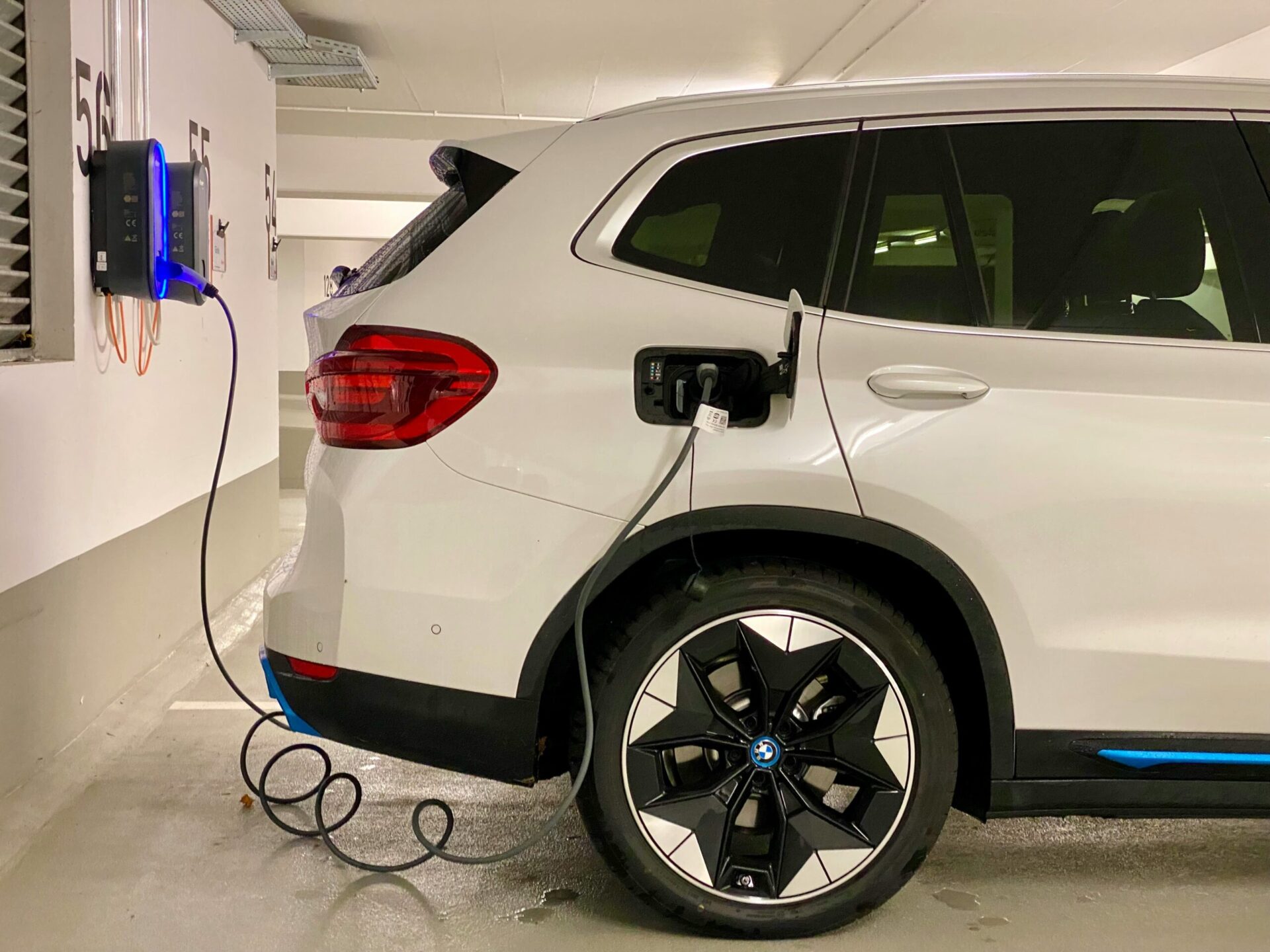
BMW’s heated-seat subscription is the best-known cautionary tale. From 2020 to 2023, BMW offered heated seats, heated steering wheels, and other features as monthly subscriptions in several markets. The hardware was present in the vehicle — the seat heaters were installed and wired — but activation required a $18/month payment. Consumer backlash was intense, and BMW canceled the heated-seat and heated-steering-wheel subscriptions in 2023, describing them as having had “low acceptance rates.” The company continues subscription models for other features, including Driving Assistant Plus at $35/month.
Tesla has been the most sophisticated practitioner of software-locked features for over a decade. Acceleration Boost on the Model Y Dual Motor is a $2,000 one-time software unlock that removes a software-imposed 0-60 limit on the hardware the car already has. Full Self-Driving (Supervised) ranges from $8,000 one-time to $99/month and consists almost entirely of software features on the same hardware every Tesla carries. Premium Connectivity at $10/month enables streaming, live traffic, and satellite imagery that the vehicle’s cellular modem can technically deliver without subscription.
Mercedes-Benz EQS owners can purchase a $575/year subscription to unlock an extra 6 degrees of rear-wheel steering that the vehicle’s physical steering mechanism is capable of but software-limited to 4.5 degrees without the subscription.
GM’s Super Cruise hands-free driving system is free for the first 3 years on supporting vehicles, after which activation requires a $25/month subscription. The sensors, cameras, and processing are all present in the vehicle from day one.
Ford’s BlueCruise follows a similar model — 90 days free, then $75/month or $800/year.
Toyota’s remote-start subscription, which became briefly notorious when it emerged that Toyota had started charging subscription fees for a feature previously included in the vehicle purchase, charges $80-150/year after the included period ends. The initial inclusion period has ranged from 1 to 10 years depending on model and trim.
Volkswagen’s Car-Net connected services cost $199/year after a 5-year free period. Rivian’s Connect+ charges $15/month for streaming, navigation, and other features.
The subscription model has two specific implications for right-to-repair. First, even if you have the right to repair the vehicle, you may not have the right to activate features on hardware you technically own. Second, when a vehicle changes ownership, subscriptions typically do not transfer — the second owner has to subscribe separately to enable features the first owner was paying for.
The successes against subscription models have come from consumer backlash, not law. BMW killed heated-seat subscriptions because customers refused to buy them, not because any legislation required unbundling. The REPAIR Act in its current form does not address subscription-locked features. State laws similarly leave the question unaddressed. The right-to-repair movement has begun pushing for explicit coverage of software activation rights, but no US jurisdiction currently requires automakers to provide owners access to hardware they paid for.
The European Union, by contrast, is moving toward requirements that paid-for hardware must be fully functional without additional ongoing payment. Right-to-repair advocates in the US are watching this closely as a possible model for future federal legislation.
Who Opposes Right-to-Repair and Why
Understanding the opposition helps explain why progress has been uneven. The primary institutional opponents are the Alliance for Automotive Innovation (formerly Auto Alliance, representing most major automakers) and the National Automobile Dealers Association (NADA, representing franchised dealers). Their arguments have focused on three themes.
Safety and cybersecurity: automakers argue that providing broader access to vehicle systems — particularly real-time telematics and software programming — creates security vulnerabilities that bad actors could exploit. This was the central argument in the federal lawsuit challenging the Massachusetts 2020 expansion; the court largely rejected it, though the question continues to appear in debates over the REPAIR Act.
Investment protection: automakers and tier-one suppliers invest billions in developing diagnostic systems, software, and training programs. Requiring them to share these at “reasonable” commercial terms (as the laws require) creates disputes over what counts as reasonable. Industry argues that aggressive right-to-repair requirements amount to subsidizing competitors at the automaker’s expense.
Franchise system economics: dealers argue that their investment in facilities, training, and brand compliance is predicated on being the primary post-sale touchpoint for owners. Right-to-repair weakens that economic model by enabling independent competition. NADA has consistently opposed the REPAIR Act on these grounds.
The counter-arguments from the right-to-repair coalition — including the Auto Care Association, ASA (Automotive Service Association), MEMA (Motor and Equipment Manufacturers Association), and consumer groups — emphasize that information and tool access do not require sharing proprietary hardware designs, that security risks are better addressed through specific protocols than through access restrictions, and that dealer franchise economics are not a legitimate reason to limit consumer choice.
The 2014 MOU between automakers and the aftermarket industry was an attempt to resolve the fight through voluntary agreement rather than legislation. It worked for several years but began breaking down as telematics data and software-locked features emerged as issues the original agreement didn’t address. The current legislative push reflects the view that voluntary agreements are insufficient for the newer categories.
How This Affects Specific Repair Scenarios
The practical impact of all this law and politics varies significantly by what the vehicle actually needs. A few scenarios that illustrate the range:
A 2015 Honda Civic with a transmission problem can be diagnosed and repaired by nearly any competent independent shop in any state. The diagnostic codes are standard, the service procedures are widely available through ALLDATA or Honda’s subscriber portal, and parts are available from multiple sources. Right-to-repair here is essentially a solved problem.
A 2024 Toyota RAV4 with an ADAS calibration need after windshield replacement faces a harder path. The calibration procedure requires specific equipment and software that many independent shops don’t have. Toyota’s subscriber portal provides the procedure to anyone who subscribes, but the equipment cost is high enough that many shops send the vehicle to a dealer for calibration. The REPAIR Act would address this; current state laws generally don’t.
A 2026 Ford Mustang Mach-E with a check-engine light and persistent fault benefits from Ford’s relatively open repair ecosystem — Ford publishes most service information through its subscriber system, and the vehicle’s software architecture is less locked down than some competitors. An independent shop with current tooling can typically address the issue.
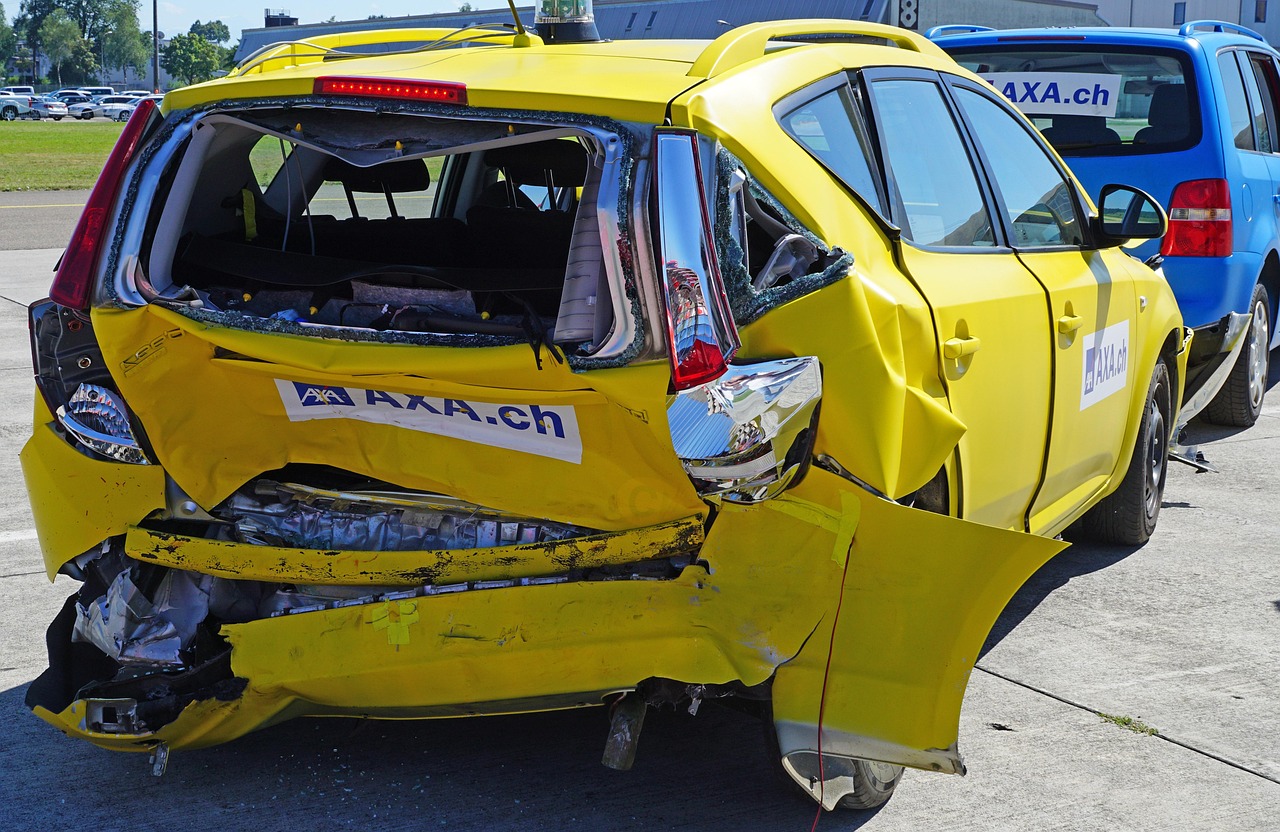
A 2025 Tesla Model 3 with a damaged side mirror faces the hardest scenario. Tesla parts distribution to independent shops has historically been limited, Tesla’s programming tools are brand-exclusive, and Tesla’s own service network has faced capacity issues. Independent Tesla specialists exist but are concentrated in major metros. Right-to-repair legislation would help but has not yet forced Tesla into fuller independent access.
A 2026 vehicle with a software-locked feature the previous owner was paying for is simply out of luck under current law. If you bought a used Tesla where the previous owner had Full Self-Driving, you cannot inherit it; you must subscribe or purchase it again. No right-to-repair law currently in effect or proposed addresses this.
The How to Interpret IIHS and NHTSA Safety Ratings article covers the related safety considerations that intersect with repair access, particularly for collision work on modern vehicles.
The Takeaway
Right-to-repair for vehicles has made real progress since 2012 but has not fully solved the problem it set out to address. For diagnostic information, repair procedures, and parts availability, the industry has largely moved to broad access — more because of Massachusetts’s 2012 law and the 2014 MOU than because of broad state-by-state coverage. For telematics data, Massachusetts and Maine have led while most states have not followed. For ADAS calibration, software-locked features, and EV-specific repair capabilities, the current legal framework provides little protection.
The REPAIR Act’s advance through House subcommittee in February 2026 is the most significant federal movement in the history of the movement. Whether it passes in 2026, 2027, or beyond will substantially determine how connected and electric vehicles get serviced over the next decade. Even if it passes, software-locked features will remain a frontier that current legislative text does not cover.
For individual owners, the practical implications of all this are mostly positive but uneven. Most repairs on most vehicles can be done at independent shops with full information access, often at significant savings versus dealer rates. Some repairs on some vehicles — particularly ADAS work, EV high-voltage work, and anything involving software activation — still require dealer service or specialty independent shops. Knowing which category your repair falls into, and which state you live in, determines how much right-to-repair actually helps.
The subscription-feature question is likely to become the next decade’s version of the diagnostic-access question — a battle over whether owning a vehicle actually means owning its full capabilities. The outcome is not yet determined. The owners paying attention and pushing back on BMW-style subscription models are shaping it.
External Sources
Rossmann Repair Group — Right to Repair Advocacy
Autobody News — Right to Repair in 2026: Where Laws, Courts, and Automakers Stand
Auto Care Association — REPAIR Act Advances to Full Committee
Collision Week — REPAIR Act Advances House Subcommittee
Common Wealth Beacon — After 2020 Ballot Question, Right to Repair Still Tied Up in Court
Repairer Driven News — Mass. Right to Repair Advocates on Federal Lawsuit
The Drive — Bipartisan Coalition Reintroduces Federal Right to Repair Bill
Fleet Maintenance — House Committee Advances Motor Vehicle Modernization Act
Edmunds — BMW Relents on Heated Seat Subscription
The Drive — BMW Giving Up on Heated Seat Subscriptions
Motor1 — BMW Heated Seat Subscription Dead Due to Low Acceptance


























Leave a Reply
You must be logged in to post a comment.