



















A new car in 2015 was effectively a rolling network of 70 to 150 small computers, each handling its own task — one for the engine, another for the transmission, another for each airbag, another for the climate controls, another for the power windows. Each was built by a different supplier, ran different software, and communicated with the others over a web of CAN bus wiring that could stretch to two miles inside a single vehicle. The whole thing worked, but it was impossible to update, expensive to repair, and architecturally incompatible with the direction the industry was heading.
A new car in 2026 looks fundamentally different under the skin. The Rivian R1S Generation 2 ships with 7 electronic control units. The Tesla Model 3’s wiring harness is roughly half the length of a comparable legacy vehicle. BMW’s Neue Klasse launching in 2026 runs on a single operating system called OS X. BYD’s Xuanji architecture consolidates what used to be dozens of discrete controllers into a handful of high-powered compute nodes. This is the shift toward centralized computing — and it is quietly the single biggest technical change in vehicles since the move from carburetors to fuel injection.
Everything else people care about in modern cars — over-the-air updates, software subscriptions, advanced driver assistance, telematics data collection, vehicle longevity questions — is downstream of this one architectural change. This article is the hub piece that explains the shift and connects to the other articles in this series that cover each of its consequences. It’s not the privacy piece, the subscription piece, or the OTA piece — it’s the piece that explains why all of those exist.
What “Centralized Computing” Actually Means
Three generations of vehicle electrical and electronic (E/E) architecture have coexisted on dealership lots in recent years, and understanding the differences is the starting point for making sense of everything else.
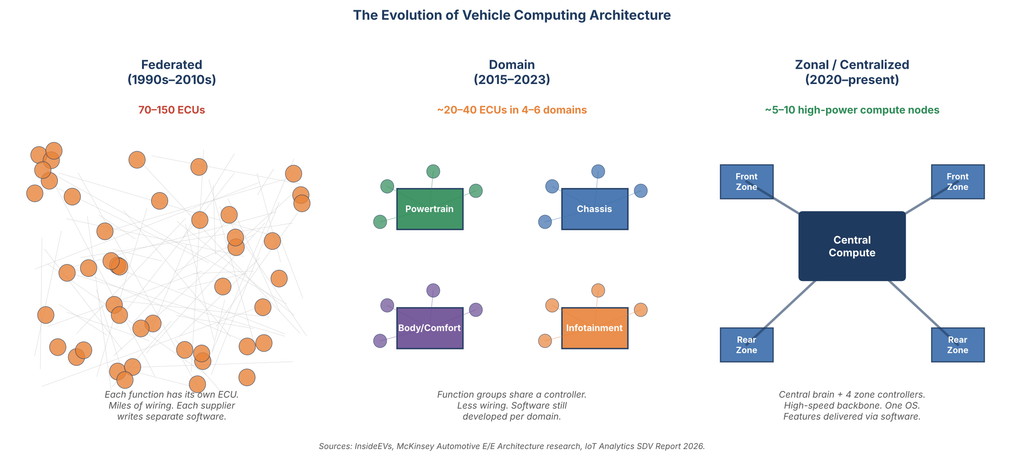
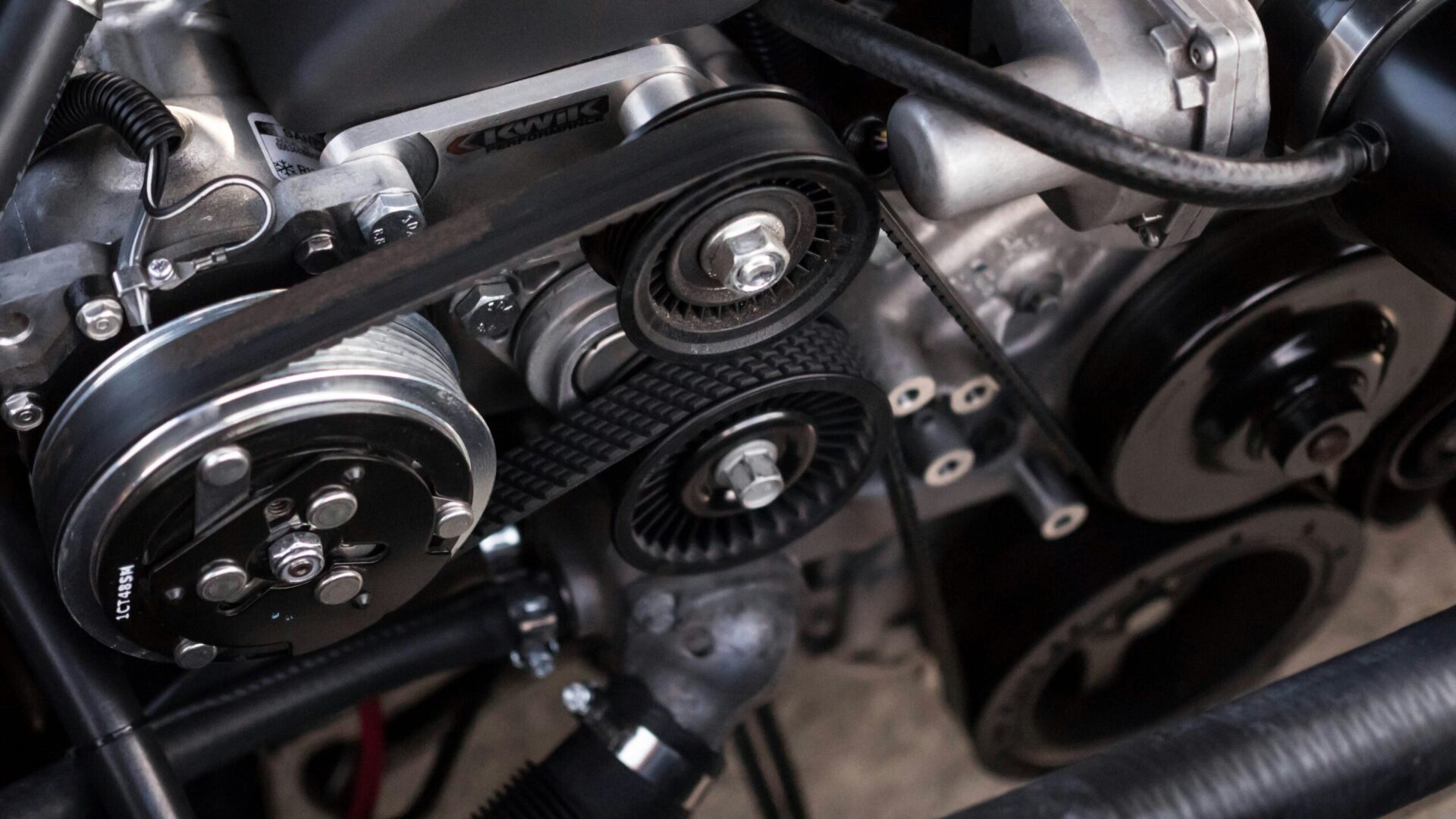
Federated architecture is what nearly every vehicle built between the late 1990s and the mid-2010s used. Each function — engine management, transmission control, anti-lock brakes, airbag deployment, infotainment, power seats, each individual lighting module — got its own dedicated electronic control unit. A fully-loaded luxury sedan in 2015 commonly had 100+ ECUs, each from a different supplier, each with its own processor, memory, and firmware. They talked to each other over various bus protocols (CAN, LIN, FlexRay, MOST), often running at modest speeds. The wiring harness required to connect them all could weigh 70+ pounds and cost $500+ in raw materials alone.
Domain architecture was the first consolidation step, emerging roughly 2015-2023. Related functions were grouped into “domains” — typically powertrain, chassis, body/comfort, and infotainment/connectivity — with each domain managed by a more powerful controller that coordinated the specialized ECUs within it. A domain architecture vehicle typically has 20 to 40 total controllers, substantially less wiring, and faster communication between related functions. Most 2020-2024 mainstream vehicles sit at some point in the domain generation.
Zonal / centralized architecture is the current direction. Instead of grouping ECUs by function, zonal architecture groups them by physical location in the vehicle (front-left zone, front-right, rear-left, rear-right, and often a central zone), with each zone having its own controller. These zone controllers talk to one or two central high-performance computers that run most vehicle functionality as software. Rivian’s Gen 2 architecture uses 7 ECUs to replace the 17 its first generation had. Tesla has been using something approximating zonal architecture since the Model 3 launch in 2017. BYD, NIO, Lucid, and Volvo all build in this direction. BMW’s Neue Klasse platform launching in 2026 is the first legacy-brand luxury line fully built this way from the ground up.
The practical implications of consolidating that many ECUs into a few high-performance compute nodes are substantial and non-obvious. Wiring weight drops significantly; Rivian cut 44 pounds and 1.6 miles of internal wiring. Assembly is faster because fewer connections mean faster robotic installation. Software can be developed as a single system rather than as 150 separate pieces that have to coordinate. Updates can be pushed over the air to all vehicle functions simultaneously. Features can be added or removed without changing hardware. And the vehicle can be designed to receive major capability upgrades years after it leaves the factory.
Why This Shift Is Happening Now
The move to centralized computing is being driven by four converging pressures that only recently aligned.
Semiconductor progress made it possible. The automotive-grade system-on-chip (SoC) products from Qualcomm (Snapdragon Ride, Snapdragon Cockpit), NVIDIA (Drive Orin, Drive Thor), Mobileye (EyeQ series), and the zonal gateway controllers from Infineon, NXP, and STMicroelectronics can now handle computing workloads that would have required a rack of ECUs in 2015. A single Nvidia Drive Thor delivers more compute than the aggregate ECUs in a typical 2018 luxury sedan. Without the chip progress, the architecture change wouldn’t be feasible.
EV platforms removed legacy constraints. Internal-combustion vehicles accumulated their federated architecture over decades of incremental additions — the new power windows ECU got added in 1988, the engine management ECU in 1994, the ABS controller in 1998, and so on. Starting a vehicle design from a blank sheet (which EV platforms forced on nearly every automaker) created the opportunity to question the whole structure. Tesla, Rivian, Lucid, and the dedicated EV lineups from BYD, Hyundai E-GMP, Kia, Ford (Mach-E), and GM Ultium all debuted with substantially more consolidated architectures than their ICE counterparts.
The software subscription business model required it. You can’t deliver connected services, OTA updates, and subscription-based features on a fragmented architecture where each ECU is its own island. The business model of software-defined vehicles — covered in detail in the How OTA Updates Change Vehicle Performance article — only works when the vehicle’s functionality lives on a few powerful computers that can be updated as a unit. Automakers that want Stellantis’s projected €20 billion in annual software-enabled revenue by 2030, or any fraction of it, need to build vehicles that can deliver it.
Tesla proved the model worked. For most of the 2010s, legacy automakers viewed Tesla’s approach as a risky bet on unproven architecture. The fact that Tesla could deliver meaningful new features to vehicles already in customers’ hands — improvements in range, acceleration, driver assistance, user interface — demonstrated that software-defined vehicles were not just marketing. By 2022, essentially every major automaker had committed to the transition, though progress has varied wildly.
Who’s Winning and Who’s Behind
Not every automaker has made this transition at the same pace, and the gaps are substantial. IoT Analytics’ 2026 Software-Defined Vehicle Adoption Report, based on survey responses from 80+ OEMs and suppliers, found that 45% of the industry now ranks the SDV transition as their top strategic priority — ahead of ADAS (25%) and EVs (14%). Over 90% of OEMs are committed to zonal architecture; 80% are already migrating.
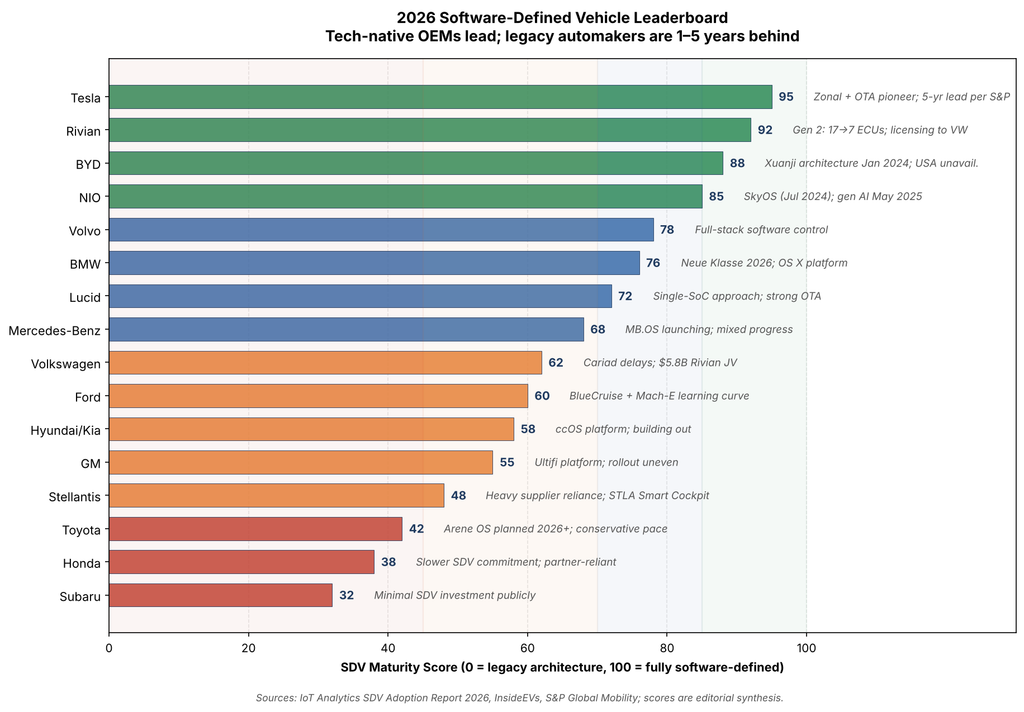
Tesla and Rivian lead by significant margins. Tesla’s lead is estimated at roughly five years by S&P Global Mobility, built on a decade of refinement and vertical integration. Rivian’s Gen 2 architecture is so advanced that Volkswagen invested up to $5.8 billion in a joint venture to license it — effectively admitting that VW’s own in-house software unit Cariad couldn’t deliver the same capability in a competitive timeframe.
Chinese OEMs — BYD and NIO — have caught up and in some areas surpassed Western manufacturers. BYD’s Xuanji architecture launched in January 2024 and the company surpassed Tesla as the largest EV seller globally in 2025. BYD is not sold in the USA, but its technology stack is influential across the industry. NIO launched its SkyOS operating system in July 2024 and added WorldModel generative AI in May 2025.
Legacy luxury OEMs — Volvo and BMW — are the most advanced among traditional manufacturers. Volvo pursues full-stack software control, taking the Tesla-style approach of building its own OS rather than relying on suppliers. BMW’s Neue Klasse platform launching in 2026 is a complete architectural reset; the OS X platform it runs is the most ambitious software effort from any traditional European automaker.
Mid-tier: Lucid, Mercedes-Benz, Volkswagen, Ford, Hyundai/Kia, GM, Stellantis. All have active SDV programs, but with varying progress. Lucid’s single-SoC approach is technically advanced but at low vehicle volumes. Mercedes-Benz is rolling out MB.OS. Volkswagen’s Cariad software unit has struggled publicly; the Rivian joint venture reflects that. Ford’s progress on BlueCruise and the Mach-E platform has been real but incremental. Hyundai/Kia’s ccOS platform is in early rollout. GM’s Ultifi has been uneven. Stellantis’s STLA Smart Cockpit relies heavily on supplier partnerships.
Laggards: Toyota, Honda, Subaru. Toyota’s Arene OS has been announced for 2026+ model years but has not yet shipped at scale. Honda has committed less publicly to SDV architecture than peers of similar size. Subaru has not made significant SDV investments publicly known. All three remain profitable on their traditional vehicle designs, but face substantial catch-up investment to remain competitive in the 2028-2030 timeframe.
The gap between the fastest-moving OEMs and the slowest translates directly to time-to-market. Leaders can develop new vehicle models more than a year faster than some traditional OEMs, which is a meaningful competitive advantage in a market that no longer measures model cycles in half-decades.
What This Shift Actually Changes
The architectural change is interesting as engineering, but the reason it matters is downstream — what centralized computing enables and constrains across the entire vehicle ownership experience. A single architectural shift drives most of the other technology-related changes affecting car buyers today.
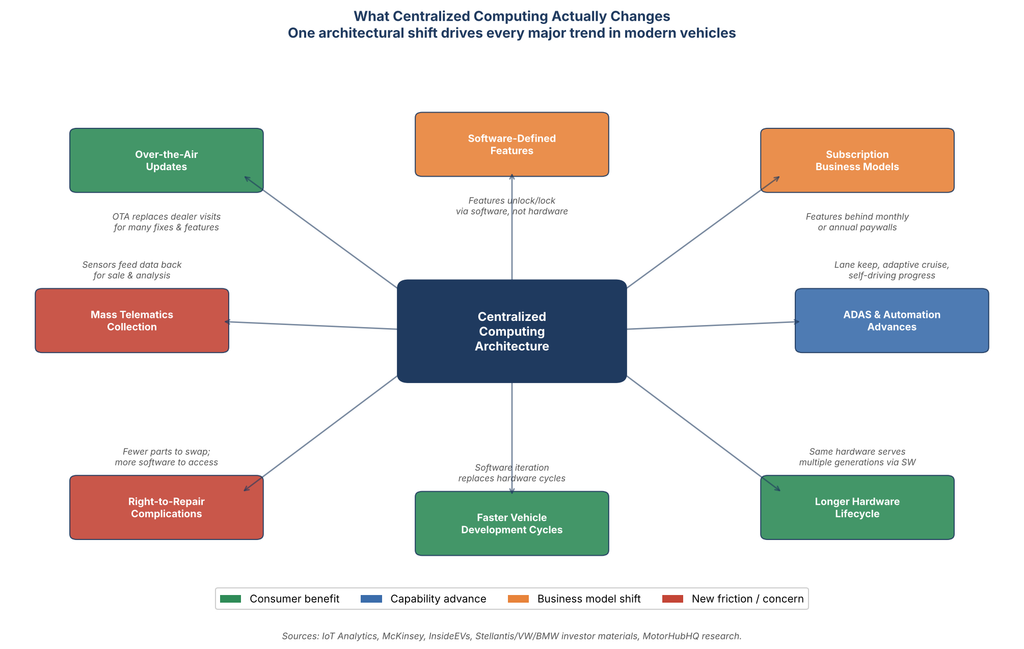
Over-the-air updates become possible at scale only because centralized compute nodes can be updated as a unit, rather than requiring dealers to individually reprogram 50+ ECUs. OTA transforms vehicle maintenance, recall fixes, feature additions, and even some subscription business models. The How OTA Updates Change Vehicle Performance article covers the mechanics, benefits, and controversies of this shift in depth — from Tesla pushing acceleration improvements to BMW remotely enabling or disabling features.
Software-defined features become possible when hardware capabilities are decoupled from feature availability. Heated seats, adaptive cruise control, acceleration profiles, and driver-assistance tiers can now be present in the physical vehicle but activated (or not) through software. This is the technical foundation for the subscription business model, which ran into significant consumer backlash with BMW’s heated-seat subscription in 2020-2023 and continues to evolve. The How Right-to-Repair Laws Affect Car Owners article covers the regulatory implications of owners paying monthly to use hardware they physically own.
Mass telematics collection becomes feasible when the vehicle has a central compute node with cellular connectivity and access to every sensor’s data stream. The ability of modern vehicles to report location, driving behavior, cabin data, and biometric information to the automaker — and the automaker’s ability to sell that data to insurance companies and data brokers — is covered in detail in the Automakers Are Collecting Your Telematics Data article. The GM/OnStar/LexisNexis scandal of 2024 that made this a national story was only possible because GM’s centralized architecture could aggregate driving data across its vehicle fleet.
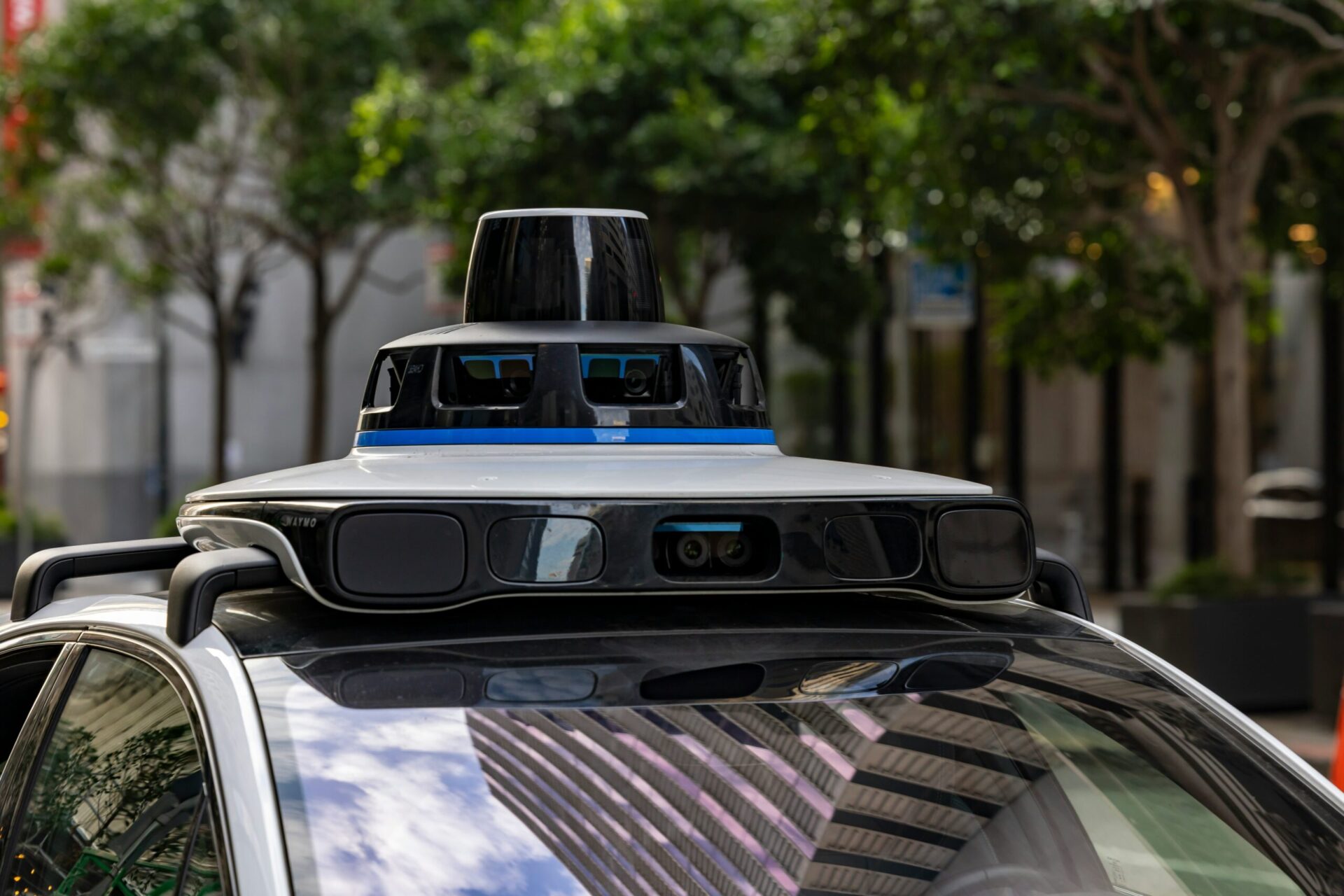
ADAS and automation advances depend on central high-performance computing because features like lane-centering, adaptive cruise, parking assist, and eventually autonomous driving require real-time fusion of data from many sensors simultaneously. A federated architecture physically cannot do the required compute. The move from basic lane-keep assist in 2018 vehicles to hands-free driving (GM Super Cruise, Ford BlueCruise, Tesla Full Self-Driving Supervised) in 2026 vehicles is a direct result of the compute capability the new architecture enables.
Faster vehicle development cycles result from software becoming the primary development vector rather than hardware. Tesla can iterate its vehicle control systems monthly; a traditional automaker historically refreshed them every 3-5 years at model midcycle. The gap between these cadences drives competitive pressure throughout the industry.
Longer hardware lifecycles paradoxically also result. Because features can be added or improved via software after sale, the underlying hardware can be designed for a longer service life. Tesla Model S vehicles from 2014 continue receiving new features via OTA in 2026 — a form of long-term value that no 2014 ICE vehicle could offer.
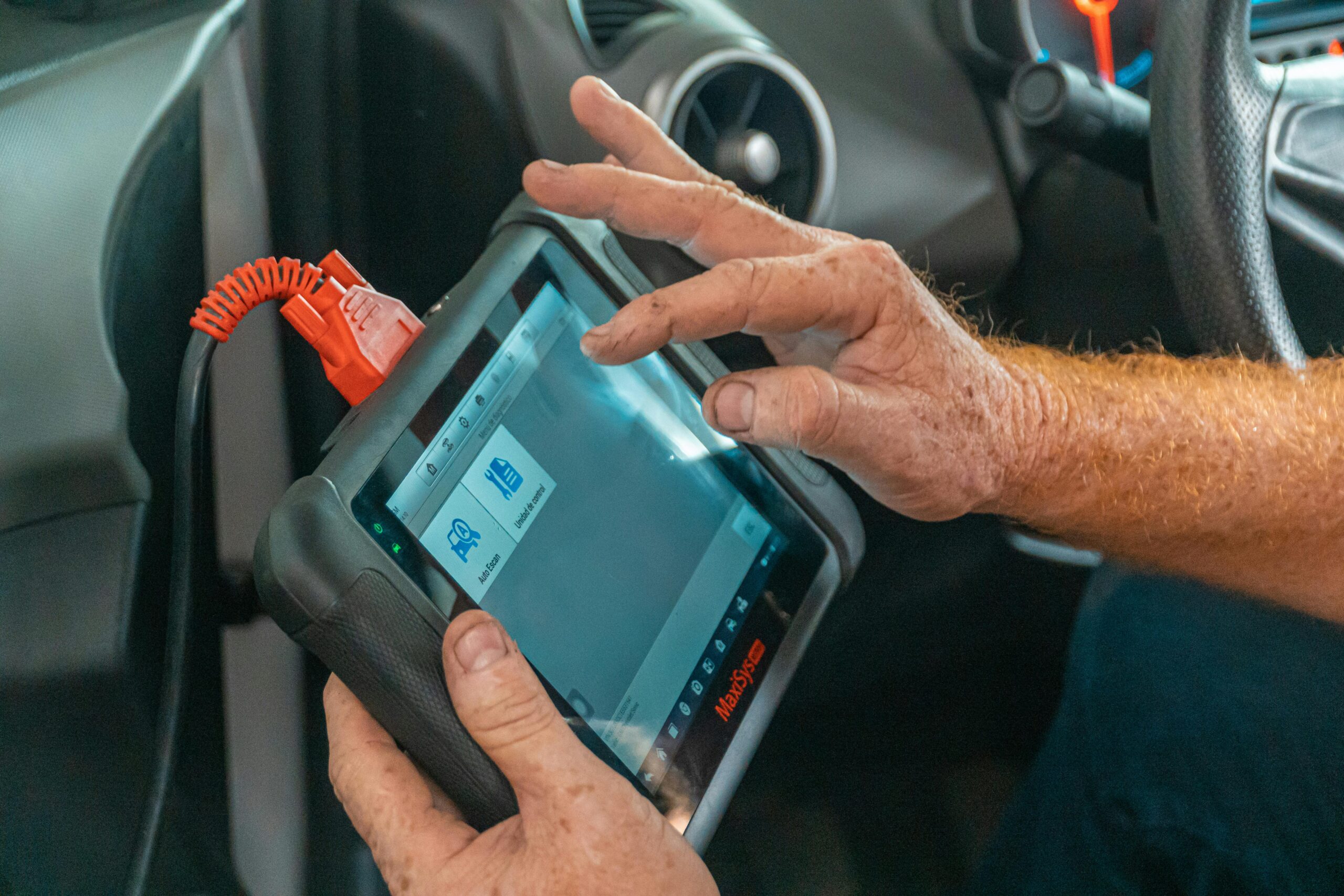
Right-to-repair complications have emerged as independent repair shops face a vehicle that has fewer parts to swap but much more software to access. The How Right-to-Repair Laws Affect Car Owners article covers the ongoing legal battle over who gets access to the diagnostic data, programming tools, and software that modern vehicles depend on.
Subscription business models are the most contested consequence. Automakers see software-defined vehicles as the opportunity to generate recurring revenue after the vehicle sale; consumers often see it as paying for features they already bought. The equilibrium is still being negotiated. The OEM vs Aftermarket Parts article covers related changes in the parts economy.
The Semiconductor Economy Behind the Change
Underneath the architectural debate sits a semiconductor industry quietly consolidating around a few key players. The high-performance SoCs that make centralized computing possible come from a relatively small list of suppliers:
Qualcomm’s Snapdragon Ride and Snapdragon Cockpit platforms power ADAS, infotainment, and digital cockpit systems at a growing number of OEMs including Volvo, Polestar, General Motors, Mercedes-Benz, and the BMW Neue Klasse.
NVIDIA’s Drive Orin and Drive Thor platforms serve the highest-end ADAS and autonomous driving compute needs, with wins at Mercedes-Benz, Volvo, Polestar, Rivian, Lucid, and the Chinese EV leaders. Drive Thor is the current generation flagship, with roughly 1,000 trillion operations per second of AI compute capability.
Mobileye’s EyeQ family (now at EyeQ6) powers ADAS at BMW, Volkswagen, Ford, Audi, Nissan, and many others. Mobileye’s strategy focuses on vision-first ADAS with eventual expansion to full autonomy.
Infineon, NXP, STMicroelectronics, and Renesas supply the zonal gateway controllers and mid-range automotive microcontrollers that handle the “nervous system” between zone controllers and central compute. These are less glamorous than the AI compute chips but equally essential to the architecture.
Bosch, Aptiv, and Continental operate as tier-one systems integrators, selling complete zonal controller hardware and increasingly the middleware and software to make it work. Bosch’s ETAS unit provides middleware and testing frameworks for several major OEM SDV programs.
The upshot of all this is that a modern car’s compute stack has more in common with a smartphone than with the vehicle it is replacing. The automotive semiconductor market is projected to roughly triple in value by 2030 as this transition completes, with the compute-heavy categories growing fastest.
The Risks: First-Year Software Problems
Centralized computing creates powerful capabilities but also introduces new categories of risk that weren’t present in federated architectures. When a single compute node runs 30 formerly independent functions, a bug in one subsystem can affect all of them. When software is the primary vector for new features, software defects become safety issues.
First-year vehicles on new software platforms have historically had rough reliability trajectories. The Should You Trust Tech in First-Year Car Models article covers this dynamic in detail. Early Tesla vehicles had well-documented software stability issues that have improved substantially but not disappeared. BMW’s iX had significant early software stability problems. Lucid, Rivian, and some EV launches from legacy OEMs have all had notable early-ownership software issues.
The mitigating factor is that OTA updates can often fix these issues after sale — a dynamic covered in the How OTA Updates Change Vehicle Performance article. A 2024 vehicle with first-year software issues in 2024 may be meaningfully more reliable in 2026 after multiple update cycles. This is a fundamentally different reliability profile than traditional mechanical reliability, which generally only gets worse with time.
A second category of risk is cybersecurity. A centralized architecture presents a different attack surface than a federated one — fewer entry points, but higher consequences if one is breached. The industry has responded with hardware security modules, OTA update signing, and network segmentation, but the concern is not fully resolved.
A third category is long-term support. Vehicles on current compute platforms will need software support for 15-20 years of their useful lives. Whether automakers maintain that support, especially for models that are no longer in production, is a question the industry has not yet answered at scale.
What This Means for Buyers
For vehicle shoppers, the centralized-computing shift has several practical implications:
Newer vehicles from SDV-leading OEMs (Tesla, Rivian, BYD overseas, BMW Neue Klasse, Volvo, Lucid) will receive meaningful post-sale updates that improve or add capabilities over time. This is a form of value that doesn’t exist in older architectures. The Should You Trust Tech in First-Year Car Models article covers the tradeoffs of early-adoption.
Vehicles from SDV-laggard OEMs (Toyota, Honda, Subaru) may be more conservative on software features but also less likely to have first-year software defects. Toyota and Honda’s reputation for conservative reliability engineering carries forward into their SDV strategies.
Subscription features require evaluation on their own terms. A vehicle with hardware physically present but software-locked may be a good or bad deal depending on which features matter and what they cost. The How Right-to-Repair Laws Affect Car Owners article covers the full landscape of software-locked features and the regulatory response.
Insurance implications follow from telematics capability. A fully connected SDV vehicle generates far more data than an older architecture, and the How Insurers Assess Vehicle Risk and Automakers Are Collecting Your Telematics Data articles cover how that data moves and affects premiums.
Repair considerations shift as more work becomes diagnostic and software-based rather than mechanical. The OEM vs Aftermarket Parts article covers how this affects parts choices for independent repair.
The Takeaway
The shift toward centralized computing is the architectural change behind essentially every other technology-related trend in modern vehicles. Over-the-air updates, software-defined features, subscription business models, mass telematics collection, ADAS advances, faster development cycles, and longer hardware lifecycles are all consequences of the same fundamental change: vehicles consolidating from 100+ small computers to a handful of powerful compute nodes.
Tesla, Rivian, BYD, NIO, Volvo, and BMW lead the transition. Volkswagen, Ford, Mercedes-Benz, Hyundai/Kia, GM, and Stellantis are building out SDV platforms with varying progress. Toyota, Honda, and Subaru remain behind but have the brand strength to catch up. The leader-to-laggard gap is currently measured in years, not quarters.
For buyers, the practical implications are that modern vehicles are more capable but also more complex and more dependent on the automaker’s long-term software commitment. The business model of vehicle ownership is actively changing as the architecture changes. Features that were once hardware are now software, and the questions of what you own, what you rent, what you can modify, and what gets updated after you drive it home are all being renegotiated in real time.
Understanding the architecture is the key to understanding why all those other battles — over OTA updates, over data, over subscriptions, over repair access — are happening now. They’re not separate stories. They’re one story about what computers did to the car.
External Sources
Motor Magazine — Software-Defined Vehicles: Built for Users, or for the Industry?
IoT Analytics — Software-Defined Vehicles Adoption Report 2026
IoT Analytics — SDV Adoption Across 4 Dimensions and Leading OEMs
InsideEVs — Why Zonal Architectures Are the Next Big Thing in EV Design
McKinsey — Rethinking Car Software and Electronics Architecture
Semiconductor Engineering — Automotive E/E Architectures Key to Innovation
Molex — Inside the Next-Gen EV Architecture
Edge AI Vision — Software-Defined Vehicles Drive Next-Gen Architectures
Automotive IQ — Smart Approaches to Consolidating ECUs
Elektronik Net — Is the Automotive Industry SDV-Ready?
Roland Berger — Consolidation in Vehicle Electronic Architectures
Yole Group — Automotive Computing and AI 2026 Report
Counterpoint Research — Global Shifts in ADAS and Autonomous Vehicles




















Leave a Reply
You must be logged in to post a comment.