




















Auto lending is a $1.6 trillion market in the United States. Every new and used vehicle financed by a bank, credit union, captive lender, or online finance company touches a web of federal and state regulations that most borrowers never read, most dealers mention only in passing, and most consumers only learn about after something goes wrong. The regulations exist because the auto lending industry has a long history of practices that regulators have had to specifically prohibit — discriminatory pricing, hidden fees, deceptive disclosures, yo-yo financing, and predatory add-ons among them.
This article covers the consumer-rights side of auto lending regulation: what protections you actually have when financing a vehicle, which agencies enforce them, how to recognize when a lender or dealer is violating your rights, and what practical steps you can take when they do. It is the companion to the How Credit Unions Compete with Big Auto Lenders and OEM-Subsidized Financing Programs Explained articles, both of which describe the market structure that these regulations govern. The How Insurers Assess Vehicle Risk article covers the related regulatory framework on the insurance side.
The regulatory landscape has shifted meaningfully since 2024, with changes in federal enforcement priorities, a significant FTC rule (CARS Rule) still being litigated, and state attorneys general taking a larger role than they historically have. Understanding what still applies and what has changed matters for anyone financing a vehicle in 2026.
The Agencies That Oversee Auto Lending
Auto lending in the US is regulated by a patchwork of federal agencies, state regulators, and state attorneys general. Each covers a different slice, and jurisdiction overlaps in important ways. Understanding which agency covers which issue is the starting point for knowing where to go when something goes wrong.
The Consumer Financial Protection Bureau (CFPB) was established by the 2010 Dodd-Frank Act in response to the financial crisis, with broad authority over consumer financial products including auto loans. The CFPB enforces most of the major federal statutes that apply to auto lending — the Truth in Lending Act (TILA), the Equal Credit Opportunity Act (ECOA), the Fair Credit Reporting Act (FCRA), the Fair Debt Collection Practices Act (FDCPA), and the Dodd-Frank prohibition on unfair, deceptive, or abusive acts or practices (UDAAP). CFPB enforcement has been the single most consequential driver of auto lending regulation for the last 15 years.
The Federal Trade Commission (FTC) oversees auto lending practices at non-bank dealers and finance companies. The FTC has specific jurisdiction over the “Buy Here, Pay Here” subprime lot segment and enforces advertising and marketing standards across the industry. The FTC’s 2024 CARS Rule (Combating Auto Retail Scams) represented the first comprehensive federal rulemaking specifically targeting dealer-side deceptive practices.
The Department of Justice (DOJ), particularly its Civil Rights Division, enforces the Equal Credit Opportunity Act against discriminatory lending patterns. DOJ enforcement typically works in parallel with CFPB cases on major fair-lending matters.
The Office of the Comptroller of the Currency (OCC) charters and regulates national banks and federal savings associations. Because these institutions make a substantial share of auto loans, OCC supervision affects how they underwrite, price, and service those loans.
The National Credit Union Administration (NCUA) regulates federally chartered credit unions. The NCUA’s consumer protection focus is less aggressive than the CFPB’s, but credit union oversight ensures that CU auto lending operates within standard consumer protection rules.
State attorneys general have become increasingly active auto lending enforcers over the last decade, especially as federal enforcement has varied by administration. The 2020 Santander Consumer USA multistate settlement ($550 million) was led by state AGs. New York, California, Massachusetts, and several other states maintain active auto lending investigations and prosecutions.
State insurance departments and state banking regulators have additional authority over specific aspects of auto lending — rate regulation in some states, licensing of finance companies, and consumer complaint processing.
The practical implication for consumers is that when something goes wrong, you often have multiple options for complaint and recourse. A single violation can be reported to the CFPB, your state AG, the FTC, and (in some cases) the OCC or NCUA. Filing with multiple agencies strengthens your case and ensures someone acts.
What the Law Actually Gives You
Ten specific consumer rights govern auto lending in 2026. Knowing them is the foundation for recognizing when they’re being violated.
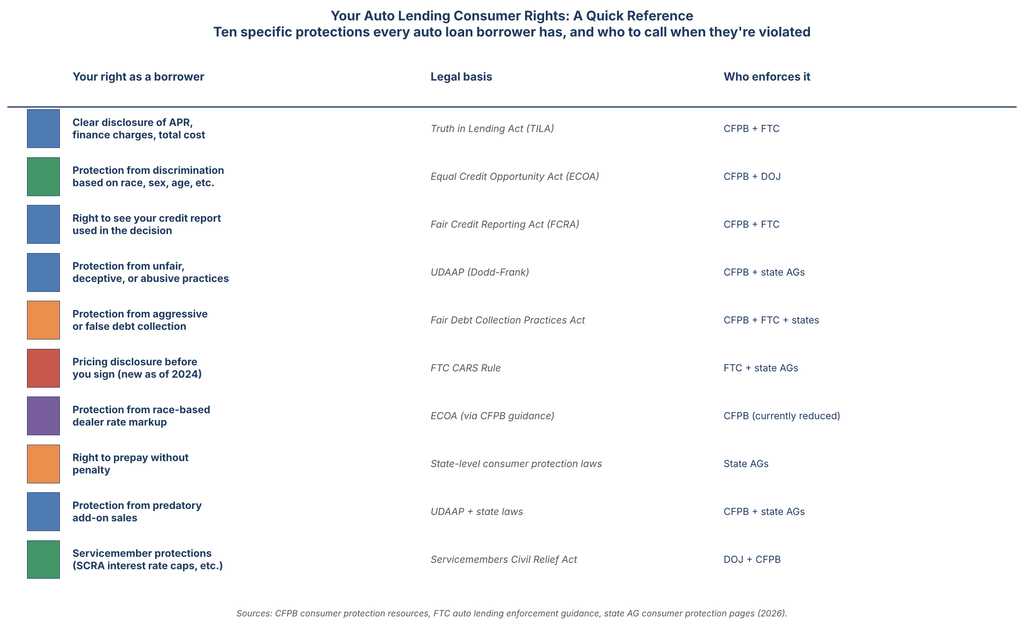
Clear disclosure of APR, finance charges, and total cost is required under the Truth in Lending Act (TILA). Every auto loan must include a Truth-in-Lending disclosure (the “TIL box”) that specifies the APR, the finance charge (total interest and fees), the amount financed, the total of payments (what you’ll pay over the life of the loan), and the payment schedule. Lenders who fail to provide this disclosure or who misstate it face statutory damages — a specific dollar penalty in addition to actual damages — meaning you can sue for a TILA violation even if the error didn’t cost you directly.
Protection from discrimination based on race, sex, age, marital status, national origin, religion, or receipt of public assistance is guaranteed by the Equal Credit Opportunity Act (ECOA). Lenders cannot deny credit, charge different rates, or impose different terms based on these characteristics. ECOA enforcement has historically been the most contentious area of auto lending regulation, particularly around dealer markup — the practice where dealers add their own margin to the lender’s wholesale rate, which studies have shown correlates with race in aggregate even when individual decisions appear neutral.
Right to see your credit report used in the decision comes from the Fair Credit Reporting Act (FCRA). If you’re denied a loan or offered less favorable terms based on your credit report, the lender must provide you with the reasons and let you obtain a free copy of the report that was used. This right applies at every stage — application, denial, pricing.
Protection from unfair, deceptive, or abusive practices is the broad consumer protection provision of Dodd-Frank (UDAAP). This covers a wide range of practices not specifically addressed by narrower statutes: misleading advertising, hidden fees, aggressive sales tactics, bait-and-switch financing offers. UDAAP enforcement has been the primary vehicle for CFPB action against dealer and lender practices that don’t neatly fit older statutes.
Protection from aggressive or false debt collection falls under the Fair Debt Collection Practices Act (FDCPA) and various state analogs. Collectors cannot call at unreasonable hours, cannot threaten actions they can’t take, cannot contact you at work after being told not to, and cannot continue contacting you after you’ve requested they stop in writing.
Pricing disclosure before you sign is the newest major right, created by the FTC CARS Rule (Combating Auto Retail Scams) finalized in January 2024. The rule requires dealers to disclose the full offering price, prohibits certain add-on fees, and requires affirmative consent for optional add-ons. The CARS Rule was challenged in federal court by industry groups and has been subject to injunctions as of 2024-2026; its final status remains uncertain. Portions are in effect; portions are stayed pending litigation.
Protection from race-based dealer rate markup was historically enforced by the CFPB under ECOA through administrative guidance and settlements. The 2017 rollback of the CFPB’s indirect auto lending guidance (Trump administration) and the 2025 further restructuring of the CFPB’s fair lending enforcement capacity have reduced this protection in practice. State AG enforcement has partially filled the gap.
Right to prepay without penalty is a state-level protection in most jurisdictions. Nearly all US states now prohibit prepayment penalties on consumer auto loans. The right exists regardless of lender type and cannot be waived in the loan contract.
Protection from predatory add-on sales — forced gap insurance, extended warranties, credit insurance, VIN etching, paint protection, fabric protection, and other dealer add-ons — falls under UDAAP and state consumer protection laws. Dealers must get clear informed consent for any add-on and cannot require them as a condition of financing.
Servicemember protections through the Servicemembers Civil Relief Act (SCRA) cap interest rates on pre-service debts at 6% while the borrower is on active duty, among other protections. The DOJ actively enforces SCRA violations.
Ten rights, ten enforcers, ten places to complain when things go wrong.
What Lenders and Dealers Actually Do Wrong
Knowing your rights is one half of the equation. Knowing what common violations look like is the other half. The industry has decades of documented patterns that regulators have targeted repeatedly.
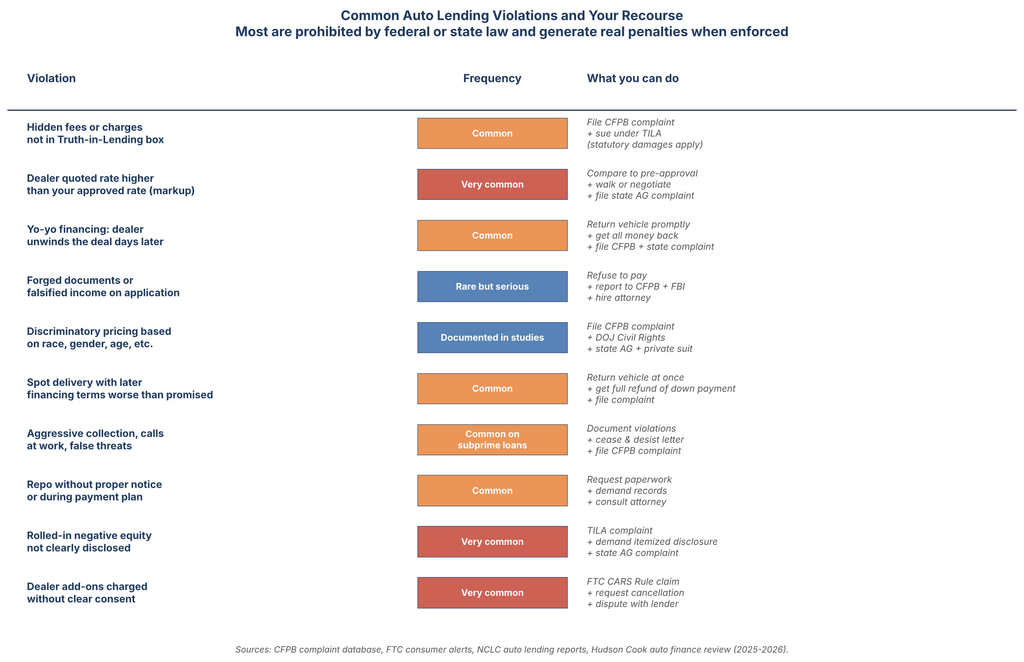
Dealer rate markup is the most common violation and the one borrowers are most likely to encounter. When you apply for financing at a dealership, the finance manager runs your application through multiple lenders. The lenders quote back a “buy rate” — the actual rate they’ll accept. The dealer then marks up the rate, often by 2-3%, and quotes you the higher number. The dealer pockets the markup as “reserve” or “participation.” This is legal in most cases, but it only works if you don’t know your buy rate. The defense is a pre-approval from a credit union or outside bank, covered in detail in the How Credit Unions Compete with Big Auto Lenders article.
Rolled-in negative equity is the practice of adding the amount you still owe on your trade-in (above what the trade is worth) onto the new loan. This is legal if clearly disclosed, but is frequently obscured in dealer paperwork. You see a monthly payment that looks reasonable without realizing the new loan is $5,000-10,000 larger than the vehicle’s price. The How Trade-In Equity Affects Loan Decisions article covers the mechanics in detail.
Hidden fees not in the Truth-in-Lending box is a direct TILA violation but a common one. Documentation fees, acquisition fees, dealer prep charges, and various compliance fees can be improperly included in ways that understate the true APR. The TILA disclosure must capture all finance charges; fees that are technically not finance charges but that you must pay to get the loan are often legally finance charges that must be disclosed.
Yo-yo financing is a particularly egregious scheme where the dealer sends you home with the vehicle, telling you financing is approved, then calls you days or weeks later saying the financing fell through and you need to sign new (less favorable) terms or return the vehicle. By then, you’ve emotionally and practically committed to the vehicle and may feel pressure to accept the worse terms. Yo-yo financing violates UDAAP and multiple state laws; the correct response is to return the vehicle and get all your money back.
Spot delivery with later term changes is a close cousin of yo-yo financing. You sign paperwork at the dealership and drive away; the dealer later tells you the lender required different terms, and you need to sign an amended contract. This is often illegal depending on how the original contract was structured and what disclosures were made.
Dealer add-ons charged without clear consent has become extremely common as dealers have shifted revenue from the vehicle sale itself to F&I income. VIN etching for $500, nitrogen tire inflation for $200, paint protection for $800, fabric protection for $600, extended warranties for $2,500 — dozens of add-ons can be bundled into the financing with little or no explicit consent. The FTC CARS Rule specifically targets this; UDAAP and state consumer protection laws also apply. You can refuse any add-on and demand it be removed, both at signing and after the fact.
Discriminatory pricing based on race, gender, age, or other protected characteristics has been repeatedly documented in studies and enforcement actions. Historical settlements with Ally Financial, Honda, Fifth Third Bank, and Toyota Motor Credit all involved patterns where protected groups paid higher rates for comparable credit profiles. The underlying ECOA prohibition remains in force even where federal enforcement has shifted.
Forged documents or falsified income on loan applications is a specific category where dealers (not borrowers) inflate reported income to qualify a borrower for a loan they couldn’t legitimately afford. When exposed, the dealer is in serious trouble, but the borrower is often left with a loan they can’t afford. The defense is reviewing every number on your application before signing and refusing to sign anything you didn’t personally provide.
Aggressive collection practices on subprime loans — calls at work after being told not to, threats of legal action the collector can’t take, false claims about debt amounts, contact outside allowed hours — are standard FDCPA violations. Documenting each violation and filing with the CFPB generates enforcement attention, particularly when a pattern emerges across multiple borrowers.
Repossession without proper notice or during active payment plans is a state-regulated area where specific requirements vary. Most states require notice of default and an opportunity to cure before repossession can occur. Many prohibit repossession when a payment plan is in effect. If your vehicle has been repossessed and you believe the lender violated procedure, consulting a consumer protection attorney immediately is important because remedies include return of the vehicle and often damages.
The Enforcement History That Shaped Current Practice
The specific consumer rights that apply in 2026 are shaped by a decade-plus of enforcement actions that established what regulators considered off-limits and what penalties violators could expect.
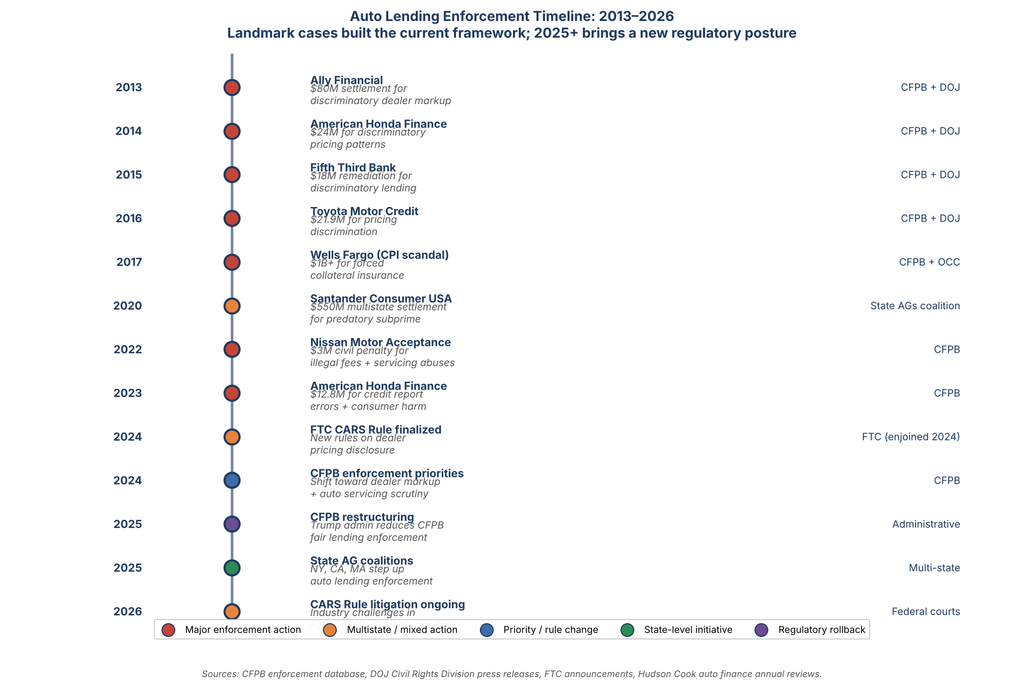
Ally Financial (2013) — $80 million settlement with the CFPB and DOJ over discriminatory dealer markup. This was the landmark case that established that lenders could be held responsible for discriminatory patterns even when individual dealer-level decisions appeared race-neutral. The theory of liability was disparate impact under ECOA.
American Honda Finance (2014) — $24 million, Fifth Third Bank (2015) — $18 million, Toyota Motor Credit (2016) — $21.9 million. These three cases extended the Ally framework to other captive lenders, establishing that pattern enforcement would continue regardless of the specific lender.
Wells Fargo Collateral Protection Insurance scandal (2017) — Over $1 billion in penalties when Wells Fargo was found to have charged auto loan customers for forced-place collateral insurance they didn’t need, in many cases without any notification. The case drove home that lender servicing practices (not just origination) were within consumer protection jurisdiction.
Santander Consumer USA (2020) — $550 million multistate settlement led by state AGs over predatory subprime lending patterns. This was the first major enforcement action where state AGs — not the CFPB — were the primary driver, foreshadowing the shift that would accelerate after 2024.
Nissan Motor Acceptance (2022) — $3 million CFPB civil penalty for illegal fees and servicing abuses. A smaller case but important because it addressed captive lender servicing practices in a specific pattern that other lenders quickly reviewed their own exposure to.
American Honda Finance (2023) — $12.8 million CFPB action over credit reporting errors that harmed consumers. The case established that lender credit-reporting practices were a growing enforcement focus.
FTC CARS Rule finalized (January 2024) — The first major comprehensive federal rule targeting dealer-side deceptive practices. The rule requires clear pricing disclosure, prohibits certain fees, and requires affirmative consent for add-ons. Industry groups immediately challenged the rule; portions have been stayed by federal courts pending resolution of the litigation.
CFPB restructuring (2025) — The Trump administration significantly reduced the CFPB’s enforcement capacity, particularly in fair lending. Auto lending priorities shifted; several pending investigations were closed or de-emphasized. State attorneys general have moved to fill the gap with increased coordinated enforcement.
State AG coalitions (2025-ongoing) — New York Attorney General Letitia James, California Attorney General Rob Bonta, and Massachusetts Attorney General Andrea Joy Campbell have all substantially expanded their auto lending enforcement in 2025-2026. Multi-state investigations of predatory lending patterns, dealer markup discrimination, and servicing abuses have continued and intensified at the state level even as federal enforcement has contracted.
CARS Rule litigation ongoing (2026) — The CARS Rule challenge is working through federal courts, with the Fifth Circuit Court of Appeals being the key venue. Outcome is uncertain; the rule could be upheld, struck down entirely, or modified. Dealers are complying with portions of the rule in states where state AGs are actively enforcing similar provisions regardless of federal status.
The enforcement environment in 2026 is less active federally than it was in the mid-2010s but more active at the state level than it has ever been. The rights themselves have not changed; the risk calculus for violators has shifted.
Practical Recourse When Something Goes Wrong
Knowing your rights and the enforcement history is background. The specific steps when you encounter a violation are what matter in the moment.
File a CFPB complaint. The CFPB’s online complaint system at consumerfinance.gov/complaint is free, takes about 20 minutes, and generates a direct response from the lender within 15-60 days. Complaints become part of the CFPB’s public database, searchable by lender. Even in the reduced-enforcement environment, CFPB complaints trigger lender response and sometimes direct resolution.
File with your state attorney general. Every state AG has a consumer protection division. State AGs have broader authority in some respects than federal agencies and have been increasingly active. Filing with both federal and state agencies maximizes attention.
File with the FTC. For dealer-side violations (as opposed to lender-side), the FTC is the primary federal enforcer. ReportFraud.ftc.gov is the standard portal.
File with the state banking or insurance regulator. Many auto lenders are licensed by state agencies that have authority to suspend licenses, impose fines, or require corrective action. These complaints often get faster responses than federal complaints.
Consult a consumer protection attorney. For significant violations (hidden fees, illegal repossession, discrimination, yo-yo financing), individual legal action is often the fastest path to remedy. Many consumer protection attorneys work on contingency, meaning no fees unless you win, and some violations carry attorney-fee-shifting provisions that mean the defendant pays your legal costs if you win.
Use the credit reporting process. If inaccurate information about your auto loan appears on your credit report, dispute it directly with the credit reporting agency (Equifax, Experian, TransUnion). The lender must respond and correct errors or validate the information within 30 days.
Return the vehicle under yo-yo financing or spot delivery disputes. If the dealer tells you financing fell through or terms changed, return the vehicle promptly and demand full return of your down payment and trade-in. Don’t drive it longer than necessary; document the return in writing.
Get everything in writing. For any dispute, written documentation is your friend. Email trails, letters sent via certified mail, screenshots, and copies of all paperwork create the evidence base that makes complaints effective.
Know what statute applies. Different violations fall under different statutes with different remedies. A TILA violation carries statutory damages. An ECOA violation can involve DOJ action. A state consumer protection violation often includes triple damages and attorney’s fees. Matching the right law to the right violation strengthens your case.
The How Insurers Assess Vehicle Risk and Red Flags for Insurance Fraud in Auto Claims articles cover related consumer protection frameworks on the insurance side of vehicle finance.
Where the Framework Is Weakest
The consumer protection framework for auto lending has specific gaps that regulators and legislators have struggled to close.
Dealer-arranged indirect lending remains a gray area where responsibility is diffused between the dealer (who structures the deal and markups) and the lender (who ultimately holds the loan). When a dealer engages in a deceptive practice, the lender can often disclaim responsibility; when the lender engages in a discriminatory pattern, the dealer can claim they were just passing through the lender’s terms. Closing this accountability gap was a major CFPB project in the mid-2010s and has been partially rolled back since.
Subprime lending operates at the edge of what’s economically profitable, which creates sustained pressure to push up against (and sometimes past) legal limits. The CFPB’s enforcement actions against Santander, Credit Acceptance, and other subprime captives have addressed specific patterns but have not fundamentally changed the industry economics.
Buy Here, Pay Here dealerships — small lots that finance their own sales to subprime buyers, typically with weekly in-person payments — operate under state-level oversight that varies dramatically. The FTC has jurisdiction but limited resources for a fragmented industry. Consumer protection in this segment is weakest in states with light oversight.
Online and fintech lenders have grown substantially and operate under the same rules as traditional lenders but have sometimes exploited perceived ambiguities. Enforcement actions against several fintech auto lenders have established that the rules apply equally regardless of channel, but the effort to keep up with new business models is ongoing.
Lease finance is governed by the Consumer Leasing Act (CLA) rather than TILA, with similar but not identical disclosure requirements. Consumer protections for leasing are generally weaker than for conventional financing, and the complexity of lease math (money factors, residual values, mileage caps) makes violations harder to detect.
State enforcement variability means that consumer rights are consistently stronger in some states than others. California, New York, Massachusetts, New Jersey, Illinois, and Washington generally have the most aggressive state enforcement. Several Southern and Mountain West states have substantially less active consumer protection enforcement. The practical rights you have depend partly on where you live.
The Takeaway
Auto lending regulation gives consumers ten substantial rights: clear APR disclosure, protection from discrimination, access to the credit report used, protection from unfair/deceptive/abusive practices, protection from aggressive collection, pricing disclosure before signing, protection from discriminatory markup, the right to prepay, protection from predatory add-ons, and specific servicemember protections. These rights apply across all auto loan transactions regardless of lender type.
Enforcement has shifted in meaningful ways since 2024. The CFPB’s enforcement capacity has been reduced; state attorneys general have stepped up correspondingly; the FTC’s CARS Rule is working through litigation with uncertain outcome. The underlying rights have not changed, but the practical enforcement risk calculus for violators has shifted away from federal and toward state oversight.
For individual consumers, the practical implications are specific. Know your rights before entering a dealership. Get financing pre-approved through a credit union (covered in the How Credit Unions Compete with Big Auto Lenders article) so dealer markup becomes transparent rather than hidden. Review every line of every document before signing. Keep copies of everything. When something goes wrong, file complaints with the CFPB, your state AG, and the FTC in parallel — multiple complaints get faster responses than single ones.
The industry has decades of documented patterns of pushing against consumer protection rules, and regulators have decades of enforcement actions responding. The framework isn’t perfect, and its application varies by state and administration, but the rights themselves are real and enforceable. The consumers who get the best outcomes are the ones who know what their rights are, document everything, and are willing to file complaints when rights are violated.
The OEM-Subsidized Financing Programs Explained, How Trade-In Equity Affects Loan Decisions, and How Interest Rates Impact Car Loans articles cover other dimensions of auto financing that intersect with the regulatory framework described here.
External Sources
National Association of Attorneys General — Consumer Protection
Consumer Financial Protection Bureau — Auto Loans
FTC — CARS Rule (Combating Auto Retail Scams)
DOJ Civil Rights Division — Fair Lending Enforcement
Morgan Lewis — Consumer Finance in the US Automotive Industry 2025
Hudson Cook — CFS Bites of the Month: 2025 Annual Review Auto Finance
Auto Finance News — Trump Defangs CFPB’s Fair Lending Unit
JDSupra — Auto Loan Origination and Servicing March 2026
American Bar Association — Automotive Finance Update 2025
National Consumer Law Center — Auto Loans
Goodwin — Auto Loan Origination and Servicing Year in Review





















Leave a Reply
You must be logged in to post a comment.