





















You walk onto a dealer lot in Charlotte and ask for a 2026 Toyota RAV4 Hybrid in Blueprint Blue with the XLE Premium trim. The salesperson pulls up inventory, frowns at the screen, and tells you the dealership can get the color but not that trim — or that trim but not that color — and either way you’re looking at a wait. Drive 40 miles to a different Toyota store and you’ll hear a slightly different story. Call three more and you’ll get three more answers. Why?
The answer is dealer allocation — the manufacturer’s process for deciding which vehicles get built and which dealers receive them. For buyers, allocation is the invisible system that determines whether the exact car you want exists on a lot anywhere nearby, how long you’ll wait, whether you can factory-order one, and whether the dealer has any room to negotiate on price. Most buyers never learn how it works. The ones who do walk into the dealership with structural advantages the salesperson rarely volunteers.
This guide explains how allocation actually works in 2026, what the current inventory environment looks like, which brands are allocating tightly vs. loosely, how factory orders fit in, and how to use all of it to find the car you actually want at a price that makes sense.
The Post-Pandemic Inventory Picture
Before getting into mechanics, it helps to understand where the market is. The 2020-2022 chip shortage and pandemic supply crisis fundamentally reshaped how buyers experience new-car shopping — and while inventory has largely recovered, the lingering effects still shape every purchase decision.
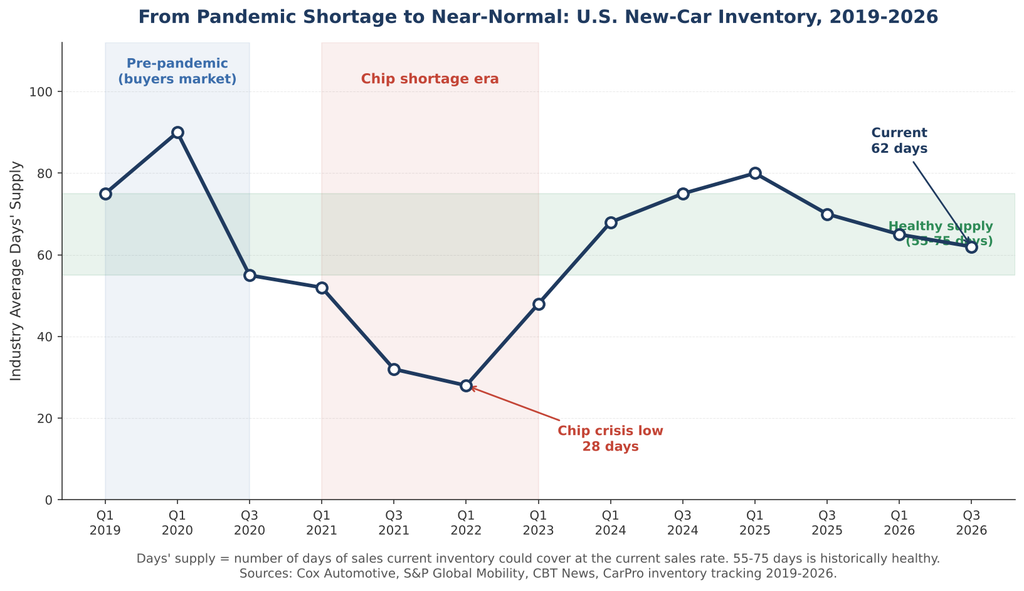
Cox Automotive’s monthly inventory reports tell the story in one metric: days’ supply, which measures how many days of sales current inventory could cover at the current sales rate. The industry considers 55-75 days healthy — enough for buyers to find variety on dealer lots without so much stock that dealers are forced into fire-sale pricing.
Pre-pandemic (2019), the U.S. industry averaged 75-90 days’ supply. Buyers had leverage, dealers negotiated hard, manufacturer incentives flowed freely. Then the chip crisis hit. By early 2022, days’ supply bottomed at 28 days industry-wide — the lowest in modern history. Lots sat empty, “additional dealer markup” (ADM) stickers of $5,000-$15,000 became normal, and buyers accepted whatever vehicle was closest to their actual order.
By late 2024 and through 2025, inventory largely recovered. The industry averaged 70-80 days’ supply through most of 2025, and dealer-side pricing pressure returned. As of Q3 2026, industry days’ supply sits at roughly 62 — back inside the healthy band, though still tighter than pre-pandemic. The buyer-leverage pendulum has swung back toward neutral, but it hasn’t swung all the way back to 2019-level buyers’ market. Which brand you’re shopping and which specific model makes an enormous difference.
What Dealer Allocation Actually Is
Dealer allocation is the process by which a manufacturer decides how many vehicles — and crucially, which specific vehicles — each franchised dealer receives. The dealer doesn’t choose what shows up on their lot. The manufacturer does.
Here’s the simplified flow:
- Forecasting. The manufacturer builds a sales forecast per model, trim, and configuration using regional demand data, market share goals, and dealer-level sales history. This happens 6-12 months out for most models.
- Production scheduling. The factory locks production runs based on that forecast, constrained by supply chain, labor, and physical plant capacity.
- Regional distribution. Vehicles are assigned to regional distribution zones. A manufacturer’s “Southeast region” allocation looks different from its “Northeast region” allocation — more pickups in Texas, more AWD in Colorado, more hybrids in California.
- Dealer-level allocation. Within each region, manufacturers run a weighted formula to determine how many vehicles (and which configurations) each individual dealer receives per allocation cycle (usually monthly or bi-weekly).
- Delivery. Cars ship from factory or port to the dealer, usually by truck. From assembly line to dealer lot: typically 4-8 weeks.
The dealer accepts (or occasionally declines) what’s offered. They can request specific vehicles through their Dealer Management System, but the manufacturer has final say on what ships to them.
How Manufacturers Decide Who Gets What
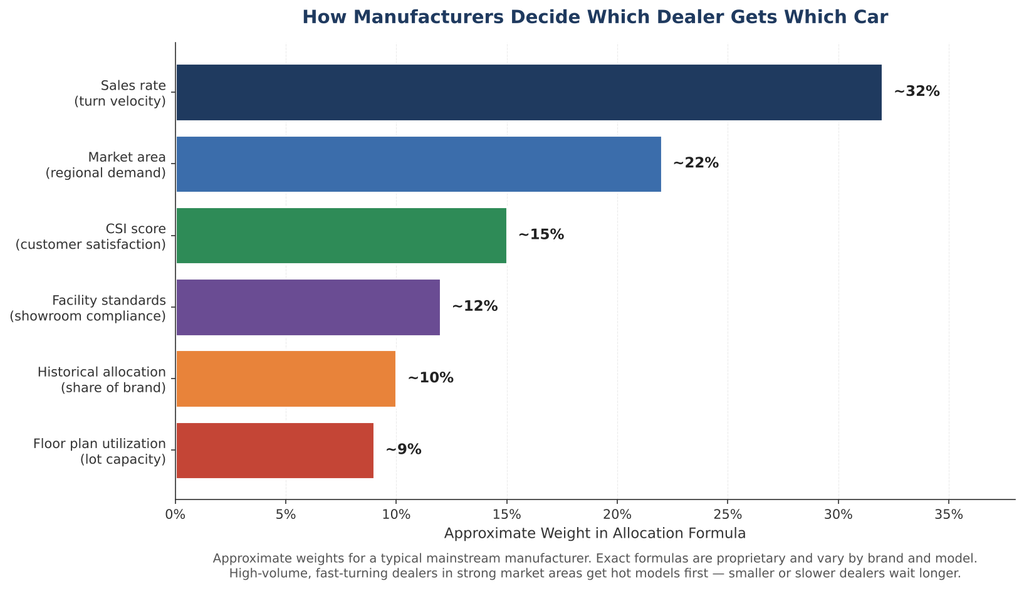
The formula is proprietary and varies by brand, but the broad weighting looks roughly like this:
Sales rate / turn velocity (~32%). The dominant factor. Dealers who sell their allocated inventory quickly get more inventory faster. A dealer who moves a Toyota Tacoma in 15 days gets priority over one who sits on it for 90 days. This is why large-metro dealers almost always have better inventory selection than rural or small-market dealers — they turn cars faster and the manufacturer rewards that.
Market area / regional demand (~22%). The manufacturer uses ZIP-code-level registration data to understand where its vehicles are actually being bought (versus where they’re being sold from). A dealer in a strong market area for a specific model (say, a Subaru dealer in Vermont) gets allocation weighted toward their market’s demand.
CSI score / customer satisfaction (~15%). Most manufacturers track dealer-level customer satisfaction scores from post-sale and post-service surveys. Dealers with consistently high CSI get allocation advantages — manufacturers protect their brand by rewarding stores that represent them well.
Facility standards / showroom compliance (~12%). Franchise agreements require dealers to maintain brand-standard facilities. Dealers that upgrade their showrooms on schedule get allocation priority. Those that fall behind on required renovations can face allocation penalties.
Historical allocation / share of brand (~10%). Each dealer has a “planning potential” — their expected share of regional brand sales based on their market territory. Allocation is calibrated against this baseline so no dealer falls far behind their expected share.
Floor plan utilization / lot capacity (~9%). Dealers finance their inventory through “floor plan” lending (usually from the manufacturer’s captive finance arm). Dealers running near their floor plan limit can be deprioritized for additional allocation until existing stock moves.
The practical implication: not all dealers are equal. The high-volume metro dealer who sells 3,000 Toyotas per year and has 4.9-star CSI gets first dibs on the hot new Tacoma. The small suburban dealer who sells 800 Toyotas annually and has an aging facility is lower on the allocation stack. When a hot model is tight, the gap between dealers is enormous.
Why Some Brands Are Tight and Others Are Flooded
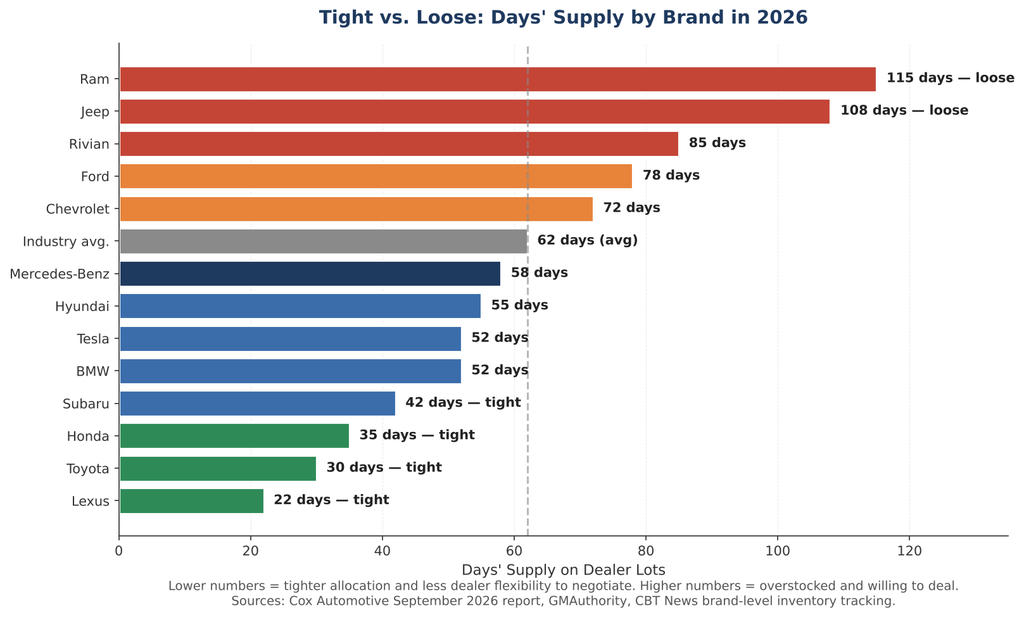
Not every brand is equally tight. In fact, as of Q3 2026 the spread across brands is massive — some are turning cars so fast they can’t keep up, while others have months of inventory piling up.
Three distinct brand groups emerge:
Tight-allocation brands (under 45 days): Lexus, Toyota, Honda, and Subaru. These brands have combined high demand with disciplined production — they intentionally build fewer cars than the market will absorb to maintain pricing power and avoid incentive wars. Buyers walking into Toyota or Honda showrooms in 2026 should expect limited inventory, limited negotiation, and factory-order waits for popular configurations. The upside: these vehicles hold their value exceptionally well. Our breakdown of how new cars depreciate over time covers why disciplined allocation and strong resale go together.
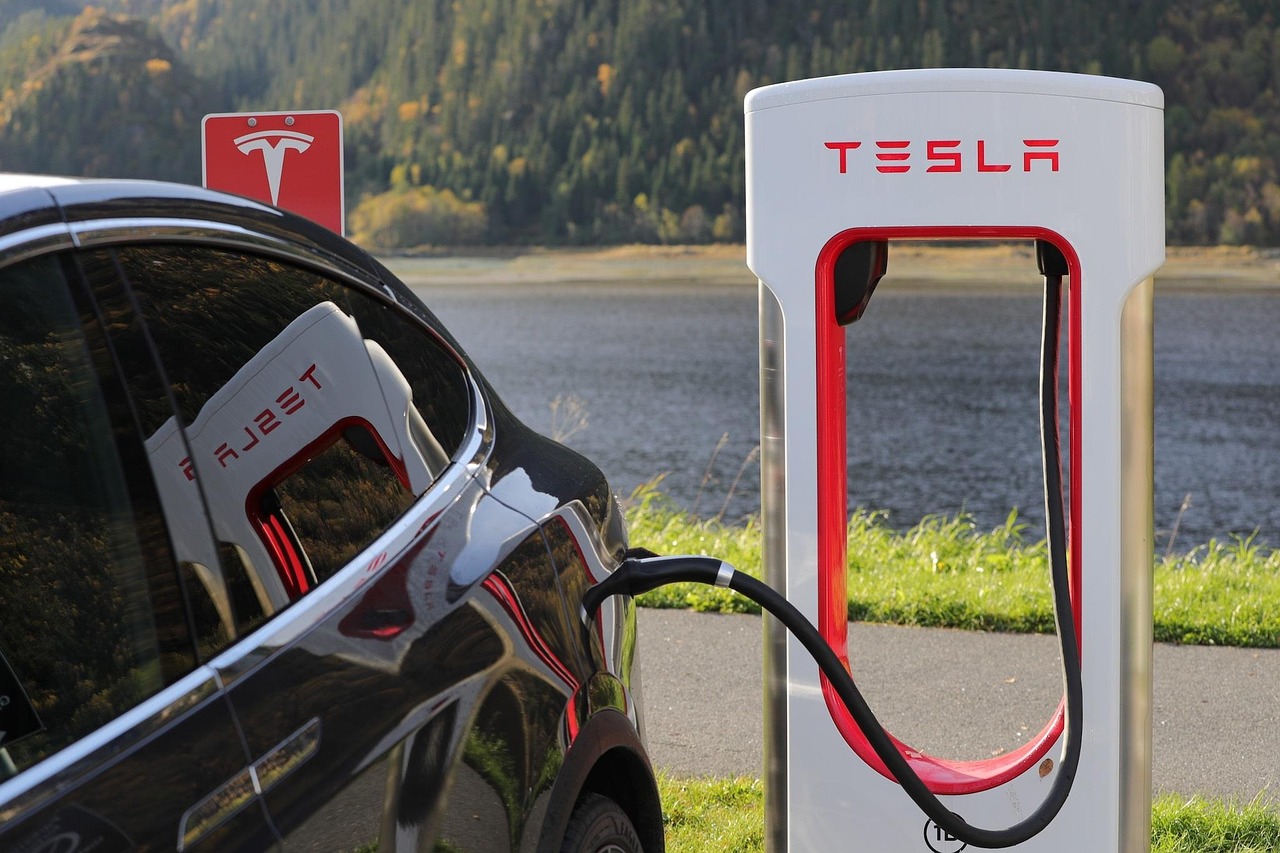
Moderate brands (50-65 days): BMW, Hyundai, Mercedes-Benz, Tesla. Mostly in the healthy band. Buyers can usually find specific configurations in-stock within a reasonable driving distance, and dealers have some room to negotiate — but not unlimited room. Tesla’s inclusion here reflects its unusual model: Tesla sells direct to consumers without a franchised dealer network, so what gets built shows up on the website inventory immediately rather than flowing through dealer allocation.
Loose / overstocked brands (75+ days): Chevrolet, Ford, Rivian, Jeep, and Ram. These brands are sitting on significant inventory for various reasons. GMAuthority’s monthly brand tracking and other industry sources show particularly loose supply for full-size pickups (Silverado, F-150, Ram 1500) and large SUVs (Tahoe, Expedition). Jeep and Ram’s Stellantis parent has had particular inventory challenges in 2026, with some Wrangler and Gladiator configurations sitting 150+ days. The upside for buyers: these are the best places to negotiate aggressively. Dealers overstocked on pickups will deal.
Important caveat: brand averages hide enormous model-level variation. Ford as a brand sits at 78 days’ supply, but the Maverick Hybrid runs under 25 days while the Edge sits at 150+. A Toyota Camry runs 25 days but a base trim Corolla can sit 60+ days. Always look at your specific model, not just the brand.
Factory Orders vs. In-Stock: The Buyer’s Decision
With allocation realities in mind, buyers face a fundamental choice: take what’s available in regional inventory, or factory-order the exact configuration you want and wait.
The In-Stock Route
Pros: Immediate delivery (or close to it). Ability to inspect the physical car before buying. No deposit risk. Available incentives and rebates often require in-stock purchase with a VIN assigned before offer expiration.
Cons: You compromise on configuration. You might accept a trim or color you didn’t originally want. Options packages are the dealer’s or distributor’s choice, not yours.
When in-stock makes sense: You’re flexible on configuration. You need the car now. The vehicle is from a loose-inventory brand or model where you can find exactly what you want in-stock. Incentives are strong and the offer window is tight.
The Factory-Order Route
Pros: You get the exact configuration, color, and options you want. Your ordered vehicle’s build sheet matches what you specified. In some cases, the invoice-based pricing is more transparent than in-stock negotiating because the dealer knows exactly what they’ll earn.
Cons: Wait times range from 6 weeks to 12+ months depending on manufacturer and model. Some manufacturers require non-refundable deposits. You can’t test-drive your specific car before committing. Prices and incentives can change between order and delivery (some manufacturers honor order-date pricing; others don’t).
When factory-order makes sense: You want a specific configuration not available in regional inventory. You’re shopping a tight-allocation brand where in-stock variety is limited. You care about options that matter structurally (towing package, specific drivetrain, enthusiast colors). Our coverage of which factory-order options are worth it covers which options protect resale and which don’t.
Brand-specific order realities in 2026:
- Toyota and Lexus: Factory ordering is encouraged but allocation-constrained. Expect 3-6 months on popular trims, longer on hybrids. Dealers submit “preference” lists that may or may not be fulfilled.
- Honda: More flexible than Toyota but still constrained on hybrid trims. 2-4 months typical for CR-V Hybrid and Accord Hybrid.
- Ford: Factory order (“retail order”) system is well-developed. Bronco orders have historically run 6-18 months; F-150 orders typically 8-14 weeks depending on configuration.
- Chevrolet, GM brands: Order system accepts customer specs. Delivery 2-4 months standard.
- BMW, Mercedes-Benz: European build-to-order is standard. Expect 4-6 months on most configurations, including European Delivery Program if you want to pick up in Germany.
- Subaru: Allocation-based with limited factory-order flexibility.
- Tesla, Rivian: Direct online ordering, no dealer involvement. Inventory vehicles ship in 1-4 weeks; custom orders in 4-12 weeks depending on model and configuration.
- Hyundai, Kia: Growing factory-order systems but allocation varies widely by model. Ioniq 5 and EV9 orders common; Palisade and Telluride more constrained.
Additional Dealer Markup (ADM) in 2026
The chip shortage normalized “additional dealer markup” stickers — dealers charging thousands of dollars above MSRP on tight-allocation models. In 2022-2023, ADM of $5,000-$15,000 was common across multiple brands.
As of late 2026, ADM has largely receded on mainstream models but hasn’t disappeared. Where it still shows up:
Hybrid and PHEV versions of popular models. Toyota RAV4 Hybrid, CR-V Hybrid, Highlander Hybrid, and several PHEVs still see occasional $1,000-$3,000 ADM at some dealers.
Limited-production vehicles. Honda Civic Type R, Toyota GR Corolla and GR86, Ford Mustang Dark Horse, and Lexus GX 550 Overtrail have all commanded ADM from multiple dealers throughout 2026.
Allocation-constrained premium models. The Lexus LX, Toyota Land Cruiser (returning model), and some trim levels of the 4Runner have seen markup.
New-launch EVs. Scout Terra and Traveler orders opened in 2025 with reservation-based pricing; early production units at launch dealers may carry markup.
Manufacturers actively discourage ADM — Ford, Toyota, and others have published statements warning dealers that excessive markup can result in allocation penalties — but enforcement is inconsistent. Practical reality: if a specific dealer is marking up the vehicle you want, drive farther. ADM is almost always a dealer-level decision, not a manufacturer requirement.
How to Actually Use Allocation Knowledge
Here’s what matters in practice:
Shop multiple dealers across a wide geographic area. Your closest dealer isn’t necessarily the one with the best allocation. Within a 150-mile radius, a buyer can usually find 3-8 franchised dealers of the same brand. One of them will have what you want, or can get it faster.
Call the Internet Sales Manager, not the general sales line. Most dealers now have a dedicated internet sales department that will give you accurate inventory information (incoming cars, not just current lot stock) without the full negotiation theater.
Ask specifically about “cars in transit.” A vehicle in transit from factory or port is often available for pre-sale with a smaller deposit than a factory order. Ask: “What do you have on lot, what’s in transit in the next 60 days, and what can you order?”
Use OEM inventory tools. Toyota, Ford, Honda, Hyundai, and most mainstream brands let you search inventory across all dealers in your state or region directly from their consumer websites. This bypasses the local-dealer bottleneck.
Factor delivery location. Many manufacturers allow dealer-to-dealer trades to get a specific car from another dealer in the region. Your local dealer can often source a car from another dealer within days — ask explicitly if they’ll do a dealer trade for your specification.
Consider timing. End-of-month, end-of-quarter, and end-of-model-year create pressure on dealers to move units. Dealers facing month-end volume quotas are more willing to negotiate. Our breakdown of how seasonality affects used car prices covers the broader timing patterns that apply across the new and used market.
Check incoming “custom orders that fell through.” Customers sometimes place factory orders and then abandon them before delivery. Those orphan orders become dealer stock when they arrive — and are often sold at invoice because the dealer wasn’t expecting them. Ask your Internet Sales Manager about these.
Shop allocation-loose brands for the best deals. If you’re brand-flexible, a Ram 1500, Ford F-150, or Chevy Silverado at 100+ days’ supply in 2026 is a dramatically better negotiating environment than any tight-allocation Toyota.
Factor allocation into trade-in timing. Our breakdown of how trade-in equity affects loan decisions covers the full math, but one angle worth knowing: if you’re trading a hot allocation-tight model, your trade-in is worth more. If you’re trading an overstocked model, less.
How Allocation Shapes the Total Cost of Ownership
Allocation doesn’t just determine whether you can find the car. It shapes what you pay for it over the whole ownership period. Our pillar guide on total cost of ownership beyond the purchase price breaks down every component, but allocation affects several of them directly:
Purchase price. Tight allocation = less negotiation room = closer to MSRP or above. Loose allocation = more negotiation room = below MSRP with incentives.
Depreciation. Allocation-tight brands (Toyota, Honda, Lexus, Subaru) hold value best precisely because manufacturers resist flooding the market. Allocation-loose brands depreciate faster.
Trade-in equity. The vehicle you buy today becomes the trade-in you sell in 3-5 years. Buying a disciplined-allocation model means a stronger trade-in position later.
The compounding effect: paying $3,000 more for a Toyota RAV4 with less negotiating room might still cost less over 5 years than getting a $5,000 discount on a Ford Edge, because the RAV4’s depreciation and trade-in value make up the difference and more. Allocation affects not just today’s price but every subsequent dollar you tie up in that vehicle.
Bottom Line
Dealer allocation is the invisible system that determines which cars show up where, and for how much. In 2026, the industry has largely recovered from the chip shortage, but allocation tightness varies enormously by brand. Toyota, Honda, Lexus, and Subaru remain highly disciplined — buyers accept constrained choice and firm pricing in exchange for strong value retention. Ford, Chevrolet, Ram, Jeep, and Rivian are sitting on comfortable inventory — buyers have real leverage and real negotiation room.
The best allocation strategy depends on your priorities. If you want a specific allocation-tight model, be flexible on configuration, shop multiple dealers across a wide area, consider factory ordering, and recognize that MSRP is often the realistic ceiling you can hope for. If you have flexibility on brand, lean toward loose-allocation segments where the negotiation environment favors you.
Either way, understanding how allocation actually works puts you in a different conversation at the dealership than the buyers who don’t. The salesperson won’t volunteer which models are tight, which are flooded, which incentives apply, or which configurations your dealer can actually order. You can walk in already knowing — and the math works out differently when you do.
Sources and Further Reading
CarEdge — Popular 20 Real Prices and Inventory for America’s Best-Selling Vehicleser can save you time, money, and frustration. Happy car shopping!
Cox Automotive — August 2026 New Vehicle Inventory Report
Cox Automotive — September 2026 New Vehicle Inventory Report
S&P Global Mobility — February 2026 New Vehicle Inventory Trends
CBT News — U.S. New Vehicle Inventory Slips in June While Prices Rise
CBT News — New Vehicle Inventory Tightens as Auto Industry Enters 2026
GMAuthority — Chevy Dealer Inventory Stable in June 2026
GMAuthority — Buick Dealer Inventory Drops in August 2026
Lotlinx — Q3 2026 Vincensus Report on Dealer Inventory Risk
CarPro — New Vehicle Inventories Tighten Up Due to Stronger July Sales
Mercer Capital — July 2026 SAAR Auto Dealer Valuation Insights
DealershipGuy — 2026 Model Year Rollout Lags as Tariff Uncertainty Lingers
























Leave a Reply
You must be logged in to post a comment.