






















The “0% APR for 60 months” sign in the dealer window is the most visible piece of marketing in all of automotive retail. It is also one of the most misunderstood. The buyer sees it as the best possible deal. The dealer knows it costs the manufacturer real money. The finance manager knows it’s gated by credit requirements most shoppers don’t meet. And the shopper almost never asks the question that determines whether it’s actually a good deal: would the same manufacturer have given me a $3,500 cash rebate if I’d skipped the 0% and taken the standard rate instead?
This article decodes OEM-subsidized financing — how it actually works, who really qualifies, when 0% APR beats a rebate and when the rebate beats 0%, and the uncomfortable truth about the captive subprime lending that gets marketed as “OEM financing” to buyers with lower credit scores. It builds on and connects to the other pieces in the Financing cluster: How Interest Rates Impact Car Loans, How Loan Terms Affect Total Cost of Ownership, How Trade-In Equity Affects Loan Decisions, and the Total Cost of Ownership Beyond the Purchase Price pillar.
What “OEM-Subsidized” Actually Means
Every major automaker owns or partners with a dedicated finance arm — the captive lender. Toyota Financial Services, Ford Motor Credit, GM Financial, Hyundai Motor Finance, Honda Financial Services, Nissan Motor Acceptance Corporation, Stellantis Financial Services / Chrysler Capital, BMW Financial Services, and so on. These finance arms exist to make it easier to sell the vehicles the manufacturer builds. That is their core job.
When demand for a specific model is softer than the automaker wants, or when inventory is piling up at specific trim levels, the manufacturer will “subvent” (subsidize) the finance arm’s rate on that vehicle. The automaker pays the finance arm the difference between what a customer actually pays and what the loan would cost at market rate. If the market rate for a 60-month auto loan is 7.5% and the automaker is advertising 0% APR, the automaker is effectively paying the lender roughly 7.5% of the financed amount over the life of the loan, in exchange for moving a vehicle off the lot.
That cost comes out of the automaker’s incentive budget — the same budget that funds cash rebates, lease specials, loyalty bonuses, and conquest incentives. Which is why automakers almost never offer both 0% APR and a large cash rebate on the same vehicle at the same time; the shopper is almost always choosing between them. Understanding that choice is the most consequential financial decision in the typical new-car transaction.
The four main types of OEM-subsidized offers:
- Low-APR financing — 0% to roughly 3.9% on loans up to 60 or 72 months, usually with specific credit score thresholds and model restrictions
- Cash rebates — manufacturer-funded discounts applied directly to the price, typically $500 to $7,500 depending on model and incentive aggressiveness
- Lease specials — subsidized lease terms with reduced money factors (the lease equivalent of APR) or inflated residual values
- Loyalty, conquest, and demographic bonuses — stacked on top of base incentives for current brand owners, competitive-brand owners, military, first responders, recent college grads, etc.
These programs change monthly and vary by region, model, trim level, inventory levels, and promotional period. The specific offers available this week on a Toyota RAV4 XLE Hybrid in Dallas may be entirely different from those on a Toyota RAV4 LE in Boston.
The 0% APR vs. Rebate Math
The single question that matters most when evaluating an OEM financing offer is: at what loan amount does the 0% APR save me more money than the cash rebate would?
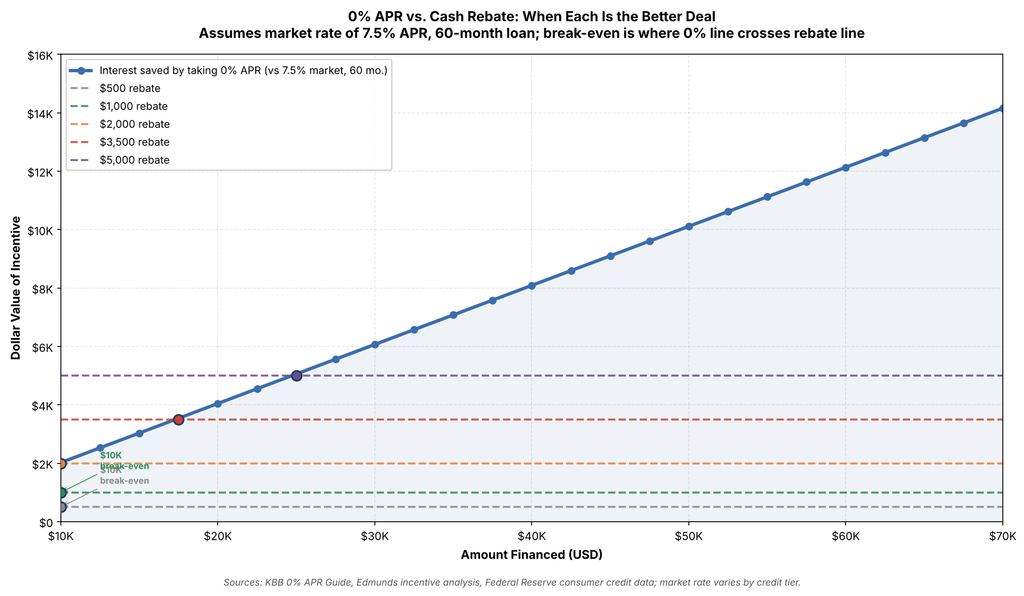
The math is straightforward but almost no one actually runs it. The dollar value of 0% APR is the total interest you would have paid at market rate — call it 7.5% for a prime borrower in late 2026 — over the life of the loan. The dollar value of a cash rebate is the rebate amount, period.
Using 7.5% market rate on a 60-month loan as the baseline, the break-even points work out like this:
- $500 rebate is beaten by 0% APR on any loan above about $10,000
- $1,000 rebate is beaten by 0% APR on loans above about $12,500
- $2,000 rebate is beaten by 0% APR on loans above about $17,500
- $3,500 rebate is beaten by 0% APR on loans above about $25,000
- $5,000 rebate is beaten by 0% APR on loans above about $35,000
The rule of thumb: on most new-car transactions (which typically involve loan amounts between $25,000 and $50,000), 0% APR outperforms rebates of roughly $3,500 or less, and rebates of $5,000+ outperform 0% APR unless the loan amount is very large.
Three important modifications to this basic math:
First, the market rate matters. If you’re actually going to borrow at 5% from a credit union rather than 7.5% at the dealer, the break-even moves significantly — the 0% APR advantage shrinks because your market rate is lower. A shopper with credit-union access or a strong bank relationship who could get 5.5% at market should treat the 0% APR as saving them only the 5.5%-market-rate interest, not the 7.5% dealer rate.
Second, the term matters. 0% APR offers typically run 36, 48, 60, or 72 months. A longer term means more interest you’d have paid at market, so a longer-term 0% offer is worth more. A 72-month 0% APR is substantially more valuable than a 36-month 0%, but it also means a larger total loan commitment and more depreciation exposure (covered in the How Loan Terms Affect Total Cost of Ownership article).
Third, the rebate can be invested. A shopper who takes a $3,000 cash rebate and puts it toward a larger down payment reduces the loan amount — which reduces interest on the remaining balance, even at market rate. The $3,000 rebate functionally worth more than its face value in this scenario.
A practical approach: ask the dealer to quote both options with real numbers. Any legitimate finance manager can print the two scenarios side by side. If they can’t or won’t, that itself is a red flag.
Who Actually Qualifies for the Advertised Deals
The second uncomfortable truth about 0% APR offers is that they are gated by credit requirements most shoppers don’t meet. The “0% APR” banner in the dealership window is usually followed by asterisks that reference “qualified buyers” or “subject to credit approval” — language designed to make clear that the advertised rate is available only to a narrow slice of the shopping population.
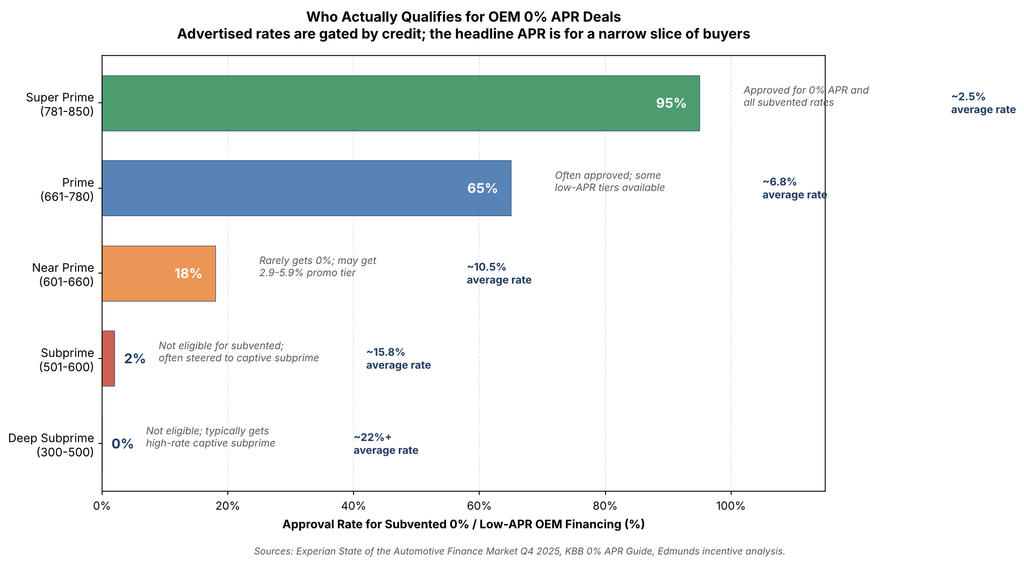
Experian’s State of the Automotive Finance Market data, which breaks down auto loan outcomes by credit tier, tells the real story. Only Super Prime borrowers (FICO 781-850) consistently qualify for 0% APR and other subvented rates — roughly 95% get approved when they apply. Prime borrowers (661-780) see about 65% approval, often for low-APR deals (2.9%, 3.9%) rather than the headline 0%. Near Prime (601-660) rarely gets 0% but may qualify for the 2.9%-5.9% promotional tiers. Subprime (501-600) gets approved for subvented financing only about 2% of the time. Deep Subprime (300-500) effectively never qualifies.
The practical implication is that the shopper walking into a dealership with a 650 FICO who saw the “0% APR” ad is almost certainly not going to get 0% APR. What they will get, if they finance through the dealer, is either a mid-tier promotional rate (if the model has one) or — more commonly — a market-rate loan that doesn’t carry any of the subsidy benefit.
This creates a specific bait-and-switch risk. The buyer comes in attracted by the 0% advertisement. When their credit application doesn’t qualify, the dealer offers them a different deal — maybe 6.9% APR plus a $2,000 rebate — and the buyer, feeling committed, accepts it. The problem is that 6.9% at the dealer is often worse than what the same buyer could get at a credit union, and the $2,000 rebate may not be worth the rate premium.
The defensive move is to get pre-approved for a loan before setting foot in the dealership. A credit union, bank, or credit union-adjacent lender (PenFed, Navy Federal, Alliant, DCU, etc.) will quote a rate based on actual credit review. The shopper then walks into the dealership knowing exactly what their market rate is and can evaluate the dealer’s offer (subvented or not) against a real alternative. If the dealer can beat the pre-approval rate — including by offering true 0% APR — great. If they can’t, the pre-approval is the path to take.
The Captive Subprime Trap
The most predatory corner of OEM financing isn’t the 0% APR teaser rate — it’s what happens to buyers with poor credit who finance through the dealership. The term “OEM financing” gets applied loosely enough that buyers often don’t realize they aren’t getting anything approaching the subvented rates the manufacturer advertises.
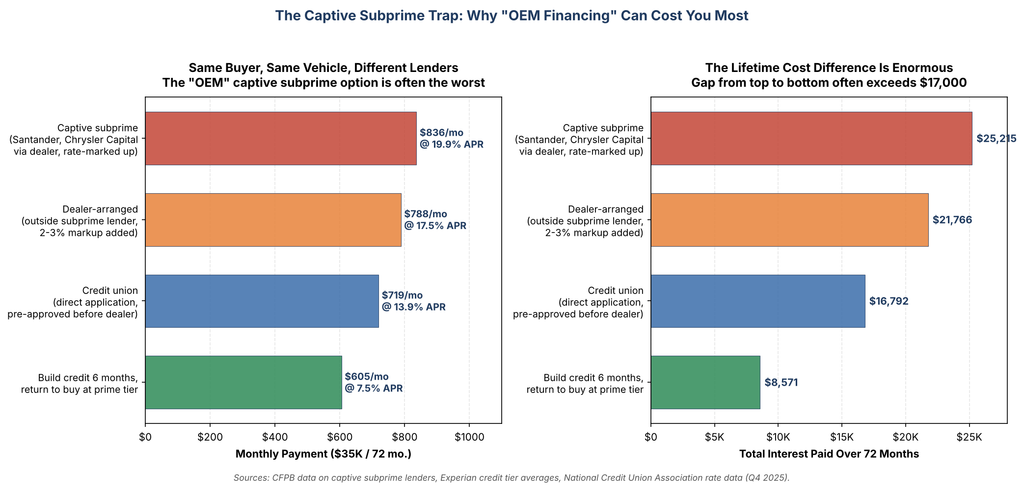
Here’s how it typically works. A customer with a 575 FICO applies for financing on a $35,000 vehicle. The dealer submits the application to multiple lenders. The captive finance arm (Toyota Financial, Ford Credit, etc.) usually declines or kicks the application to a subprime-focused captive partner. In Stellantis’s case, that partner has historically been Santander Consumer USA (operating as Chrysler Capital). GM uses GM Financial for its subprime book. Credit Acceptance Corporation and Westlake Financial serve many dealer networks across brands.
The subprime lender approves at a rate — say, 17.5% APR — and sends the dealer a “buy rate” quote. The dealer then adds a markup, often 2-3%, before presenting the rate to the customer. The customer, facing a vehicle they want and no obvious alternative, signs at 19.9% APR. The dealer pockets the markup (sometimes called “dealer reserve” or “participation”), the lender takes its spread, and the vehicle moves off the lot.
The problem is that this same buyer often has materially better alternatives they don’t know about. A credit union, especially one that specializes in subprime lending with member-focused missions, might have offered 13-14% on the same deal — not great, but a lot better than 19.9%. Waiting six months to rebuild credit, paying down revolving balances, and returning to the market as a Near Prime borrower might have gotten the buyer to 7.5%. The lifetime cost difference across these paths on a 72-month loan can easily exceed $17,000 — more than half the price of the vehicle.
The Consumer Financial Protection Bureau (CFPB) has had Santander and related captive subprime lenders in its sights for years, with multiple enforcement actions over the past decade for fair lending violations and deceptive practices. The industry has adjusted but the fundamental economics — dealer markup on subprime loans, “subsidized” marketing of what are actually above-market rates, limited rate disclosure to borrowers with weaker bargaining positions — persist.
For buyers with credit below 640, the single most important financial move is to shop lenders independently before visiting a dealer. Local credit unions, Navy Federal (for military and family members), PenFed, state-chartered credit unions, and online lenders like myAutoLoan.com, LightStream, and Capital One Auto Finance all offer pre-approvals that establish a floor on what you should accept at the dealership. Without a pre-approval benchmark, any dealer-arranged rate — “OEM-subsidized” or not — may be significantly above what the same borrower could have gotten elsewhere.
The EV Incentive Landscape Has Shifted
The federal $7,500 EV tax credit that defined the new-EV purchase economics for years is gone. The One Big Beautiful Bill Act (OBBBA) signed in 2025 eliminated the credit effective September 30, 2025. Buyers after that date cannot claim the credit, and automakers lost the ability to apply it at point-of-sale as a dealer-level discount.
In place of the EV-specific credit, OBBBA created an auto loan interest deduction for US-assembled vehicles — regardless of powertrain (gas, hybrid, or EV). This means buyers who finance a vehicle assembled in the US can deduct a portion of their loan interest on their federal taxes, up to specified limits. The deduction effectively shifts the incentive toward where a vehicle is built rather than what type it is. For OEMs with major US assembly footprints (Toyota, Honda, Hyundai, Kia, Ford, GM, Tesla, Rivian, BMW, Mercedes, Volkswagen, Nissan, Stellantis), this partially offsets the lost EV credit.
Some states continue to offer EV-specific incentives, though the landscape varies significantly. California’s Clean Vehicle Rebate Project (CVRP) has been inconsistent in funding; Governor Newsom announced in 2025 that California would not replace the federal $7,500 credit. New York’s Drive Clean Rebate continues to offer up to $2,000 for eligible EVs. Colorado, Connecticut, Massachusetts, New Jersey, Oregon, and several other states maintain state-level rebates ranging from $1,000 to $5,000. The specific amounts, eligibility, and whether the incentive is applied at point-of-sale or requires a post-purchase application vary. A state-by-state check at purchase time is essential; relying on old guidance is risky.
Automaker response to the federal credit ending has been aggressive incentive deployment on EV inventory. Ford and GM both maintained EV-specific discounts on Mach-E, Lightning, Blazer EV, Equinox EV, and related vehicles through late 2025 and into 2026 to clear inventory that had been priced assuming the federal credit. Hyundai and Kia have run similar programs on Ioniq 5, Ioniq 6, EV6, and EV9. Tesla continues to use direct price cuts and financing specials rather than traditional dealer incentives.
The practical implication for an EV shopper is that the federal credit math no longer applies. If you see commentary from 2024 or earlier that assumes the $7,500 credit, discard it. Current EV financing requires evaluating only the OEM-level incentives, state-level rebates if available, and the OBBBA auto loan interest deduction — all of which require current research rather than relying on prior assumptions. The The Economics of EV Charging Infrastructure and Why EVs Have Different Insurance Costs articles cover the broader EV ownership cost picture that shapes whether the remaining incentives are enough to justify the purchase for a given buyer.
How to Actually Shop OEM Financing
Putting all this together, the practical shopping process that gets to the best available deal is specific:
- Check your actual credit score at myfico.com or through your bank. The score the dealer pulls may be slightly different than what you see (FICO Auto Score vs. FICO 8), but knowing your range is essential for calibrating expectations.
- Get pre-approved by at least two independent lenders before visiting any dealership. One should be a credit union (lowest rates for most borrowers); one should be a bank or online lender. The pre-approval quotes establish what market rate you actually qualify for.
- Research the specific OEM incentives available on the models you’re considering. Manufacturer websites publish current offers; Edmunds.com and CarsDirect.com aggregate them with more detail. Look for the specific stack: 0% APR option + rebate option + lease option + loyalty/conquest bonuses + inventory discounts.
- Run the rebate vs. APR math using the break-even approach above. Take the rebate when the rebate dollars exceed what 0% APR would save you against your actual market rate (your pre-approval). Take the 0% APR when the math reverses.
- Calculate out-the-door price before discussing financing. The incentive math is cleaner when you’ve already negotiated the vehicle price separately from the financing terms.
- Decline dealer rate markup. If the dealer quotes you a rate higher than your pre-approval, tell them you’ll use your pre-approval. Many dealers will match or beat the pre-approved rate at that point; the markup only works on buyers who don’t know it exists.
- Watch for hidden costs. Extended warranties, gap insurance at dealer markup, document fees above state limits, and dealer-installed add-ons can erode the benefit of a good financing rate quickly.
- Read the fine print on 0% APR specifically. Payment schedules are tighter (shorter terms often make monthly payments higher than market-rate loans with longer terms would produce). Missed payment consequences can be severe, including conversion to a much higher rate on some programs.
- Consider the trade-in and down payment separately. Rolling negative equity from a previous vehicle into a new loan undoes most of the benefit of a good rate. The How Trade-In Equity Affects Loan Decisions article covers this specifically.
- Walk away if the numbers don’t work. Dealers’ positions soften substantially at the walk-away moment; this is often when the best offers appear.
What Shoppers Get Wrong
A few specific traps worth naming:
Chasing the headline rate without the rebate. If the rebate math favors the rebate but the shopper takes 0% because it sounds better, they lose real money. The break-even chart earlier shows how often this happens on smaller loan amounts.
Assuming they qualify. Taking the 0% APR advertisement at face value and not pre-approving elsewhere means walking in blind. If the dealer approves at 6.9% instead of the advertised 0%, the shopper has no benchmark for what they should actually be paying.
Letting the dealer pad the term. 0% APR on a 72-month loan sounds great until the shopper realizes their total payment is on a $43,000 vehicle they’ve committed to for six years. Longer terms mean more depreciation exposure, less likelihood of reaching positive equity.
Ignoring captive subprime markups. Buyers with weaker credit often accept dealer-arranged subprime loans without comparing to credit unions or online lenders. The 2-3% dealer markup on a subprime rate can easily add $5,000-$10,000 in interest over the life of the loan.
Treating lease specials as straightforward. Subvented leases are OEM incentive programs too, but the math is harder to evaluate because of residual value manipulation, money factor masking, and complex fee structures. For lease shoppers, the How Loan Terms Affect Total Cost of Ownership article covers the comparison framework.
Not stacking incentives. Loyalty bonuses, military discounts, conquest incentives, and recent-graduate bonuses can often be stacked on top of base rebates. Many shoppers don’t ask what additional programs they qualify for, and dealers don’t always volunteer them.
The Takeaway
OEM-subsidized financing is real, meaningful, and worth understanding — but it is also more complicated and more selectively available than the marketing suggests. The 0% APR headlines go mostly to Super Prime borrowers who could have gotten competitive rates elsewhere anyway. The deepest rebates typically come with trade-offs that make them better or worse than low APR offers depending on loan size and term. The captive subprime lending that gets marketed as “OEM financing” to buyers with poor credit is often the worst option available to those buyers, not the best.
The practical defenses are the same across all of this: pre-approve with independent lenders before visiting the dealer, run the rebate-versus-APR math with your actual market rate rather than the dealer’s standard rate, read the fine print on term and credit requirements, and never accept dealer-arranged subprime without comparing against credit union alternatives.
The federal EV tax credit that shaped electric vehicle financing math for years ended on September 30, 2025. State-level incentives continue in some jurisdictions but are inconsistent. The new auto loan interest deduction for US-assembled vehicles applies regardless of powertrain and partially compensates. EV shoppers should verify current incentives carefully rather than relying on pre-2026 guidance.
The dealers who structure these programs understand the math. The shoppers who get the best deals are the ones who understand it too.
External Sources
- KBB — Zero APR Car Loan Guide
- Experian — State of the Automotive Finance Market Q4 2025
- CBT News — Goodbye to $7,500: The EV Tax Credit Ends September 30
- Automotive World — US Eliminates the $7,500 EV Federal Tax Credit
- Crediful — How to Get a 0% APR Car Loan in 2026
- Real Car Tips — Decide Between 0% and Cash Rebate
- Edmunds — Incentives and Rebates
- CarsDirect — New Car Deals and Incentives
- CFPB — Auto Finance Enforcement Actions
- Insurance.com — How Credit Score Affects Car Loan Rates
- The Nation — Subprime Auto Lending Predatory Practices
- Kiplinger — How the EV Tax Credit Works
- Federal Reserve — Consumer Credit G.19 Report






















Leave a Reply
You must be logged in to post a comment.