




























The average 60-month new car loan from a credit union in Q2 2025 carried a 5.75% APR. The average 60-month new car loan from a bank in the same period carried 7.49%. Multiplied across the typical loan size and term, that gap — 1.74 percentage points — translates to roughly $1,500 to $2,000 in interest savings over the life of a typical auto loan. Credit unions have been quietly beating banks on auto loan rates for decades, but the gap has become more pronounced as banks and captive lenders have raised rates faster than credit unions over the last three years.
This article is the practical playbook for taking advantage of credit union auto lending: how to find a CU you qualify for (most people qualify for several), how to actually join one (often $5 and a few minutes online), how to get a pre-approval that works at the dealer, and how to use that pre-approval to negotiate against OEM captive financing. It also covers something the standard CU pitch leaves out: the specific CUs that offer discounted rates for EV and hybrid buyers, which can push already-competitive rates another 0.5 to 1.25 percentage points lower.
This piece builds on the OEM-Subsidized Financing Programs Explained article, which covered when captive financing beats credit union rates and when it doesn’t. The companion How Auto Lending Is Regulated piece covers the consumer protection framework that makes the whole process work in your favor when you know your rights.
Why Credit Unions Win on Rate
Credit unions are structurally different from banks in a way that directly affects auto loan pricing. They are member-owned, not-for-profit financial cooperatives. Where a bank generates returns for shareholders, a credit union returns its “profits” to members through better rates on loans and deposits. The National Credit Union Administration (NCUA), the federal regulator, tracks the rate advantage across the industry and publishes it quarterly. The rate gap has been consistent for decades and has widened recently.
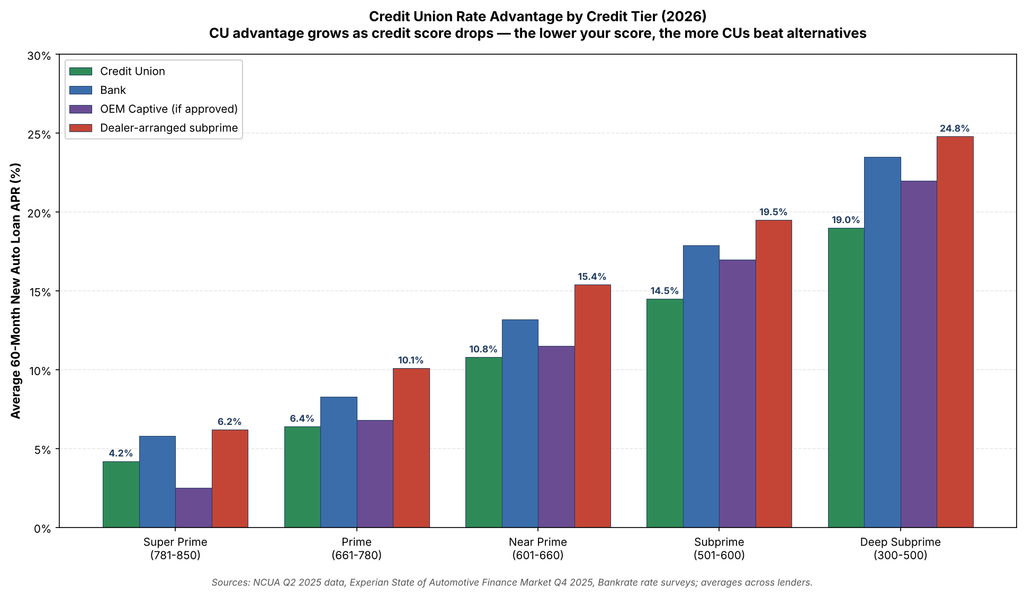
The rate advantage varies by credit tier, and the variation matters more than the headline average suggests. For Super Prime borrowers (FICO 781-850), the typical credit union offers around 4.2% APR on a 60-month new car loan. A bank will come in around 5.8%. An OEM captive — if the shopper qualifies for subvented financing — can offer as low as 2.5% (the 0% APR specials target this tier). For this tier, the OEM captive is often the best deal when subvented financing is available on the specific vehicle; the credit union is a solid backup.
For Prime borrowers (661-780), credit unions average 6.4% against bank rates of 8.3%. OEM captives sit around 6.8% at this tier because the subvented programs mostly don’t extend here. The CU is typically the best deal.
For Near Prime (601-660), the gap widens. CUs average 10.8%; banks run 13.2%; dealer-arranged financing can hit 15.4%. The CU is almost always the best option available.
For Subprime (501-600) and Deep Subprime (300-500), credit unions remain the best mainstream option by meaningful margins. The average deep subprime borrower pays 19% at a credit union versus 24.8% through dealer-arranged subprime. Over a 72-month $35,000 loan, that rate difference translates to roughly $8,000 in saved interest.
The structural explanation for why the CU advantage grows at lower credit tiers is that credit unions are not under the same pressure to extract maximum revenue from subprime borrowers that captive subprime lenders face. Credit unions often offer financial counseling, deferment programs, and refinancing options to members in temporary hardship — practices that would cost a profit-maximizing lender money and therefore don’t happen at most banks and subprime shops.
Finding a Credit Union You Can Actually Join
The most common objection to credit union auto loans is “I don’t qualify for a credit union.” For most Americans, this is false, usually by a wide margin. The membership criteria that once restricted CUs to specific employer groups or communities have loosened substantially over the last two decades. Multiple large, competitive CUs are now essentially open to anyone willing to pay a one-time $5 fee to an affiliated charity.
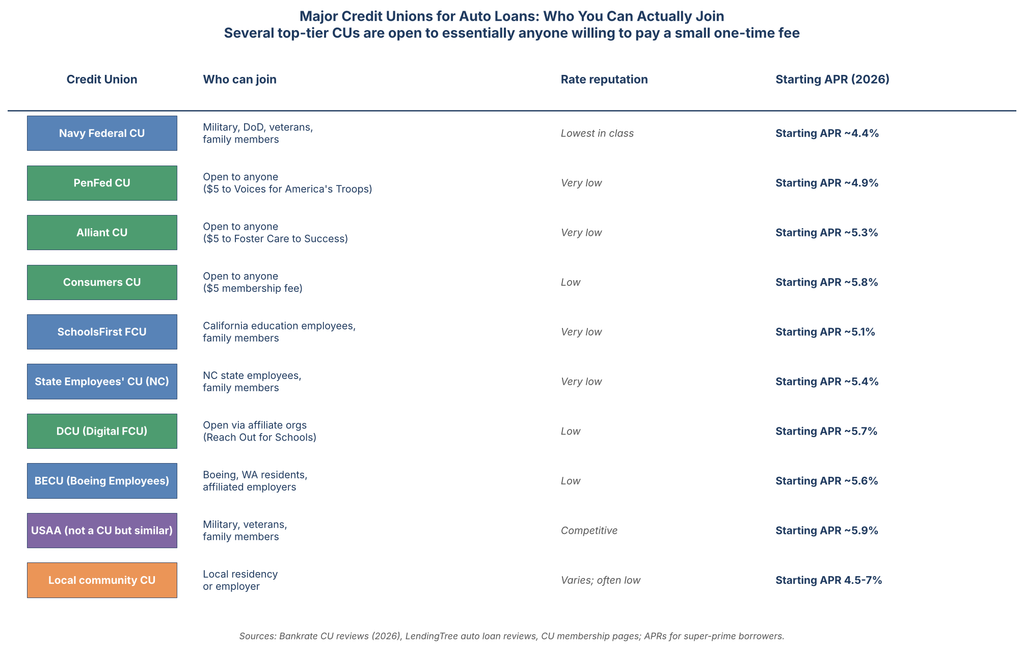
PenFed Credit Union is the single most widely accessible premium CU. Original eligibility was tied to the Pentagon and defense employees; today anyone can join by making a $5 donation to Voices for America’s Troops during the application. PenFed’s starting new auto APR of roughly 4.9% is among the lowest in the industry.
Alliant Credit Union is similarly open — a $5 donation to Foster Care to Success satisfies the affiliation requirement. Alliant’s starting APR of about 5.3% and its fully online application process make it a frequent top pick in objective reviews.
Consumers Credit Union (not to be confused with Consumers Union, the publisher) allows anyone to join through a $5 membership fee and offers starting APRs around 5.8% with TrueCar integration for vehicle shopping.
Navy Federal Credit Union is restricted but the restriction is broader than most people realize. Eligibility covers active military, DoD civilians, veterans, and their family members — immediate family and extended family. The “family member” criterion sweeps in millions of Americans who don’t realize they qualify. NFCU’s rates are typically the lowest in the industry at every tier.
SchoolsFirst Federal Credit Union serves California education employees and their families, offering starting APRs around 5.1%.
State Employees’ Credit Union (NC) serves North Carolina state employees and their families, with starting APRs around 5.4%.
DCU (Digital Federal Credit Union) allows affiliation through various non-profit organizations including Reach Out for Schools, making it effectively open to most applicants.
BECU (originally Boeing Employees Credit Union) serves Washington state residents, Boeing employees nationwide, and affiliated employer groups.
Local community credit unions throughout the US serve specific metropolitan areas or counties. These often have the most flexible rates for members and can beat the national CUs in specific markets. Checking your local community CU is worth 10 minutes.
USAA is technically a bank, not a credit union, but operates on similar principles and serves current and former military and their families. Rates are competitive but typically not quite as aggressive as PenFed or Navy Federal.
For most Americans, the correct answer to “which CU should I use?” is: apply to two or three that you qualify for and take the best rate. Most CUs offer pre-approvals that don’t ding your credit beyond a single soft or hard pull, and multiple pre-approvals within a 14-day window are typically treated as a single inquiry by the credit scoring models.
The Pre-Approval Process That Actually Works
The point of CU pre-approval is not primarily to use the CU’s financing — though that often ends up being the outcome. The point is to establish a documented alternative rate that you can use to pressure the dealer’s financing department into either matching or beating it.
The process is specific:
Step 1: Open membership. Most CUs let you join entirely online in 10-15 minutes. You’ll typically need a government ID, Social Security number, proof of address, and the $5-25 initial deposit or membership fee. Membership is usually immediate, though some CUs impose a 30-day waiting period before you can borrow.
Step 2: Apply for pre-approval. Through the CU’s website or mobile app. You’ll provide income information, employment details, and authorize a credit check. Most CUs provide a decision within minutes to 48 hours.
Step 3: Get the pre-approval terms in writing. You want a specific rate (not a “starting at” range), a specific maximum loan amount, a specific term (often 60 or 72 months), and a specific expiration date (typically 30-60 days from issuance). PenFed, Alliant, Navy Federal, and most major CUs provide this documentation electronically.
Step 4: Shop the vehicle separately. Before engaging with dealer financing at all, know what you want to buy and the out-the-door price you’re willing to pay. Don’t let the dealer start the conversation with monthly payment numbers that bundle vehicle price, financing, and add-ons together.
Step 5: Present the pre-approval to the dealer. After you’ve agreed on vehicle price, when the dealer brings up financing, show them your CU pre-approval and ask whether they can beat it. Many dealers will match or beat it because their captive lenders pay them a bonus (called “flats” or “rebates”) for financing through them. A dealer who can’t or won’t beat your CU rate is a dealer whose financing you should decline.
Step 6: If the dealer beats it, read the paperwork carefully. Dealers sometimes “beat” CU rates by extending the term (reducing monthly payment but increasing total interest), by rolling in dealer add-ons, or by selling extended warranties that pay the dealer significant commissions. The APR comparison must be like-for-like on term, loan amount, and included add-ons.
Step 7: Use the pre-approval for the purchase if the dealer can’t beat it. The CU typically mails you a check (made out to the dealer) within 1-3 days of you confirming you want to use the pre-approval. Some CUs have arrangements with specific dealers that allow direct transfer. Either way, the mechanics are straightforward once pre-approval is in hand.
The leverage is real. Dealers make significant money on financing — the industry term is “F&I income” — and they would rather beat a CU rate by a small amount than lose the financing profit entirely to the CU. Walking in with pre-approval shifts the negotiation from “what can you afford per month” to “what is the real APR you’re offering.”
EV and Green Vehicle Loan Discounts
A growing number of credit unions have begun offering explicit discounts on auto loans for electric vehicles, hybrids, and other low-emission vehicles. The discount amounts are modest — typically 0.25 to 1.25 percentage points off the standard new auto rate — but on a 60- to 72-month loan, they add up to meaningful money and they further widen the CU vs. captive gap for EV buyers.
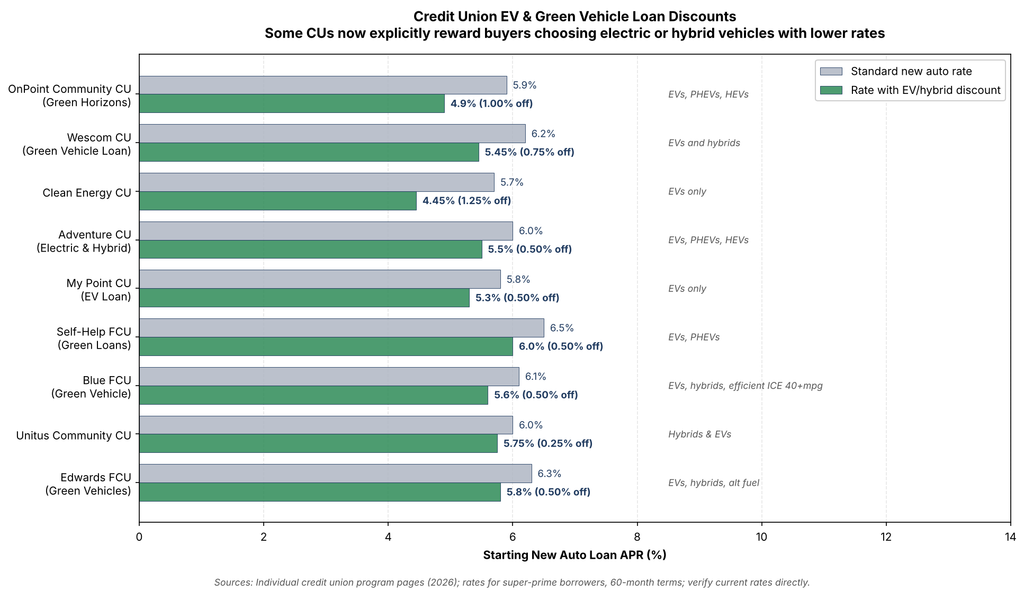
OnPoint Community Credit Union offers a Green Horizons program with a 1.00% discount on EVs, PHEVs, and hybrids, bringing their new auto rate from ~5.9% to ~4.9%.
Clean Energy Credit Union specializes in green financing and offers the deepest discount — 1.25% off standard rates for EVs, bringing their EV rate to approximately 4.45%. Clean Energy is a national CU specifically chartered to finance clean energy projects.
Wescom Credit Union, Adventure Credit Union, My Point Credit Union, Self-Help Federal Credit Union, Blue Federal Credit Union, Unitus Community Credit Union, and Edwards Federal Credit Union all offer 0.25% to 0.75% discounts on green vehicles. Eligibility varies — some cover EVs only, some include PHEVs and full hybrids, a few extend to efficient conventional vehicles meeting mileage thresholds.
The practical combination of CU rates plus EV discounts makes credit unions substantially more attractive for EV buyers in the current environment. With the federal $7,500 EV tax credit having ended September 30, 2025 (covered in the OEM-Subsidized Financing Programs Explained article), any mechanism that reduces EV ownership cost matters more than it did a year ago. The remaining state-level EV rebates plus a CU green loan discount can offset a meaningful portion of what the federal credit used to provide.
The Why EVs Have Different Insurance Costs and The Economics of EV Charging Infrastructure articles cover the broader ownership cost picture for EVs that shapes whether the CU financing advantage is enough to swing the overall math.
Where Credit Unions Fall Short
The CU advantage is not universal. For some buyers and some vehicles, other options genuinely win. Specifically:
Super-prime borrowers on subvented OEM financing. When a manufacturer is offering 0% APR on a specific model to clear inventory, no CU can match that rate. The CU advantage reasserts only when the subvented offer doesn’t apply (wrong model, wrong trim, wrong month) or when the rebate option is more valuable than the 0% APR (covered in the OEM-Subsidized Financing Programs Explained article’s break-even math).
Specialized vehicles with limited CU underwriting. Exotic cars, salvage-title vehicles, kit cars, and older classics sometimes fall outside standard CU lending guidelines. Specialty lenders or the specific brand’s captive may be the only option.
Buyers without strong banking relationships or short credit histories. CUs often require a brief membership period (30-60 days) before approving significant loans. For a buyer who wants to purchase immediately and doesn’t have any CU membership in place, the timing can be a problem. Having at least a nominal account open at a quality CU ahead of time is good insurance.
Buyers who live in markets with limited CU presence. The nationally-available CUs (PenFed, Alliant, Consumers) cover most needs, but check deposits, branch access, and specific services may be less convenient than a large national bank for buyers who value those features.
Dealer-exclusive or in-house financing offers. Some manufacturers run specific promotions (loyalty bonuses, conquest incentives, military bonuses) that are only accessible if you use their captive lender. In those cases, the incentive amount vs. CU rate difference requires specific calculation.
Very low-value used vehicles. CUs typically have minimum loan amounts ($5,000-$7,500 at most) and may not lend on very old vehicles. For a $4,000 used-car purchase, dealer financing or a personal loan may be the only option.
For most mainstream new and used car purchases, the CU remains the best starting point. The exceptions are specific enough to identify in advance; when they apply, you know. When they don’t, the CU wins.
Refinancing and Longer-Term Member Benefits
The credit union relationship extends beyond the initial auto loan in ways most borrowers don’t utilize. A few specific long-term benefits worth knowing about:
Refinancing is easy and often advantageous. If your original loan was through a dealer or bank and your credit has improved since purchase, refinancing to a CU rate can save thousands. The refinance process at most CUs is streamlined — apply online, provide proof of current loan, and the CU pays off your existing loan directly if approved. For buyers who took subprime dealer financing because they had no alternative at purchase, refinancing to a CU after 6-12 months of on-time payments can dramatically reduce lifetime cost.
Payment flexibility. Most CUs allow skip-a-payment programs (typically one skipped payment per year, sometimes two), payment deferments in hardship cases, and bi-weekly payment plans that reduce interest. Banks offer these less consistently.
Member rate discounts. Many CUs offer additional rate reductions for members who maintain checking accounts, direct deposit, or other services with the CU. Alliant’s 0.25% discount for Alliant checking members is typical; stacking these can push the final rate even lower.
No prepayment penalties. This is not CU-exclusive — most auto lenders have eliminated prepayment penalties under pressure from CFPB and state regulators — but it’s worth confirming on any loan. Early payoff of a CU loan is always allowed and often rewarded through member communications and relationship value.
Vehicle discount partnerships. PenFed, Navy Federal, Consumers, and several other large CUs maintain discount programs with specific manufacturers and dealers that provide additional savings on top of the financing advantage. These are typically small (hundreds to a few thousand dollars) but stack with other incentives.
The How Interest Rates Impact Car Loans and How Loan Terms Affect Total Cost of Ownership articles cover the broader financing considerations that apply regardless of which lender you choose.
The Playbook, Summarized
For buyers approaching a new or used car purchase, the credit union approach reduces to a specific sequence:
- Open membership at 2-3 credit unions you qualify for, ideally including one open-membership national CU (PenFed, Alliant, or Consumers), one affiliation-based CU if available, and your local community CU. Cost: $15-30 and 30 minutes.
- Apply for pre-approval at each a few days before you plan to shop for the vehicle. This clusters the credit inquiries to minimize impact on your credit score.
- Document the best rate and terms in writing, with term, amount, and expiration date clearly specified.
- Shop the vehicle separately from financing. Agree on an out-the-door price before any financing discussion.
- Present the pre-approval at the dealership when the finance manager raises financing. Ask them to beat the rate. If they do, verify the comparison is apples-to-apples. If they don’t or can’t, use the pre-approval.
- If buying an EV or hybrid, specifically check the CU’s green vehicle loan programs; some offer 0.5-1.25% discounts that apply only when requested.
- After purchase, revisit the loan at 12-month intervals to consider refinancing if rates have moved or your credit has improved.
The discipline is worth the effort. Over the typical five- to seven-year life of a car loan, the gap between the best achievable rate (CU pre-approval, properly leveraged) and the default rate (whatever the dealer offers first) often exceeds $3,000-$5,000 for prime borrowers and $10,000+ for subprime borrowers. For those lower on the credit spectrum, the CU rate advantage is often the single largest piece of the total car-buying decision.
The Takeaway
Credit unions have beat banks on auto loan rates for decades, and the gap has widened since 2022. Most Americans qualify for at least one and often several high-quality CUs, and the open-membership options (PenFed, Alliant, Consumers) cover the needs of borrowers without specialized employer or community affiliations. The CU rate advantage grows as credit scores drop, making credit unions particularly important for Near Prime, Subprime, and Deep Subprime borrowers whose alternatives are increasingly expensive.
The practical shopping process is simple once set up: open CU membership, pre-approve a few days before shopping, present the pre-approval to the dealer, and use it as leverage against captive financing. The rate advantage is real, documented, and measured in thousands of dollars over the life of a typical auto loan.
For EV buyers specifically, a growing number of CUs offer explicit green vehicle discounts of 0.25% to 1.25% off standard rates — a meaningful additional benefit in an environment where the federal $7,500 EV tax credit has ended and state-level incentives are inconsistent.
The one thing that ends the CU advantage is a true subvented 0% APR offer from an OEM captive, when the shopper qualifies and the specific vehicle offers it. For everyone else and every other situation, credit unions are the first call, not the backup.
The How Auto Lending Is Regulated article covers the consumer protection framework that governs the entire auto lending industry — the rights that apply whether you finance through a CU, bank, or captive lender, and what to do when any lender violates them.
External Sources
- Bankrate — Credit Union Car Loan Guide
- NCUA — Credit Union and Bank Rates Report
- LendingTree — Navy Federal Credit Union Auto Loan Review
- PenFed Credit Union — Auto Loan Programs
- Alliant Credit Union — Auto Loans
- Credit Karma — Best Auto Loan Rates of 2026
- Experian — State of the Automotive Finance Market Q4 2025
- OnPoint Community Credit Union — Green Horizons Program
- Clean Energy Credit Union — EV Loans
- Adventure Credit Union — Electric and Hybrid Loans
- Recharged — Credit Union EV Loan Rates Guide
- Bankrate — 6 Reasons to Get a Credit Union Car Loan
- CUNA — Credit Union National Association Resources





























Leave a Reply
You must be logged in to post a comment.